One of the largest names in the ski world is taking steps to make the industry more sustainable.
“The outdoors is our business,” says Kate Wilson, vice president of environmental and social responsibility at Vail Resorts.
Vail Resorts, a mountain resort company with a network of 41 ski resorts across four countries, set out to make a major commitment to their sustainability efforts in 2017. The intent was to achieve a net-zero operating footprint by 2030. This “Commitment to Zero” includes the ambitious goal of zero net emissions, zero waste to landfill, and zero net operating impact on forests and habitat.
“On day one, we didn’t have the road maps and plans on how we were going to get there, but we’ve since built those,” Wilson says. “And we’ve brought others in the industry with us.”
Just six years later, Vail Resorts is ahead of schedule to reach its emissions goals and on track to achieve the zero net operating footprint by 2030. The company reached 100% renewable electricity for the second year and hit its 2030 energy-efficiency target early.
Offsets are another way Vail Resorts is supporting sustainability. They have reforested over 200 acres of land since 2017 and support wind farms across the country. Plum Creek is a large-scale wind farm enabled by Vail Resorts. In its 2023 fiscal year, it produced 350,177 megawatt hours of renewable electricity, equivalent to the electricity needed to power 48,286 homes for one year.
“Sustainability and the way it is integrated into our business and operationalised with every decision that we make is something I’m really proud of,” Wilson says. “We’re not just thinking about how we, as a resort, can make an impact on climate change but how we can use our voice across our resorts, our industry, and beyond.”
Commitment to Zero gives the Vail Resorts properties one central sustainability focus. With one common goal, the company can lean into and take advantage of their enterprise network.
“At every resort we’re sharing lessons learned: ‘We did this thing in Whistler, we should do it in Park City,’” Wilson says. “That’s the power of the network and coming together to say, ‘what can we do that’s bigger than each of our resorts?’”
To further that goal of sharing lessons and ideas, Vail Resorts spearheaded The Mountain Collaborative for Climate Action in 2019. Now with over 76 resorts in the collaborative, the group works together on innovative solutions to help spread sustainability across the ski industry. Vail Resorts also partners with the National Ski Areas Association on quarterly meetings to discuss items related to green initiatives and share its experiences with an even larger group.
“There are smaller resorts that don’t have sustainability resources. We can share lessons learned, come up with solutions where we tell them, for example, how we recycle our nitrile gloves and turn them into pellets that become playgrounds,” explains Wilson. “We don’t need to own these things we want to share with others so they can take action, too.”
Developing innovative solutions for recycling and reducing landfill waste is a key part of this sustainability strategy. Initiatives to collect and upcycle waste can be easily replicated at multiple resorts. A project to collect and recycle soft plastics into decking is being piloted at various properties across the Vail Resorts mountains.
Other innovative solutions Vail Resorts has implemented include the ski industry’s only gondola-based waste removal system, a custom-designed recycling center at Vail Mountain, and a resource-efficient snowmaking system.
Vail Resorts also leans on strategic partners to assist with their green efforts. The company worked with PepsiCo, their on-mountain beverage partner, to develop a program to upcycle candy and snack wrappers into furniture and terrain park features. There’s now a Mountain Dew wallride in the terrain park at Breckenridge crafted from recycled bottles and snack packaging materials.
The company also joined together with Helly Hansen to turn old ski resort work uniforms into tote bags and ski patrol backpacks. The products were sold on behalf of their EpicPromise Employee Foundation, which provides hardship and education grants to teammates.
The employee foundation is one way Vail Resorts is expanding its efforts beyond environmental initiatives. The company has a large youth access program and hosted more than 11,000 youths across 32 properties in the 2022-23 season, according to the resort.
“We really believe the future of the sport is inclusion. We care deeply about removing some of those barriers to have people try the sport for the first time,” Wilson says.
TOKYO—The Bank of Japan on Tuesday ended negative interest rates after eight years and unwound most of its unorthodox monetary easing policies, saying a new era of stable inflation is in sight in Japan.
The decision marks the end of a global era of negative interest rates that began in the 2010s. Other central banks that had introduced negative rates in the 2010s, including the European Central Bank and the Swiss National Bank , have already moved back into positive territory amid inflation triggered by the Covid-19 pandemic and the war in Ukraine.
For a generation, the Japanese central bank served as a laboratory for monetary-policy experimentation as it addressed the country’s chronic stagnation, which was marked by flat or falling prices.
On Tuesday, BOJ Gov. Kazuo Ueda said those policies have fulfilled their roles and the principal ones will be ended. The Bank of Japan is moving its key target for short-term rates to a range of 0% to 0.1%, its first rate increase since 2007.
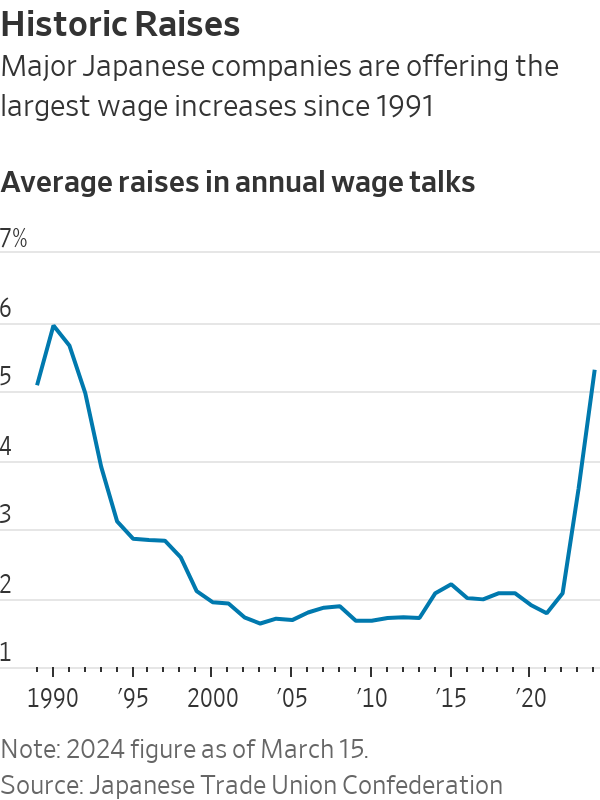
Ueda said the move was justified by steadily rising wages and prices in Japan. The central bank “judged that sustainable and stable achievement of our 2% inflation goal has come into sight,” he said.
The BOJ said it removed a target for the yield on 10-year Japanese government bonds. And it is halting its purchases of assets such as stocks, real-estate investment trusts and corporate bonds that don’t typically go onto the books of central banks. The Bank of Japan has amassed the equivalent of hundreds of billions of dollars in such assets since the global financial crisis of 2008-09.
Market reaction was restrained because Bank of Japan officials had telegraphed their intentions. The Nikkei Stock Average closed up 0.7%, while the yen was down.
“Accommodative financial conditions will likely continue, and these accommodative financial conditions will firmly support the economy and prices,” Ueda said at a news conference. He said he didn’t expect to raise interest rates rapidly.
Prime Minister Fumio Kishida welcomed the continuation of easy money, saying it was too soon to declare an end to deflation.
The BOJ had already begun to ease away from its unconventional policies. In September 2016, it set a target of around zero for the yield on 10-year government bonds. After initially enforcing that target strictly, the bank last year loosened its control , allowing the yield to move higher amid a surge in global bond yields. As of late Tuesday, the 10-year yield was 0.725%.
The Bank of Japan’s move to restore traditional monetary policy tools is one example of how Japan’s economy has recently reverted to conditions not seen in more than three decades.
However, the Bank of Japan’s economic assessment pointed to some warning signs. With China’s economy struggling recently , the BOJ said Japan’s economy “is expected to be under downward pressure stemming from a slowdown in the pace of recovery in overseas economies.”
Two of the BOJ’s nine-member policy board dissented from the decision to end negative rates, saying the economy’s recovery was too fragile to allow for a rate increase.
Katsutoshi Inadome, senior strategist at SuMi Trust, said the BOJ probably saw a window to act after the recent good news on wages, but he said there was a chance Tuesday’s rate increase was premature.
“In a textbook approach, this is timing the bank would have done better to avoid,” Inadome said. He pointed to sluggish consumption in Japan, which Ueda acknowledged as a risk.
Ueda said if the economy received shocks in the future, the central bank would consider using policy tools it has used previously.
“The Bank of Japan is unlikely to make additional rate increases because there will gradually appear more headwinds such as the lack of strength in prices,” said Mizuho Securities chief market economist Yasunari Ueno.
On Central Park South, retired entrepreneur Ron Pobuda has relisted his two-bedroom apartment for $8.95 million, a dramatic 40% reduction from its first asking price in Sept. 2020. Twenty blocks north, on the Upper East Side, real-estate agent James Morgan found a buyer for an $18 million penthouse before he could even get the property listed online.
In the wake of the Covid pandemic and interest-rate hikes—and amid an AI-driven stock market climb—buyers and sellers are having a hard time deciphering the New York City luxury real-estate market.
Ask a broker in Miami and they’ll say New York is dead. Ask a residential tower developer in New York, they’ll say that is nonsense. Ask a local real-estate agent, and he’ll say the market has rarely felt so hit-or-miss.
“It’s a mixed bag. Some things sell in two days. Other things sit there for two years,” said Leonard Steinberg, a luxury real-estate agent with Compass .
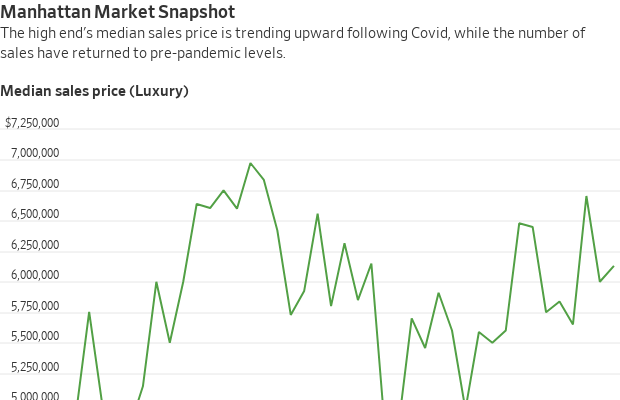
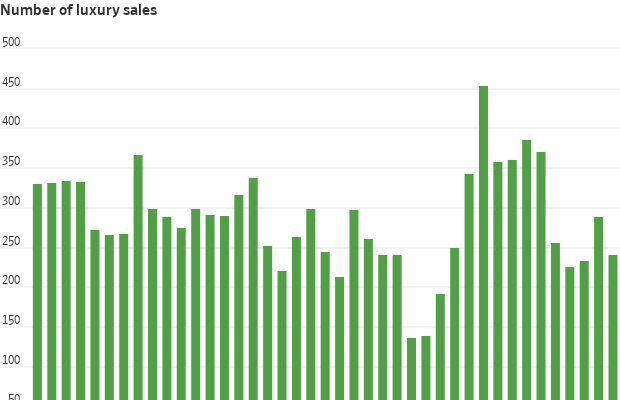
The Manhattan numbers point to a post-Covid luxury market that likely bottomed out in 2023, said appraiser Jonathan Miller . A report he prepared for brokerage Douglas Elliman shows that, in the fourth quarter of 2023, sales of luxury Manhattan homes (defined by the report as the top 10% of all sales ) were down by 5.9% compared with the same period a year prior.
It seems to be improving. So far in 2024, luxury contract activity has ticked up incrementally, according to local agents, who cite a decrease in inventory and a rising stock market. Liquidity pace, a measure of the rolling previous 30 days of signed-contract volume, was up by 9% so far in 2024 through Feb. 26 for apartments priced at $5 million and up, compared with the same period last year, according to real-estate data firm UrbanDigs.
“It looks like 2024 will be better, but it won’t be a boom,” Miller said.
Thanks to higher interest rates, all-cash deals are dominating the market, with roughly 68% of all Manhattan transactions unfinanced in the fourth quarter, according to Miller. That is up from the usual average of around 50%, Miller said.
Here’s a closer look at New York’s contrary, confusing high-end property market.
Where the sales are
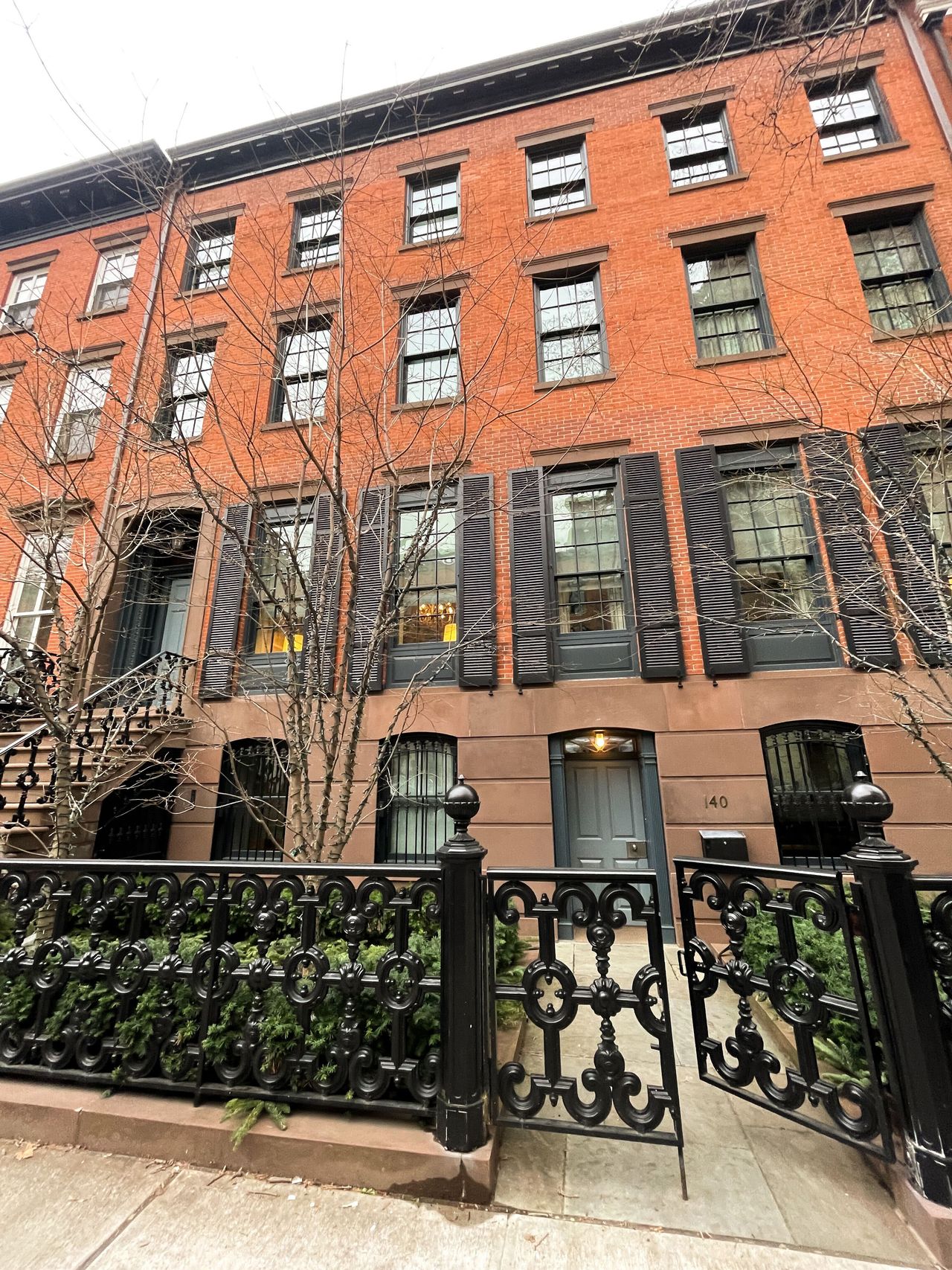
The sale of a roughly 12,000-square-foot Greenwich Village mansion owned by Dexter Goei , the former chief executive of telecommunications company Altice USA , set a new price record for Downtown Manhattan. (NYC brokers define Downtown as south of 34th Street. It is more commonly defined as south of 14th Street.) It traded off market for $72.5 million in January. The price was more than double the $30.9 million that Goei paid for it in 2016, records show.
A West Village townhouse recently set a Downtown record when it sold for $72.5 million. PHOTO: MARCY AYRES/THE WALL STREET JOURNAL
The deal added to a string of major Downtown transactions that propped up the Manhattan market in 2023. In July, a penthouse at 150 Charles Street, a successful West Village condominium project, sold for $52 million . The seller was a company tied to former Credit Suisse executive Robert Shafir . In June, a Soho penthouse tied to Stefan Kaluzny, managing director of the private-equity firm Sycamore Partners, sold for $50 million , one of the largest deals ever recorded in Soho.
Clayton Orrigo, who worked on the $72.5 million Greenwich Village deal, said his team at Compass has closed or signed contracts on more than $500 million in real estate since the beginning of the year, with about 80% located south of 30th Street, and he expects the Goei property to be the first of a handful of major house sales in the neighbourhood. Other major Downtown properties that have been shopped for sale at similarly ambitious price points in recent years include financier Steve Cohen’s fortresslike, single-family mansion on Perry Street, which is said to have asked around $150 million in off-market conversations.
“I do believe that it’s a pioneer,” Orrigo said of the $72.5 million deal, declining to confirm the identity of his clients. “I don’t think it’s the last and I don’t think it will be the most expensive.”
Orrigo attributed the rise of Downtown prices to a lack of available inventory. Sought-after Downtown neighbourhoods like Greenwich Village, the West Village and Tribeca don’t see the same levels of new development as other Manhattan neighbourhoods, thanks in large part to height restrictions tied to their designations as historic districts. He said many of his moneyed clients who visit the city eventually look to buy pieds-a-terre in the area because they are unsatisfied with the hotel offerings. Airbnb listings in New York City have also all but disappeared as the city cracks down on short-term rentals .
In addition to the city’s stepped-up enforcement of short-term rental rules, many condo and co-op boards don’t allow owners to rent their properties at all, even if the rental wouldn’t be subject to the city’s short-term rental regulations. “When they realise how hard it is, they end up buying,” Orrigo said.
Orrigo said the buyer pool is made up of tech titans and “the nepo community,” meaning the children of wealthy individuals. “We’re seeing a tremendous amount of inherited wealth,” he said.
Luxury agent Sarah Williams of Societe Real Estate said she recently had a client sign a $41,000 a month, long-term rental deal when they couldn’t find a home that met their criteria in the West Village or Tribeca.
“There’s this widespread misunderstanding about New York, that it’s struggling,” she said. “New York is so sought after, it’s just that people cannot get what they want.”
One of the most successful new condos of 2023 was also located Downtown at 450 Washington Street. A rental-to-condo conversion by the Related Companies, it posted roughly $240 million in sales across 85 transactions in 2023, the developer said. Units were priced between $1 million to $15 million for studio to four-bedroom homes. Bruce A. Beal Jr., Related’s president, said the project had the “right pricing” and that buyers, the majority of whom were local, “understood the product.”
Where it’s still tough to sell
While Downtown is thriving, Midtown has been hobbled by excess inventory, remote work and a decline in foreign buyers, who have historically gravitated toward Midtown apartments, agents said.
When Pobuda, the entrepreneur with the Central Park South apartment, listed his longtime unit, a sprawling two-bedroom with a large terrace overlooking the park, in late 2020, he first asked $15 million. While ambitious, the price reflected the property’s trophy views and location, next door to 220 Central Park South , the most expensive building in the city. He got no offers.
“It was really obvious very quickly that nothing was going to happen, so I said, ‘Let’s just pull it off the market.’ ” Pobuda said.
The new asking price is a reflection of how the market has moved in response to interest rates and is strategically pegged just under $10 million to put it in a different bracket for New York’s mansion tax, said Peter McLean of the Corcoran Group, who is listing Pobuda’s unit. “We’re throwing as many incentives to the buyers as possible,” McLean said. (The tax, paid by the buyer, starts at 1% beginning with properties of $1 million or more and gradually increases to a maximum of 3.9% for properties purchased for $25 million or more.)
Pobuda’s story is typical of Midtown sellers, many of whom have had to slash prices on luxury properties to make a deal. Compass agent James Morgan said he recently lost a listing for a three-bedroom apartment at Museum Tower on West 53rd Street after the seller refused to consider reducing the $4.25 million price. Meanwhile, his high-end listings on the more inventory-constrained Upper East Side, such as the $18 million sale of a penthouse at 135 East 79th Street, are moving quickly.
“We’re still dealing with the Covid effect in Midtown,” he said. “People are working from home and they want to be in areas that are considered more neighbourhoody.”
Midtown also has the largest concentration of high-end, unsold new development units in Manhattan. Much of the unsold inventory is on the Billionaires’ Row strip south of Central Park. It sits in buildings such as Extell Development’s Central Park Tower, the 1,550-foot-tall glassy behemoth at 217 West 57th Street, which launched sales in 2018 and has roughly 77 unsold units priced at $5 million and up as of late February, according to real-estate data and analytics company MarketProof. While 53w53, the Jean Nouvel-designed tower next to the Museum of Modern Art, which has struggled to find buyers since launching in 2015, has about 65 units remaining priced at $5 million and up as of late February, as per MarketProof.
Units at both towers are routinely selling for significant discounts. A roughly 3,700-square-foot two-bedroom unit at 53w53 recently sold for $7.85 million, 32% less than its original $11.5 million asking price in 2016, records show.
Sales hobbled by rules
While the condo and townhouse markets are generally showing signs of life, agents say the city’s co-op market remains muted. Many of them blame antiquated co-op board rules that restrict a resident’s ability to sublet their units or renovate them. Some posh buildings insist on approving contractors, for instance, or fine residents if their renovations take too long, said luxury agent Donna Olshan.
Anne Hendricks Bass in 2010 PHOTO: MIMI RITZEN CRAWFORD FOR THE WALL STREET JOURNAL
The subletting rules seem particularly egregious post-Covid, said Williams, the luxury agent, since many high-net-worth individuals moved to Florida and want more flexibility to use their units as pieds-a-terre.
“They want to live in Miami, they want to live in London. They don’t want to be tied down,” she said.
Some of the city’s priciest co-ops have seen their prices reduced in recent months. A Manhattan apartment long owned by the late pharmaceutical executive Martin Howard Solomon is now asking $45 million, down from the original $55 million when it listed in 2022. The longtime Fifth Avenue home of the late oil heiress and philanthropist Anne Hendricks Bass also got a $10 million price chop to $60 million in November. Both remain on the market as of March 18.
“Even the best of these addresses are going for ridiculously low prices,” Olshan said “It’s amazing that the shareholders don’t file activist lawsuits to try to motivate their boards to change.”
A new development drought
For the past few years, the Manhattan market has suffered from a serious oversupply problem, appraiser Miller said. For now, overall inventory remains high outside of a few select neighbourhoods, but that likely won’t last. That is because filings for new luxury condos have plummeted.
Plans approved by the New York Attorney General’s office for units priced $5 million and up peaked in the mid-2010s and have dropped since 2020, according to MarketProof. In 2015, offering plans were approved for 952 units at that price point. In contrast, there were just 57 approved in 2023.
“In the years since Covid, so many things stood in the way of new inventory,” said Kael Goodman, co-founder of MarketProof. “There was supply chain, Covid shutdowns, a perception of oversupply and a high cost of capital. There was also an attention shift from New York to Miami.”
As of the close of February in Manhattan, there were close to 1,400 developer-owned units for sale at prices over $5 million, with an average asking price per square foot of $3,820, according to analytics firm MarketProof.
Outside of Midtown, neighbourhoods with significant new development inventory at that price range include West Chelsea, Lincoln Square and the Financial District. Again, that is thanks to a handful of mega projects, including Chelsea’s One High Line and Macklowe Properties’ One Wall Street.
After a slow start marred by controversy, One High Line was among the top-selling buildings of 2023. It posted 35 closings with an average price per square foot of around $3,000, according to a spokeswoman for the developer. That brought the total number of sales to around 80, she said. Formerly known as the XI, the 235-unit condo project first launched sales in 2018, but the original developer, HFZ Capital Group, faced financial distress and the project stalled. Witkoff and Access Industries took over the project in 2022 and rebranded it.
Meanwhile, industry sources say sales have been slow at One Wall Street, the former headquarters of the Irving Trust Company bank. Sales launched at the 566-unit building in September 2021 and there were still 467 units remaining as of late February, according to MarketProof. A spokeswoman for the project didn’t respond to a request for comment.
Gary Barnett of Extell Development, the firm behind Central Park Tower, said that while “inventory is gradually getting eaten up” across the city, his company is now being “very careful to pick the right projects.”
“You don’t want to be in a situation where your cost basis is so high that you have to make $6,000 or $7,000 a foot to make money,” he said.
While he has plenty of inventory remaining on Billionaires’ Row, another of the company’s projects, 50 West 66th Street, a roughly 125-unit project off Central Park on the Upper West Side, is close to 50% sold without having even formally launched sales, he said.
Barnett pointed to the project as evidence that “if you have the right product in the right location, you can still get very real and serious prices.”
Monaco’s prime real estate market remained strong despite global macroeconomic challenges and became the most expensive prime property market in 2023, according to a report Monday from Savills.
The price per square metre in the principality may have grown just 0.9% during 2023, but that increase, however slight, left the average price per square metre at €51,418 (US$55,852).
In comparison, the price per square metre was €39,100 in Hong Kong, €25,300 in New York, €18,900 in London and €8,400 in Dubai.
There were 416 transactions across the principality in 2023, which represented a decline of nearly one-fifth compared to the previous year. However, the total transaction value declined by a smaller amount than the number of transactions, which indicated that fewer but higher value transactions were recorded in 2023.
In examining the total sales by price point, the proportion of apartments selling for more than €5 million increased 2% in 2023, while the share of apartments sold priced below that same threshold fell by an equal amount, according to the report.
Interest in Monaco has risen since the pandemic, contributing to space constraint issues in the principality. Residence card applications also now require a property’s size to match the intended occupying family’s size, which has resulted in greater scrutiny, Savills said.
In response to this rule, many new-build projects are offering larger apartments. The sales of more spacious apartments with three or more bedrooms accounted for over 60% of new-build sales and 22% of the resales across the principality in 2023.
“The number of resales in Monaco has returned to pre-pandemic levels, and this rebound has largely been driven by the increase in sales of larger apartments,” Kelcie Sellers, associate director of world research at Savills, said in the report.
Potential buyers don’t just want to live in Monaco. They are very specific when it comes to choosing a particular district or even development. Together, Monte Carlo and La Rousse comprise over 40% of the total housing area in the principality, yet they accounted for more than 60% of resale transactions in 2023.
In fact, the mean price for resales increased to an all-time high in five out of seven Monaco districts in 2023. Jardin Exotique and La Condamine saw the highest price-per-square-metre growth of 19% and 22%, respectively. Larvotto maintained the top spot for most expensive district by square meter, according to the report.
In an effort to meet the high demand for real estate in this principality, which is smaller than New York’s Central Park, construction projects are in progress. Two large communities are expected to launch this year: Mareterra and Bay House Monaco. These projects will add a combined 166 new apartments and 15 villas to the Monaco market.
Prospective buyers around the world are approaching the current market with caution as they wait to see how macroeconomics, inflation and interest rates play out. However, as Monaco offers somewhat of a safe haven, it may attract buyers who would have purchased property elsewhere, which would continue to drive demand in the coming months, Savills said.
The incidents have been unsettling: a homeowner’s thermostat raised to 90 degrees by hackers with no way to turn it down, baby monitors used by online stalkers to spy on families, webcams and other home devices hijacked to help take down corporate computer networks.
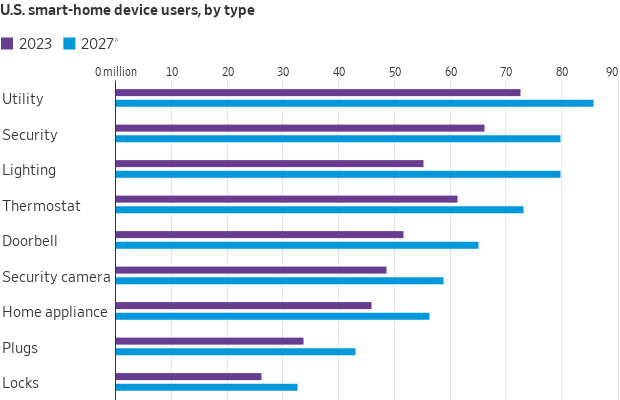
Thanks to the boom in “smart home” devices, we now live with vastly more connected gadgets: internet-linked TVs; camera-equipped doorbells; online thermostats, door locks and lightbulbs; web security cameras; and even refrigerators, dishwashers and ovens with Wi-Fi. Each online link provides a tempting target for a hacker.
The problem isn’t simply that somebody can hack a refrigerator or dishwasher, of course. It’s that once a bad actor breaches one of these devices, he or she potentially could control every other device on your home network. What’s more, these gadgets pose privacy concerns since their cameras, microphones and motion sensors could be used to monitor you.
As sales of smart-home devices continue to grow, consumers need to be cautious. Here are some questions and answers about how to thwart digital vandals.
How big a cybersecurity risk are smart-home devices?
Every new digital device introduced into your home comes with security risks. Most are connected to your Wi-Fi network and many come with an app that links them to your phone via Wi-Fi or your cellphone network. All of these are potential pathways for a hack—and the device with the weakest security could provide a way for hackers to reach the others.
In other words, you are only as safe as your weakest device.
“A lot of these devices don’t even have basic security features or protections,” says Wendy Frank , U.S. cyber internet-of-things leader for consulting firm Deloitte. Most lack virus protection and other security software that is common in personal computers and phones. Many don’t offer automatic updates of software or firmware (the coding that controls devices’ basic functions) from the manufacturer to fix security flaws, also standard with phones and PCs.
What kind of damage could hackers inflict?
Smart-home devices can be exploited to hack into the owners’ private information or attack a website.
In 2016, hackers controlling hundreds of thousands of internet-connected devices, believed to include webcams, smart TVs, printers and even baby monitors, unleashed several massive attacks that knocked out dozens of popular websites, including those of Twitter, Netflix , Amazon and Visa. Such “distributed denial-of-service” attacks instruct the devices to send millions of requests in unison to overwhelm a computer system, causing it to shut down.
Considering the enormous number of U.S. homes with smart devices—more than 60 million—and their low levels of security precautions, they are likely to continue to be tempting targets for all kinds of attacks, says Yuvraj Agarwal , an associate professor of computer science at Carnegie Mellon University. It’s “a disaster waiting to happen,” he says.
Among the potential risks experts cite: People could be locked out of their house by hackers who tapped the security system seeking a ransom. Burglars could listen in over smart speakers to figure out when you aren’t home. Smart lightbulbs could be used as a way to break into personal information on a phone.
What steps can we take to protect devices from hackers?
First, make sure your Wi-Fi router is secure—the router is the key to your digital home. Use the website or app that controls your router to check that it isn’t using the default password—that same password could have been given to many other customers. Give the router a unique password you use only for that device.
Next, ensure that the router’s security feature called a firewall is turned on, and that it is using encryption called WPA2 or the newer WPA3. And turn on the control to allow automatic software updates, if provided.
What about settings on the smart devices themselves?
As with routers, don’t use the default password they came with. Instead, use a different password for each device, so that if someone were able to figure out, say, the password for your smart doorbell, he or she wouldn’t have access to everything else.
And if a device allows two-factor authentication, be sure to use it. This means that to log in to the device you will need to type in a code sent by text or email, or generated by a device called an authenticator, in addition to the password. That extra step, while annoying, could keep out a hacker.
Is it risky to put smart devices on the same home Wi-Fi network you use for your computer and phone?
Yes. Someone could hack into one of your smart devices as a way to break into your Wi-Fi router, and from there could attack your computer, phone and everything else on the same network.
Instead, set up a guest network on your router that has its own unique password and use that network to connect your smart devices. Many routers include such a second network, but you may need to take a few steps to turn it on. Guest networks generally are sealed off from the main Wi-Fi network, so a hacker couldn’t leap from it to the main network.
When shopping for these devices, how do you know which are safer than others?
Check the makers’ security policies online before buying. Look for manufacturers’ statements that they periodically send security updates to the devices and encrypt the communications between the devices and their cloud service. Seek out products that offer two-factor authentication.
Are there certain types of smart devices to avoid?
Hundreds of types of internet-connected gadgets are sold online by innumerable companies, often at very low prices. “If it costs $5 for a smart plug, most of it is not going toward thinking about security and privacy first,” says Carnegie Mellon’s Agarwal, who does research on smart-device security.
Stick to devices from mainstream makers, since they are more likely to take security considerations seriously and spend the time and money to periodically update these features, he says. These companies don’t want to risk tarnishing their brands with products of questionable security.
What else can consumers do?
Limit how many smart devices you own—the more you have means more pathways for hackers to try to break in. Get fewer, more-secure devices rather than having insecure, cheaper devices in the whole home, says Deloitte’s Frank.
While you might find an Alexa or Google digital assistant useful on the kitchen counter, avoid putting one in a home office where you might talk about confidential financial or work-related topics that could be a juicy reward for a hacker, she adds.
Moreover, disable functions you don’t use or need on the devices, such as the camera on a digital assistant or the ability of the device to save recordings of your voice commands. “Having those turned on creates a larger attack surface” for a hacker, Frank says.
Do proprietary home networking systems provide more security than plain Wi-Fi?
While networks such as Google Home, Apple HomeKit and Amazon Alexa likely have enhanced security, in most cases they also use your home Wi-Fi to connect to their cloud services that run the networks. That raises the same security concerns as relying solely on Wi-Fi, Agarwal says.
Why don’t device makers build more security into their products?
A big factor is cost, says Deloitte’s Frank. Adding the level of security found in a laptop computer to a $15 internet-controlled lightbulb could make its price uncompetitive.
Moreover, she says, device makers want their products to appeal to ordinary consumers, so “they need to prioritize convenience, prioritize ease of use. Security often takes somewhat of a back seat.”
What is the smart-device industry doing to prevent hacks?
One effort is an industry standard called Matter from a consortium that includes Apple, Amazon, Google, Samsung and others, which works to make networked home products interoperate with each other. The Matter standard has security and privacy safeguards built in, says the group behind the standard. Products that meet the standard are being rolled out gradually and can carry its logo .
What is the government doing?
A project by the Biden administration aims to have makers of digital home devices label their products to indicate their security and privacy protections. Called the Cyber Trust Mark , it’s akin in some ways to the government’s Energy Star certification for the efficiency of home appliances.
The voluntary program, overseen by the Federal Communications Commission, is still under formation; the White House said last year it expected it to be in place in 2024. Under the proposal, device makers seeking to use the label would need to certify that their products meet certain standards by having them tested by an accredited lab. Agarwal says he has provided input to the government effort based on a Carnegie Mellon program to devise a similar label for smart products.
Bulgari celebrated its 140th anniversary this week with a trio of Octo Finissimo Sketch limited editions dedicated to the art of trompe l’oeil.
The French art history term translates to “deceive the eye,” a reference to the artist’s ability to fool the viewer into thinking they are looking at something real when it’s simply an artistic illusion.
Bulgari’s Sketch series debuted in 2022 with an Octo Finissimo Automatic and an Octo Finissimo Chronograph GMT featuring “sketched” dials depicting the original hand drawings. This time, Bulgari flips the script with dials bearing illustrations of the interior movements, mirror images of the actual calibers that can be viewed through sapphire crystal case backs.
Limited to 280 pieces in steel (€17,800/about US$19,400) and 70 pieces in 18-karat 5N rose gold (€51,000/about US$55,500), the new Octo Finissimo Automatic Sketch depicts the in-house BVL 138 caliber’s micro-rotor, escapement, bridges, rubies, and intricate finishing details, such as Côtes de Genève and circular graining.
undefined Each monochromatic piece measures 40mm in diameter and 6.4mm thick, in keeping with Octo Finissimo’s ultra-thin theme. The sapphire crystal case back is engraved to commemorate the anniversary.
The third piece is a Chronograph GMT Sketch (€20,800/about US$22,600), featuring a 43mm polished steel case measuring 8.75mm thick. In 2019, the original Octo Finissimo Chronograph GMT broke an ultra-thin record with a 3.33mm-thick caliber incorporating a 30-minute chronograph and central second in addition to a second time zone at 3 o’clock.
Limited to just 140 pieces, this edition’s dial features a sketch that blends dial and movement elements. The Tri-Compax chronograph dial display (GMT at 3 o’clock, 30-minute counter at 6 o’clock, small seconds at 9 o’clock) is combined with a balance between 4 and 5 o’clock, the chronograph column wheel at 8 o’clock, and finishing details on the bridges and gears.
Those who follow the Instagram account of Fabrizio Buonamassa Stigliani, Bulgari’s product creation executive director, will instantly recognise the stylistic signature of his fast-motion freehand sketching videos. Before joining Bulgari as a designer in 2001, he designed cars for the Fiat and Alfa Romeo brands at Centro Stile Fiat, where he honed his precise yet spontaneous fast-sketching technique using a pen or marker on paper.
Each monochromatic piece measures 40mm in diameter and 6.4mm thick, in keeping with Octo Finissimo’s ultra-thin theme. Bulgari
In 2014, he re-envisioned Gérald Genta’s Octo design with the goal of creating the world’s thinnest mechanical watch. The resulting Octo Finissimo line went on to set nine ultra-thin records, including a number of complications, such as the world’s slimmest tourbillon, minute repeater, automatic chronograph, and perpetual calendar. In 2022 it went to extremes with the futuristic Ultra, measuring just 1.80mm thick. (Ultra was ultimately bested in 2022 by Richard Mille’s UP-01 Ferrari at 1.75mm thick.)
Such accomplishments represented daunting technical feats that brought Buonamassa Stigliani’s sketches into reality. When Bulgari acquired the Gérald Genta and Daniel Roth brands in 2000, it also secured the technical know-how to create such record-breaking ultra-thin watches. (LVMH acquired Bulgari in 2011 and has relaunched the Genta and Roth brands separately.)
Bulgari’s Sketch series pays homage to the importance of hand-drawn renderings in art history. Since the Renaissance, Italian artists kept their schizzi (sketches) for their students and their archives as references to use in the quest to improve upon an original design.
The global market for art may have been softer last year against a more volatile economic backdrop, but trends detailed within the latest annual report from Art Basel and UBS released earlier this week continue to show collectors are willing to buy.
Scanning a chart within the report of sales since 2009 reveals an ebb-and-flow in the overall market, but surprising consistency in the value of transactions and an uptick in volume.
The year-to-year differences, such as the 4% dip in market value to US$65 billion last year, are mostly driven by the number and outcome of big-ticket sales, which declined across auction houses and galleries in 2023.
How many high-value works of art come to market in a given year, however, often has less to do with buying interest from collectors during shaky economic conditions and more to do with the willingness of sellers to part with paintings or sculptures during a time of perceived weakness, according to Matthew Newton, art advisory specialist at UBS Family Office Solutions in New York.
“I don’t think we see an unwillingness to buy those works when they do come to market,” Newton says.
When the economy is weak, estates with less discretion over timing often are the main consignors of expensive art. For example, last fall in New York, Sotheby’s sold works owned by Emily Fisher Landau , a long-time patron who amassed a collection bursting with masterpieces that hadn’t appeared at an auction before.
Sotheby’s single-owner auction of the Fisher Landau collection led to the US$139.4 million sale of Pablo Picasso’s Femme à la montre (the second highest price for a Picasso work at auction); the US$41 million sale of Jasper Johns’ Flags ; and the record US$18.7 million sale of Agenes Martin’s Grey Stone II —prices that were within or exceeded expectations.
“People are still willing to make trophy purchases,” Newton says. “I don’t think there’s a lack of demand, it’s about a lack of supply.”
Rising interest rates since 2022 arguably could be another factor in slower high-end sales, since wealthy individuals finance about 29% of their art collections, on average, while the ultra-wealthy (those with a net worth above US$50 million) finance as much as 39%, according to a separate report on global collecting trends published late last year from Art Basel and UBS.
But Newton doesn’t believe higher rates played a significant role in the art market last year. The wealthy typically borrow money for business or investment opportunities; if they have a US$500 million art collection on their walls, borrowing against it can be a good source of liquidity. Any impact it has on the market would be “within the margin of error,” Newton says.
Another chart in the report tracks sales growth from 2009 through 2023 in five segments of the auction market, from works sold below US$50,000 to those achieving US$10 million or more. The results show the performance of most works of art that are sold—that is, those that fall below the US$10 million level—has been “relatively flat over a decade plus,” Newton says. “It’s really those works that are over US$10 million … that’s where we see growth in the art market.”
At auction, the US$10 million-plus segment fell a substantial 25% in 2023 from the previous year, but overall, the sales trend for those ultra-expensive paintings since 2009 has been on an upward trajectory. That’s no accident, considering the population of billionaires who fuel those sales has also continued to rise, with their wealth doubling over the last 10 years to about US$13.1 billion, according to the report.
“It’s a relatively very small group of people who can spend over US$10 million on artwork,” Newton says. Of those who can afford to, not everyone does, meaning a few individuals can alter total sales for the whole market.
In part, that’s because global art sales are relatively small even at US$65 billion. Consider the global private-equity market—another place where the wealthiest individuals place their money—was estimated to reach US$16.3 trillion last year, according to London data firm Preqin.
“$65 billion … that’s obviously a lot of money,” he says. “On the other hand, that’s the entire art market—it’s like less than half the net worth of a few individuals.”
Newton says he often reminds clients that not that much art that exists in the world is sold. “What is traded is a very, very small percentage of the work that’s out there.”
Suzanne Lovell, a Chicago-based designer, had already worked with her clients—who are in their late 50s and work in the boating industry—on a condo in Chicago and a 15,000-square-foot penthouse in Naples, Fla., when the husband called with a special request. “He had just purchased a car condo about 5 miles from their Naples residence,” Lovell says. “And he asked me to design the coolest man cave ever.”
The car condo is in a gated community, but instead of front doors, there are garage doors. The units don’t have bedrooms. Instead, there is generous space for cars and for entertaining—complete with bathrooms and wet bars—making a car condo the perfect place to host a Formula One viewing party. The double unit, which the couple bought in 2021 and would cost about $3 million in today’s market, is about 3,400 square feet. The second-floor entertaining space overlooks the ground floor, which has space for five of the owner’s 20 cars, including a 1957 Porsche Speedster, a 1962 Ferrari 250GT and a 1961 Facel Vega. Along with multiple seating areas, the entertainment floor also has a race simulator and a room for the owner’s custom slot car track. The couple spent about $1.2 million to outfit the space. Cars not included!
Eames Lounge Chairs After a little research, Lovell discovered Racing & Emotions will customize classic Eames lounge chairs in Ferrari racing red, complete with the owner’s race number. “I was able to pair classic furniture with a classic car collection,” Lovell says. // Price: $US25,000 for bothMural Lovell’s client suggested she work with artist Marcus Zotter to create a wall mural in the space. “When I met with Marcus, we talked about making it feel like you’re on a racetrack, in the race,” she says. “That’s what inspired the painting on the walls.” The client chose his favourite cars to be pictured in the mural that covers three of the walls. // Price: $US75,000Desk The space includes an area for the owner to work. Lovell outfitted it with a CEO Cube desk designed by Lella and Massimo Vignelli for Poltrona Frau. Says Lovell, “I’ve wanted to do that desk for so long, and to do it in red was fabulous.” // Price: $US35,000
They came, they saw, they conquered work. Then they shrugged.
Some strivers who piled up money and status say they’re over the endless hustle and are embracing what they call a “post-achievement” lifestyle with family, health and passion projects taking priority over career accomplishments.
Another promotion? Too busy surfing. Deferred compensation that’s oh-so-close to vesting? Slipping the golden handcuffs is less painful than you might think.
Post-achievement professionals aren’t necessarily retired, even if they’re financially set for life. Many have transitioned to roles with fewer hours and responsibilities to make time for pursuits they find more meaningful such as podcasting, meditating and playing guitar.
Rather than grab every available dollar and accolade, Kevin Dahlstrom quit a seven-figure, round-the-clock job in 2018. He prefers to be seen as a bold, slightly mysterious figure who could have risen higher but opted out on his own terms.
“I’d be lying if I said that doesn’t stroke my ego,” says Dahlstrom, who left a chief-marketing-officer role and moved to Boulder, Colo., to rock climb. Professional acquaintances sometimes refer to him as a legend because he jumped off the corporate ladder in a way that most people only dream about. “Who wouldn’t like being called a legend, right?”
At age 53, he estimates that he passed up more than $10 million of future earnings but says he doesn’t need to make another penny. He recalls an executive meeting where he looked around the room, saw high-powered colleagues who seemed unhappy, and thought: What’s the point of grinding if it doesn’t bring joy?
He’s still ambitious and recently accepted a more flexible marketing-executive position at a smaller company that allows him to be on task as needed, and on a mountain whenever climbing conditions are good.
“To me, that’s nirvana because I still want to do hard things and work on fun projects,” he says. “But I also want that to be only one part of my life—and not the biggest part of my life anymore.”
Less money, more passion
Here’s the thing about getting to post-achievement status: You have to earn it by doing something impressive first.
The former go-getters I’ve met aren’t the types who could have coasted through middling careers from day one, despite being full of potential. (That would make them quiet quitters or, perhaps, masters of work-life balance .) They needed to prove, to themselves and others, that they could excel at high levels. Only then—with killer résumés and F-you money—could they make dramatic life changes.
Khe Hy , who helped popularise the term post-achievement on his website and YouTube channel , RadReads, says it’s hard not to look back. He left his job as a hedge-fund managing director in 2015 and still feels the occasional pang of envy when he considers the riches that former colleagues have accumulated. Hy, 44, says he’s sitting on about $5 million, probably enough to retire to a frugal lifestyle, but likely not enough to sustain his family forever in pricey, coastal California. Had he remained on Wall Street for a few more years, he might never have to work again.
Still, he moves past those feelings by remembering how numb he’d become to big paydays in finance.
“The key moment is when you realise that no next achievement will significantly change your baseline happiness,” he says. “I consider myself post-achievement because I’m not really striving for anything.”
That’s not entirely true. Hy is trying to bulk up but struggles to add weight to his 155-pound frame. Between running 25 miles a week and surfing almost daily, it’s tough to sculpt more than a lean six-pack, you know?
His RadReads business, which includes coaching for hard-charging professionals who want to rebalance their lives, generates about $200,000 annually. He works about 35 hours a week but controls his schedule and no longer fixates on career advancement.
Rachel Barek , 44, isn’t ready to step down as chief executive of Said Differently, the marketing agency she co-founded, anytime soon. But the majority stake she and her partner sold to a private-equity firm comes with a lifetime of financial security, she says.
“I could very easily fall into the trap of being a serial entrepreneur. I was born that way,” she says. “A lot of serial entrepreneurs are scared of the white space in their lives, and I’m really excited by that white space.”
In her future post-achievement phase, Barek plans to do something radically different: beauty school. She developed the interest while cutting her son’s hair at home during the pandemic and wants to offer pro bono barber services for children with special sensory needs and others who can’t afford to pay. But she concedes her clipping skills could use some work.
Avoiding the success trap
Kristopher Abdelmessih says he was six months shy of collecting about $1 million of deferred compensation when he walked away from his job as an options trader in 2021.
“Maybe it was rash, but I’ve replayed this in my head many times, and I don’t think I would do it any differently,” he says. “I was done.”
Abdelmessih, 45, was motivated to succeed by his modest upbringing in an immigrant household. There would be no safety net if he sputtered professionally, so he picked a field that paid well, played to his strengths and didn’t require graduate school.
But trading was never a calling. Leaving wasn’t so much about losing ambition as it was about a desire to chase fulfilling interests, like tutoring low-income students, gaining the confidence to play guitar on stage for the first time and traveling with his family six to eight weeks a year.
He and a business partner are in the early stages of developing a trading software tool that Abdelmessih hopes will become profitable. If it takes off and demands more of his time someday, that’s OK with him because it’s a passion project.
Jason Chow , a financial-services firm vice president, isn’t post-achievement yet, but he wants to be. Chow, 45, and many others say they’ve climbed high enough to realise each progressive rung brings new hassles and fleeting satisfaction.
“It resonates with me because my life is work, and I know there’s more,” he says. “I just haven’t found what that is yet.”
THE DECOR doldrums hit hard as the weather lollygags toward spring. “We spend so much time in our most lived-in spaces, like the living room, that they begin to feel monotonous after a long winter,” said Malorie Goldberg, an interior designer with Noa Blake Design, a firm in Marlboro, N.J.
Fortunately, rearranging your stuff can significantly shake up a stale space , and all you need is 15 minutes to do it.
“We get used to where things are and overlook potential in objects we already have,” said Leslie Martin, of M+M Interior Design in Kenilworth, Ill. The pro calls this state of inertia “house blind,” and asks rhetorically, “Does the chair you have piled with laundry in your bedroom suddenly take on new life when moved to your living room?”
Here, interior designers share their fast fixes for breathing new energy into your tuckered-out living room decor.
1. Flip your layout from one side of the room to another to “create new traffic patterns and sightlines,” said New York designer Kimberly Bevan. “Don’t forget to rotate your rugs along with the furniture.” Adds Ariel Okin, another New York designer, “Map the arrangement out in blue tape beforehand to make sure you like the look.”
2. Don’t be afraid to pull in pieces from other rooms. “Two dining chairs and a side table can become a game-table vignette,” said Kristine Renee, of Design Alchemy in Sacramento, Calif. Add a side chair or ottoman underneath a console table to get a “new” writing desk.
3. Group flowers , a few coffee table books and a small dish on a big, handsome tray, said Okin, for a “styled moment that feels considered.”
4. Swap lampshades from one room to another, suggests Bevan. “Imagine the difference between a simple linen shade and one that’s patterned ,” she said.
5. For a coffee table refresh , “throw a beautiful tablecloth over it and let the edges drape on the floor,” said Toronto designer Justine Alexandra Dunk. A couple of books or decorative catchall on top will layer in the “super cozy, Old World English feel.”
6. Beware the “dorm-room phenomenon,” said Pittsburgh designer Leanne Ford. “We never stopped thinking we had to push everything against the walls.” Moving your furniture just 6 inches off the wall “will actually make your space feel bigger.”
7. Clean exterior windows , says Jacu Strauss, creative director at hospitality company Lore Group, in London. “You’ll be pleasantly surprised at how much extra light the room receives.”
8. Steal a throw blanket from a guest bedroom and swap it for the one currently in your living room, says New York interior designer Emma Beryl. “Artfully drape it, either on the corner of the sofa or over the arm of a chair to make it look purposeful.”
9. Use your printer to reproduce a few favourite photos in black and white, and swap them for what’s currently in your frames, says Okin. “Black and white brings an instantly classic, clean and edited look to the room.”
10. Shuffle your art. “This will breathe new life into the space,” said Boston designer Honey Collins.
11. “Deflect attention from the TV by repositioning artwork and light fixtures to create new spots that draw the eye,” said Lindye Galloway, a designer in Newport Beach, Calif. Lean a bold art print against the wall on the credenza or move a mirror so it doesn’t reflect the television, says Goldberg. “Then the TV just exists in the room instead of owning it.”