TikTok urged its users to call Congress and lawmakers to drop a bill that could ban the popular video-sharing app in the U.S., and those users listened.
But the plan backfired. Instead of dropping the bill, which was introduced just two days ago, the House Energy and Commerce Committee approved it in a 50-0 vote Thursday afternoon. House Majority Leader Steve Scalise said he’s bringing it to a floor vote.
That was after beleaguered house staffers across the Capitol grounds endured hours of office phones ringing off the hook in an all-out push from TikTok users.
While TikTok the company has criticized efforts to ban it or crack down on it, this week’s legislative move prompted the social media company to appeal directly to users.
“TikTok is at risk of being shut down in the U.S. Call your representative now,” the app told its users when they logged into their accounts.
The app asked users to enter their ZIP codes and then directed them to their local congressional representatives.
TikTok was responding to a measure proposed Tuesday by Reps. Mike Gallagher (R, Wisc.) and Raja Krishnamoorthi (D, Ill.), co-chairs of the House Select Committee on the Chinese Communist Party, that claims TikTok “poses a grave threat to U.S. national security.”
TikTok, based in Singapore, is owned by China-based ByteDance, and that’s what lawmakers object to. The measure focuses on “foreign adversary controlled applications.” It would require ByteDance to divest of TikTok about five months after the law is passed, or risk being removed from app stores in the U.S.
That would make it illegal to distribute TikTok through any U.S. app store or from any U.S. web-hosting platform. TikTok says that is effectively a ban of the platform.
A TikTok spokesperson told Barron’s that “This legislation has a predetermined outcome: a total ban of TikTok in the United States.”
“The government is attempting to strip 170 million Americans of their Constitutional right to free expression,” spokesperson Alex Haurek said. “This will damage millions of businesses, deny artists an audience, and destroy the livelihoods of countless creators across the country.”
TikTok CEO Shou Zi Chew and others have repeatedly insisted that ByteDance and TikTok aren’t controlled by the Chinese government or Chinese Communist Party, and that U.S. user data is stored securely in Singapore and the U.S.
Krishnamoorthi said on X that TikTok has “launched a massive propaganda campaign, requiring users to call their representatives, and falsely labeling our legislation a ‘total ban’ of TikTok.”
“Phones are completely bogged down hearing from students, young adults, adults, and business owners who are all concerned at the option of losing their access to the platform,” a Republican aide told Axios.
The National Security Council has called the bill “an important and welcome step” to addressing risks to sensitive U.S. data, and the White House has said that if Congress passes it, President Joe Biden would sign it.
Rivian Automotive stock was surging after the company introduced its new vehicle platform on Thursday.
Investors knew the car was coming, but the electric vehicle start-up sprinkled a couple of extra surprises in its presentation to the delight of its shareholders.
As its name suggests, R2—unveiled Thursday afternoon—is Rivian’s second vehicle platform. It’s a lower-cost product that should enable the company to widen its addressable market with a cheaper price tag. The R2 will start at around $45,000, and is slated to hit the streets in 2026.
The timing was the first surprise. CEO R.J. Scaringe said the car will ship in the first half of 2026. That brings some certainty for investors and, of course, the sooner the better.
“I’m so excited about this vehicle,” said Scaringe. “I’m so excited about what it represents for us as a company in terms of achieving scale.”
Rivian’s first platform, R1, is the base for the R1T pickup truck and R1S SUV. Those two vehicles start at around $75,000.
The R2 SUV shown at the event has Rivian’s trademark look. The vehicle—which could be called the R2S if Rivian sticks with its first platform’s naming conventions—is a smaller version of the R1S. The wheelbase is a little shorter than that of the R1S.
The R2’s per-charge range will exceed 300 miles and there will be a tri-motor version that goes from zero to 60 miles an hour in about three seconds.
The second surprise was another vehicle—the R3 and sportier trim called the R3X. It’s another vehicle that will be built on the platform. Pricing and timing for the R3 weren’t part of Scaringe’s prepared remarks. Rivian didn’t immediately respond to a request for comment.
Rivian shares were up 13.8% in late trading at $12.55, while the S&P 500 and Nasdaq Composite were up about 0.9% and 1.4%, respectively.
The stock had gotten a lift even before the R2 launch event, which started around 1 p.m. ET Thursday, thanks to a new call to buy the shares on Wall Street.
Earlier Thursday, Jefferies analyst Philippe Houchois launched coverage of Rivian with a Buy rating and a $16 price target.
“Rivian has looked closest to Tesla in spirit, with its own software stack, strong brand identity, global potential, and similar growth pain,” wrote the analyst.
(Product launch events weren’t what Houchois was referring to, looked a little like a Tesla product launch event run by Elon Musk.)
The cost of the new platform will be key, the analyst said.
Rivian “is facing two critical if not existential tests this year: (1) deliver a $35,000-to-$40,000 reduction in unit production costs from redesign, purchasing, and manufacturing efficiency; and (2) demonstrate the R2 model can be developed at a significantly lower cost than R1,” wrote Houchois in his coverage launch report.
The new vehicle and Buy rating should come as a relief for investors. Coming into Thursday trading, Rivian stock was down about 53% so far in 2023. Slowing demand growth for EVs, along with disappointing production guidance from Rivian, has pushed down shares.
Rivian expects to produce about 57,000 units in 2024, roughly the same amount produced in 2023. But Houchois sees a silver lining there.
“Slower EV demand and planned second-quarter [plant] shutdowns will constrain growth this year but could also help deliver the sharp $20,000 reduction in unit costs to achieve positive gross margin exiting 2024,” wrote Houchois.
Rivian hasn’t achieved the scale required yet to generate positive profits and cash flow. It delivered about 50,000 unit to customers in 2023. Tesla wasn’t producing consistent profits until it was delivering roughly four times that amount.
Wall Street expects Rivian to use about $4.3 billion in cash in 2024. It ended 2023 with about $9.4 billion in cash, and $10.5 billion in total liquidity.
Overall, 55% of analysts covering Rivian stock have Buy ratings, according to FactSet. The average Buy-rating ratio for stocks in the S&P 500 is about 55%. The average analyst price target for Rivian stock is about $17.
The minimalist Paris apartment that was the home and studio of the late fashion icon Karl Lagerfeld is headed to auction later this month with a starting price of €5.3 million (US$5.77 million).
Nestled in the heart of the Saint-Thomas d’Aquin district, on the city’s Left Bank, the roughly 2,800-square-foot spread will go under the hammer on March 26 at the city’s Chamber of Commerce and Industry, according to a news release from the Paris Notaires Services, which plays an essential role in French real estate transactions.
The apartment is on Quai Voltaire, a Seine-front street, and within a historic building dating from 1694 that belies the contemporary home inside that was Lagerfeld’s until his death in 2019 at the age of 85.
He told the New Yorker in 2007 , as he was moving into the property, that living there would be “like floating in your own spaceship over a very civilised past.”
The home has a stainless steel kitchen. Mediacorp
Located on the third floor, the apartment has a sprawling living room with a panoramic view of the Seine, polished concrete floors, and walls of towering glass bookshelves that once held the designer’s vast collection of books.
The avant-garde space “embodies Lagerfeld’s visionary aesthetic,” with an “ambiance that is both luxurious and design-oriented,” the news release said.
Elsewhere in the achromatic home is a bedroom overlooking a courtyard, a dressing room, a shower room, a bathroom and a professional-looking stainless steel kitchen.
The entire home, including the bathroom, has a modern aesthetic. Mediacorp
The auction “represents a rare opportunity to acquire a part of the history of fashion and of French cultural heritage,” according to Paris Notaires Services.
With his iconic signature style of black sunglasses, fingerless gloves and high-starched collars, Lagerfeld was the long-time creative director of Chanel and creator of his own eponymous fashion label.
The apartment’s giant living room has polished concrete floors and walls of glass bookshelves. MEDIACORP
Visitors to John Bautista and Pedro Salrach’s San Francisco home can’t get enough of the lap pool, sauna and movie theatre. But they also get a whiff of something else they value: clean air.
“The house smells new—and after two years it still smells new,” said Bautista, an attorney. “I know when I’m home because it smells clean and fresh.”
The Glatts’ Maryland home has five HVAC units and eight thermostats to regulate air quality in individual zones. They also added UV lights to the system to prevent mold. MELISSA LYTTLE FOR THE WALL STREET JOURNAL (4)
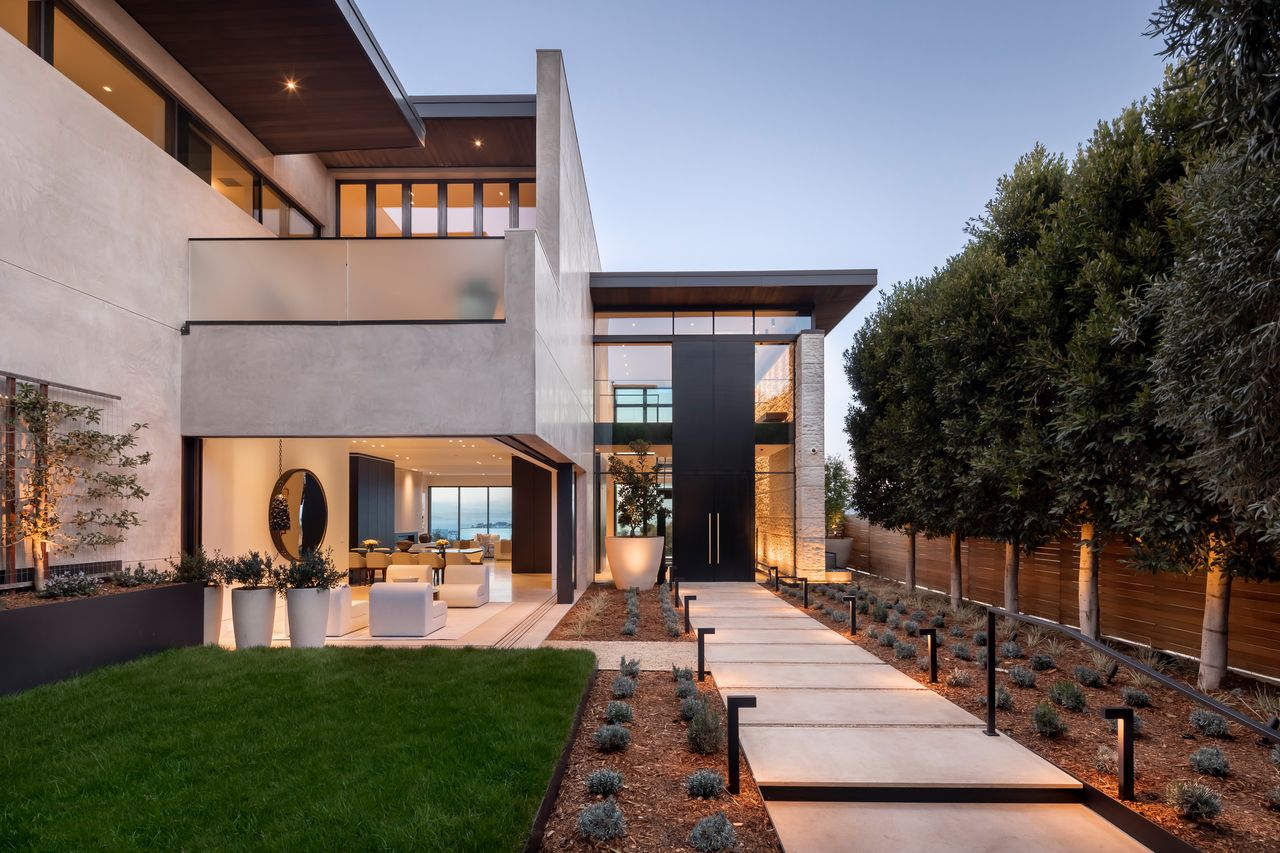
The six-bedroom home with seven bathrooms and two half-baths includes an elaborate air-filtration system meant to deal with the region’s varying air quality. The tightly sealed floor-to-ceiling windows and sliding doors offer hilltop views of the bay and access to the backyard without sacrificing air quality.
Bautista plans to further upgrade his system this year with the aim of filtering and recirculating indoor air rather than fresh outside air during periods of heavy pollution. Despite the home’s superior air quality, the family can still feel a difference on days when the outdoor air is filled with smoke. “We’ve suffered, as most people have in the Bay Area,” he said. “What we want to have is isolation.”
Developer Gregory Malin, who specialises in wellness-focused real estate, sold Bautista the home for $32 million, he said, plus an additional $5 million for fixtures and furnishings.
The Glatts gave priority to air quality in their $2.5 million home. PHOTO: MELISSA LYTTLE FOR THE WALL STREET JOURNAL
Luxury homeowners are known to splurge on sleek kitchens, custom decor and art, but they are increasingly turning their attention to something less visible. Forest-fire smoke, the pandemic and increased awareness of sensitivities to mould and other irritants are making their interior environment a priority.
Many are investing in complex systems and flexible designs that promise healthier indoor air but still include spaces, such as glass-enclosed rooms, that make being indoors feel natural.
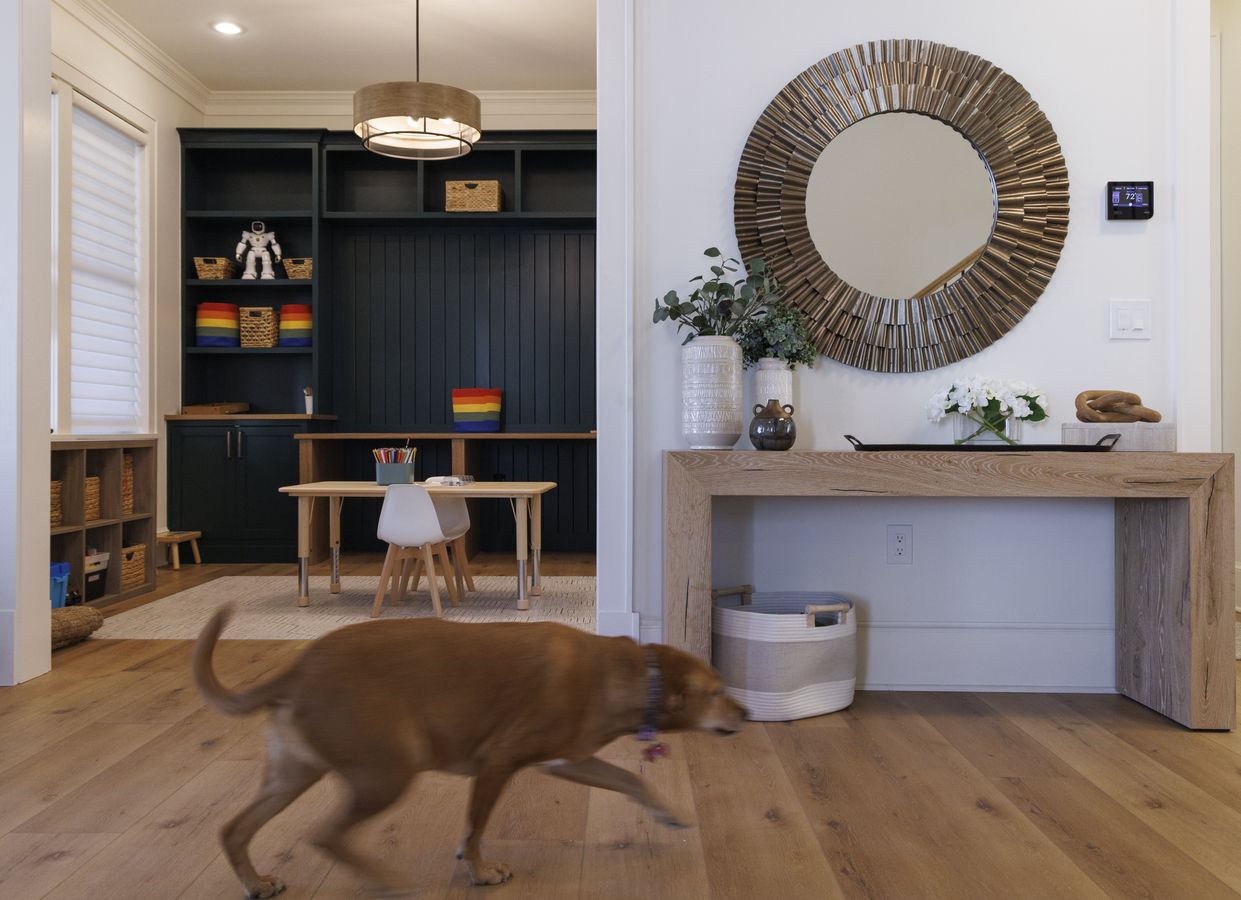
Listings are increasingly touting pollution-fighting amenities to lure home buyers. In Santa Rosa, Calif., a 13-acre estate for sale at $15 million has a whole-home air purifier. This spring, the Dovecote building, under construction in Manhattan’s Harlem neighbourhood, will offer six, three-bedroom condos built to strict green and clean-air standards, starting at $1.5 million.
Malin, founder of Troon Pacific, a San Francisco-based developer of $15 million to $45 million properties that he calls healthy homes, said he focuses on the smallest details that can affect air quality. New tools allow for more-precise measurement of various particulate matter and carbon dioxide levels, he added. “Covid changed people’s perspective on connecting air quality to health, and the [wildfires] only enhanced that.”
The Bautista home has windows and doors that shut tightly so unfiltered outdoor air doesn’t seep in. PHOTO: JACOB ELLIOTT/TROON PACIFICThe home has views of San Francisco Bay, Alcatraz Island and the Golden Gate Bridge. While the area’s air quality is generally good, wildfires cause spikes in air pollution. PHOTO: JACOB ELLIOTT/TROON PACIFIC
His company’s newer homes have exhaust fans, tied to ventilation systems, in laundry rooms and under sinks, where there are various pollutants and harmful cleaning products, said Malin. Their garages have separate exhaust fans that go on long enough for three air exchanges after the door opens. Ionisation-based filtration systems also are included to eliminate airborne particles too tiny to see but hazardous when inhaled.
His homes also feature perforated piping with in-line fans to exhaust air from under slab foundations to keep contaminated soil vapours from entering the houses.
He said his company is considering building to the Living Building Challenge standard, in which homes have their own electricity, water and waste management. Demand is high for such standards, he said, including passive-home construction, where airtight homes are built using specific materials and energy-efficient systems that circulate highly filtered air. He said passive-home certification is costly, especially for big homes, and has limitations that some homeowners don’t want, like bulky windows. In the long run, however, he said eliminating most heating and cooling bills is probably worth it.
Caroline Smythe used hemp block to build a more breathable home in Charleston, S.C. The building material absorbs moisture and keeps humidity steady in the home to prevent mould growth. HADLEY HENRY FOR THE WALL STREET JOURNAL (4)
Clean air has become more of a talking point in homeownership, added Elliott Gall, an associate professor of mechanical and materials engineering who researches indoor-air quality at Portland State University.
While high-rises are often built to be airtight, there is a greater focus now on having windows that open while adding better filtration systems, he said. Units with outdoor access sometimes give homeowners another way to control the humidity and indoor air-pollution levels inside the home, he added.
To improve the air quality in her new Charleston, S.C., home, Caroline Smythe, 67, imported a hemp block covered in a mixture of lime and sand for the construction, rather than standard brick. Living in a high-humidity area means moisture can cause mould, said Smythe, whose 2,400-square-foot Lowcountry home was completed in 2023 for about $1 million, including $250,000 for the land.
Incorporating the new material allows the moisture to get absorbed in the walls and keeps humidity steady in the home. “It has very much an earthy feel,” said Smythe of her thick, soundproof walls.
Inside, the home’s two bedrooms and two offices have additional air-filtration elements, including stand-alone air filters for each bedroom. Smythe, a psychiatrist, chose a bamboo kitchen countertop and mineral-based wall paint to prevent any chemical off-gassing. “It makes a huge difference,” she said.
Homeowners have long tried to improve air quality. In the early 1900s, homes that let in fresh air were critical to good health, but by the 1950s some owners were trying to tame outdoor air pollution by focusing on better insulation. More recently, the pandemic made access to outdoor air essential, and turned the focus again to indoor-outdoor living.
Today’s picture is mixed. Climate change has made outdoor air quality less reliable, with the added problems of prolonged forest fires.
Many people are realising their indoor air quality is often compromised by a combination of poor indoor airflow, activities like cooking and cleaning, and outdoor pollutants that settle into confined spaces, said Gall. Homeowners now want better control over their wider living space, including modifiable systems that deal with both indoor and outdoor pollution, he added.
In Manhattan, the Charlotte of the Upper West Side has seven full-floor units. A heating-and-cooling system filters fresh air directly into each unit. The air is also treated with UV light. PHOTO: JOSHUA MCHUGH CONTACT: kristen@m18pr.com
Jason Glatt, a commercial window contractor, and his wife, Lauren Glatt, a stay-at-home mom, of North Bethesda, Md., built a $2.5 million home that includes a children’s slide into a basement playroom, an attic-level cigar room and plenty of entertaining space.
The 11,000-square-foot home’s most striking feature, however, may be the five HVAC units tucked inside utility closets and other closed rooms, controlled by eight thermostats that regulate the air quality as well as temperature in each part of the home. Their $120,000 HVAC system also includes UV lights to prevent mold.
Seth Ballard, an architect who worked with the Glatt family, said individually controlled temperature zones and more return-air vents promote better air flow. Costs can be $100,000 to $200,000 for a 10,000- to 15,000-square-foot house. “They are choosing this over a kitchen countertop,” he said of homeowners in general.
The Charlotte’s air-filtration and passive-home construction added an estimated 15% to building costs. PHOTO: CHRISTOPHER PAYNE/ESTO Contact: kristen@m18pr.com
Charlotte of the Upper West Side, a building in Manhattan that opened in 2023, has seven full-floor units, each with a private entrance. The building has airtight construction with enhanced insulation. Each unit has an independent heating-and-cooling system with fresh-air filtration directly into the home that isn’t shared with other spaces.
The system can achieve full air exchange 13 times a day in normal-use mode and more than 28 times a day in boost mode, said the building’s developer John Roe of the New York-based Roe Corp. The building uses louvers outside the windows to deflect the heat of the sun and cut energy use on summer days.
Roe, who lives in one of the building’s 3,570-square-foot, four bedroom, 4.5-bathroom homes, said the air-filtration system and strict passive-home construction added 15% to the building cost.
Three of the building’s units are on sale, from $8.35 million to $17 million.
He said there is little dust in the home, and he swears it now takes longer for his cut white hydrangeas to wilt.
Cookie Monster is a blue furry muppet who lives on a fake street, but even he is sick of a real menace in supermarket aisles.
“Me hate shrinkflation!,” the “Sesame Street” character wrote to his 626,000 followers on X. “Me cookies are getting smaller.”
Shrinkflation—when companies shrink their products but not the price—has been a hot topic as Americans spend more of their disposable income on food than they have in 30 years . Shrinkflation saves companies money, but politicians have called it greed. It’s been showing up everywhere: fewer sheets of toilet paper in a roll; less juice in a bottle; or in Cookie Monster’s case, smaller cookies that cost the same as when they were bigger.
President Biden has been critical of shrinkflation lately, calling it “a rip-off” by companies who he said are giving Americans less for every dollar they spend.
“As an ice-cream lover,” Biden said in an Instagram video posted last month on the same day as the Super Bowl, “what makes me the most angry is that ice-cream cartons have actually shrunk in size but not in price.”
On Monday, the White House weighed in on Cookie Monster’s post.
“C is for consumers getting ripped off,” the White House posted on X . “President Biden is calling on companies to put a stop to shrinkflation.”
Sen. Elizabeth Warren (D., Mass.) told Cookie Monster she and Sen. Bob Casey (D., Pa.) “have a bill for that.”
Called the Shrinkflation Prevention Act, the bill was introduced by the Democratic senators last week. It would give the Federal Trade Commission and state attorneys general the authority to punish companies engaging in shrinkflation.
Snacks such as chips and cookies have become 26% more expensive since January 2019, according to a report by Casey released in December . Nearly 10% of the price increase was due to shrinkflation, the report said.
Oreo fans have noticed less cream in the black-and-white cookies, but the company behind them has said there hasn’t been a change to the cookie-to-cream ratio. French supermarket chain Carrefour started attaching labels to products in September warning shoppers of what it deems to be shrinkflation. And even the rich and famous have noticed: Rapper Cardi B has ranted about high inflation and rising lettuce prices . “Naaaaaa,” she tweeted last year, “grocery shopping prices are ridiculous right now.”
David Chavern , the chief executive of the Consumer Brands Association, which represents major food makers, said industry leaders understand the pressures of inflation on Americans and have asked to meet with Biden.
“This is a serious issue and needs responsible leadership, not gimmicks or muppet memes,” he said. “In the meantime, we will continue our efforts to provide the best products at the most competitive price.”
“Sesame Street” characters have been diving into real world issues on social media, gaining differing reactions from politicians.
When the Covid-19 vaccine was approved for children, Big Bird tweeted he got the shot.
“My wing is feeling a little sore, but it’ll give my body an extra protective boost that keeps me and others healthy,” he wrote .
Republican Texas Senator Ted Cruz tweeted that it was , “Government propaganda…for your 5 year old!”
In January, Elmo asked a question on X : “How is everybody doing?,” only to get inundated with replies from people talking about their mental health and saying how bleak their lives are, garnering a tweet from Biden.
“I know how hard it is some days to sweep the clouds away and get to sunnier days,” Biden responded to the red muppet . “Our friend Elmo is right: We have to be there for each other, offer our help to a neighbour in need, and above all else, ask for help when we need it.”
Representatives for “Sesame Street” didn’t respond to requests for comment Tuesday.
As for Cookie Monster’s shrinkflation rant, Edgar Dworsky is happy to have more allies.
“I’ve been campaigning against shrinkflation for more than three decades,” said Dworsky, who calls out companies engaging in shrinkflation on his websites ConsumerWorld.org and MousePrint.org. “I welcome the help of such prominent figures as Cookie Monster and of course, the president.”
In the meantime, Cookie Monster seems to have found his own shrinkflation solution.
“Guess me going to have to eat double da cookies!,” he tweeted .
Rolls-Royce’s Bespoke division is exclusivity personified, and the highest rung in that ladder is Coachbuild—which goes far beyond selecting unique colours or interior finishes and gives customers the chance to help design their own new cars.
The first of the Coachbuild cars was the Phantom-based Sweptail, hand-built over four years, reportedly for Hong Kong businessman Sam Li. It has a dramatic fastback roof that was a hit when revealed to the public in 2017. Rolls didn’t confirm the car’s cost, but some reports said more than US$12 million. The Sweptail has been spotted on the road in Europe.
The Droptails are Rolls’ first roadsters in modern history. Rolls-Royce
The Boat Tail, shown (above) in 2021 and built on the Architecture of Luxury platform with Phantom V12 power, was the first commission from a consortium of three couples. It’s a unique convertible with a carbon-fibre parasol that opens to shade its occupants during al fresco parties. Beyoncé and Jay-Z are reported Boat Tail owners. Argentine footballer Mauro Icardi is said to be another keeper of the keys. The purchase price of these cars is around US$28 million, sources say.
There will be a total of four Droptail roadsters created, and these now include the Amethyst Droptail and the La Rose Noire Droptail, each with unique rear-deck treatments and personal detailing throughout. The newest, third commission is Arcadia Droptail, which will come with a removable hardtop (and no soft top). The car will be delivered to an international client in Singapore, said Rolls’ Americas spokesman, Gerry Spahn. The price tag is likely in Boat Tail territory.
Arcadia was known in Greek mythology as a place of “Heaven on Earth.” The one-off car has a vivid recessed wood-panelled rear deck that took 8,000 hours to create, according to the company, and recalls vintage Chris Craft power boats—or woodie station wagons. It’s in left-hand drive, reportedly to better facilitate its use around the world. Rolls used a 3-D environment to show the client how the car would look in various locales.
“Coachbuild commissions like Droptail Arcadia are immediately the classic Rolls-Royce collectibles. Coachbuild is more than Bespoke, it’s the ultimate personal statement,” says Martin Fritsches, president of Rolls-Royce Motor Cars in North America.
Alex Innes, head of Coachbuild Design, added (in a statement) that the Arcadia is “one of the most faithful expressions of an individual’s personal style and sensibilities we have ever created within the Coachbuild department.”
Design inspiration for the Arcadia came from sky gardens in Singapore, Indonesia, and Vietnam, in addition to British “biometric” architecture.
The white paint is infused with aluminium and glass particles to give it depth and shine. The lower sections of the Arcadia Droptail are in carbon fibre, painted silver. The wood on the rear panel is mirrored on the dashboard (in Santos Straight Grain veneer), door linings, and central armrest. The wood pieces were mounted on stiff bases developed using carbon-fibre layering techniques derived from Formula One racing.
The Arcadia Droptail has a unique wood panel on its rear deck. Rolls-Royce
The hardtop, in a contrasting dark colour, slants down to a short rear greenhouse, giving the car a racy look. The doors are rear-hinged, with prominent chromed handles. The nose and grille are somewhat rounded, with narrow horizontal headlights, yielding a more aerodynamic prow than is customary in Rolls-Royce history.
The dash’s crown jewel is a clock with a face that took five months to assemble, after two years of development. Its raw metal geometric guilloche pattern has 119 facets. Rolls describes it as “the most complex Rolls-Royce clock face ever created.” The hands are partly polished and partly brushed, and have 12 hand-painted “chaplets” (hour markers) that are only 0.1 millimetres thick.
Many automakers are establishing bespoke divisions, but Rolls-Royce is, per tradition, taking it further than others.
My girlfriend and I treat the outside of our apartment fridge like one big collage.
In the past few years, after attending wedding after wedding after wedding, we have unwittingly created a standing scrapbook of “Save the Date!” magnets and floral-patterned invitations, among other gilded mementos. But recently, we decided it was time to give the fridge collage a refresh. And in doing so, we realized something depressing: The majority of the happy-looking couples pictured were either now divorced, breaking up or in the process of seriously re-evaluating their relationship.
As a friend, I’ve learned so much from my newly divorced pals, and I admire the resilience, optimism and strength they demonstrated in the face of their breakups. But as a personal-finance columnist, I have also taken a lot of money lessons from these new divorcées—and I believe the insight is relevant to more than just other married couples.
One friend was able to rely on her prenuptial agreement to save her close to $100,000 in the wake of a speedy split; another woman I know escaped a financially abusive relationship with less than a grand to her name remaining in her savings account.
Darla Gale , a California-based therapist and founder of Heartstrings Counseling, says she often talks with clients about making meaning from these relationships and the accompanying financial fallout. Sharing lessons and experiences is one way to do so. “Money comes up a lot in my practice, because financial hardships are one of the reasons for divorce,” she says. “It can be very empowering to say, ‘I can do this on my own. I just didn’t have the tools to do it on my own.’ ”
Together isn’t always better
The dissolution of a relationship can bring a host of financial lessons that shape how we talk about money in our relationships going forward—whether we were the bride, the groom or the smiling person snapping a selfie with the cake.
In my previous reporting, I’ve researched quite a bit about just how beneficial it can be for couples to combine finances. Studies show this enables them to maximise their potential to grow wealth and even leads to both partners feeling happier in the relationship.
But after witnessing their first wave of divorces, many younger people are embracing a different approach. “I’m doing a lot of prenuptial agreements for people who are younger, and they are for the most part wanting to keep their money separate, which is interesting and very different from the way prenups were done 10 to 20 years ago,” says Lisa Zeiderman , a New York-based divorce lawyer.
Gale says she now often sees couples doing both: sharing expenses in one joint account, for example, while still maintaining separate funds “so it doesn’t feel like one person is more in control.”
Inspired by this approach, my girlfriend and I have adopted something similar. To save for a down payment on a future house, we contribute near-equal amounts to a joint high-yield savings account that we opened together. We also share a credit card to use when we buy groceries, pay our dog’s vet bills or handle other shared expenses.
But at the same time, we both maintain separate checking accounts and saving accounts, for our own individual needs. This way, should disaster ever strike, we’re both able to maintain a level of personal autonomy and build our own lives anew.
After all, as Gale put it, “Autonomy equals equality.”
Older is better…and worse
Here’s the good news I’ve learned while looking at divorce through a personal (and personal-finance) lens: On the whole, millennial couples are actually divorcing at lower rates than people of previous generations at similar ages.
Economist Brett House , a professor of professional practice in the economics Division at Columbia Business School, attributes this decline to two important things: Millennials are getting married at later ages. And they’re likelier to have received more education by the age of their first marriage.
But waiting to tie the knot doesn’t protect you against the financial fallout of a divorce—if anything, marrying later means both parties might have had more time to accumulate more assets that could lead to financial conflict once split.
“People may be more mature and more aware of themselves and clearer about what they want from a relationship than was the case in earlier years,” House says.
Gale recommends clearly stating those financial priorities at the start of a relationship, when everything still seems rosy. “Don’t be sneaky about it, but go into the relationship and say ‘I’m going to have a separate bank account, whether that is for going out or having a ‘fun’ fund but autonomy is really important to me,’ ” she says.
And watch your potential partner’s reaction to such a conversation—that can also inform your decision to build a life with them.
Don’t compromise your career
In her many years advising women and working in divorce courts, Zeiderman says she often gives young to-be-married women the same advice: Don’t lose sight of your career.
Zeiderman has seen firsthand how difficult it is for many people, in compromising their own professional trajectories, to rebuild their earnings post-divorce.
“So many decide, frankly, to let the other person build their career and then at the end of the day, you cannot make up for this in spousal support, you cannot make up for it in the distribution of their assets,” she said. “Stay in the workforce. You must.”
We like to think that is easy to do, but in practice, both partners prioritising their careers isn’t easy.
This summer, I’ll have just embarked upon a new career as a freelance writer and podcast host; at the same time, my girlfriend, also a journalist, will be traveling throughout France covering the summer Olympics. We talked in advance about how important this summer will be for us, work-wise, and agreed that although our relationship—and our patience!—may be tested, affording each other some grace during this high-pressure time will go a long way. Building our careers will benefit our household bottom line, but it’s also insurance for both of us.
The ‘what if we broke up’ talk
“The forethought is easier to do when things are good,” Zeiderman told me. And her words stuck with me.
I thought back to the dozens of conversations I’ve had with my divorced friends. So many of them regretted never discussing money goals, habits or strategies with their partners in advance of marriage. Far too often, they said, they worried bringing up finances would dampen the excitement of the honeymoon phase; then, months or years later, the unsaid words curdled and soured with resentment.
My girlfriend and I keep a standing monthly “money date” on the calendar. We make the time to curl up on the couch, just the two of us, and review our household finances. For us, that looks like going over the bank statement and checking on progress made toward our financial goals. On past money dates, we’ve compared prices for coming purchases, paid down debt and even shared how things stand in our separate personal accounts.
No one likes paying bills or calculating debt totals, but we work hard to make the process as painless as possible. But this coming month, I think the topic I have planned may be our most uncomfortable one yet.
That’s because, inspired by Zeiderman and Gale, this time I have something particularly “special” planned for our money date: the “What if we broke up?” conversation.
I want to plan out how we would divide our shared assets and then put these details in writing—together. If something were to happen in the future, we could hopefully put aside our differences to rely on this plan and make the detangling of our finances much simpler.
Luckily for me, my girlfriend knows me well enough by now to see the romance hiding in this gesture.
The price of a basic Hermès Birkin handbag has jumped $1,000. This first-world problem for fashionistas is a sign that luxury brands are playing harder to get with their most sought-after products.
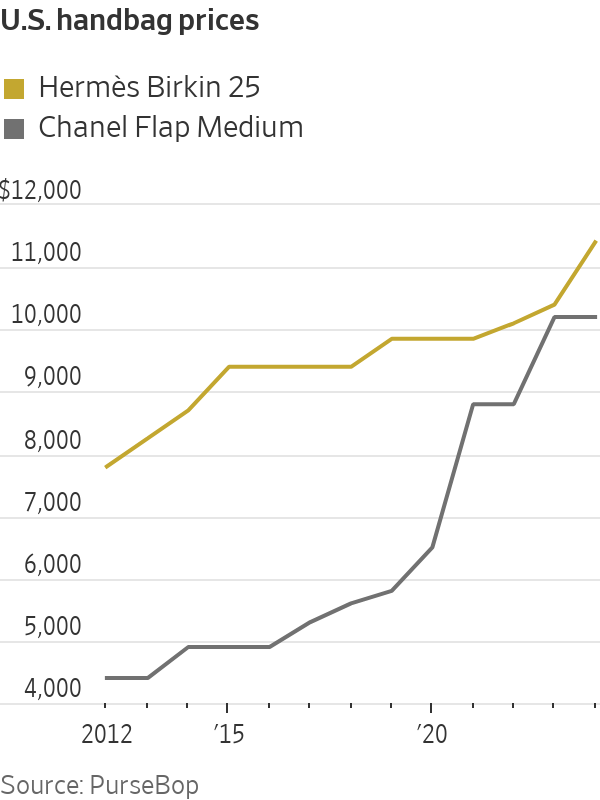
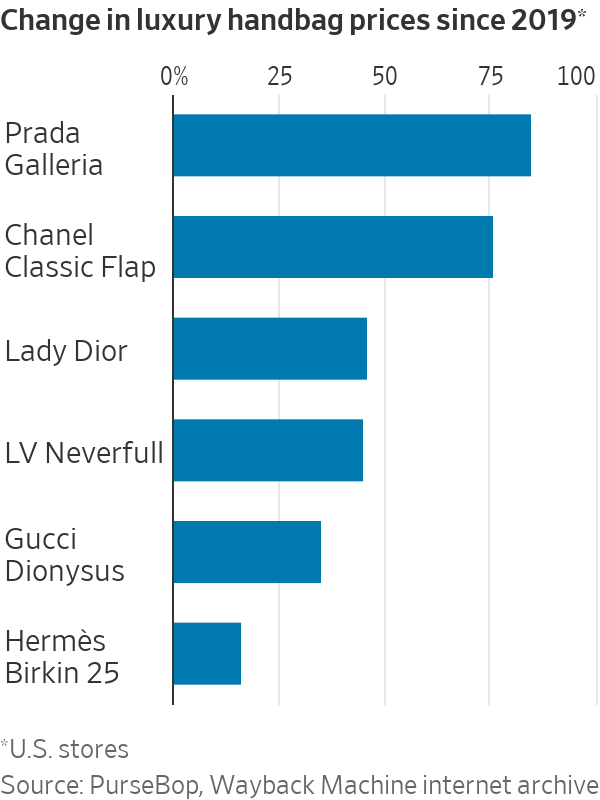
Hermès recently raised the cost of a basic Birkin 25-centimetre handbag in its U.S. stores by 10% to $11,400 before sales tax, according to data from luxury handbag forum PurseBop. Rarer Birkins made with exotic skins such as crocodile have jumped more than 20%. The Paris brand says it only increases prices to offset higher manufacturing costs, but this year’s increase is its largest in at least a decade.
The brand may feel under pressure to defend its reputation as the maker of the world’s most expensive handbags. The “Birkin premium”—the price difference between the Hermès bag and its closest competitor , the Chanel Classic Flap in medium—shrank from 70% in 2019 to 2% last year, according to PurseBop founder Monika Arora. Privately owned Chanel has jacked up the price of its most popular handbag by 75% since before the pandemic.
Eye-watering price increases on luxury brands’ benchmark products are a wider trend. Prada ’s Galleria bag will set shoppers back a cool $4,600—85% more than in 2019, according to the Wayback Machine internet archive. Christian Dior ’s Lady Dior bag and the Louis Vuitton Neverfull are both 45% more expensive, PurseBop data show.
With the U.S. consumer-price index up a fifth since 2019, luxury brands do need to offset higher wage and materials costs. But the inflation-beating increases are also a way to manage the challenge presented by their own success: how to maintain an aura of exclusivity at the same time as strong sales.
Luxury brands have grown enormously in recent years, helped by the Covid-19 lockdowns, when consumers had fewer outlets for spending. LVMH ’s fashion and leather goods division alone has almost doubled in size since 2019, with €42.2 billion in sales last year, equivalent to $45.8 billion at current exchange rates. Gucci, Chanel and Hermès all make more than $10 billion in sales a year. One way to avoid overexposure is to sell fewer items at much higher prices.
Many aspirational shoppers can no longer afford the handbags, but luxury brands can’t risk alienating them altogether. This may explain why labels such as Hermès and Prada have launched makeup lines and Gucci’s owner Kering is pushing deeper into eyewear. These cheaper categories can be a kind of consolation prize. They can also be sold in the tens of millions without saturating the market.
“Cosmetics are invisible—unless you catch someone applying lipstick and see the logo, you can’t tell the brand,” says Luca Solca, luxury analyst at Bernstein.
Most of the luxury industry’s growth in 2024 will come from price increases. Sales are expected to rise by 7% this year, according to Bernstein estimates, even as brands only sell 1% to 2% more stuff.
Limiting volume growth this way only works if a brand is so popular that shoppers won’t balk at climbing prices and defect to another label. Some companies may have pushed prices beyond what consumers think they are worth. Sales of Prada’s handbags rose a meagre 1% in its last quarter and the group’s cheaper sister label Miu Miu is growing faster.
Ramping up prices can invite unflattering comparisons. At more than $2,000, Burberry ’s small Lola bag is around 40% more expensive today than it was a few years ago. Luxury shoppers may decide that tried and tested styles such as Louis Vuitton’s Neverfull bag, which is now a little cheaper than the Burberry bag, are a better buy—especially as Louis Vuitton bags hold their value better in the resale market.
Aggressive price increases can also drive shoppers to secondhand websites. If a barely used Prada Galleria bag in excellent condition can be picked up for $1,500 on luxury resale website The Real Real, it is less appealing to pay three times that amount for the bag brand new.
The strategy won’t help everyone, but for the best luxury brands, stretching the price spectrum can keep the risks of growth in check.
As migration hits record levels worldwide, a debate is building among economists over whether some industries are becoming too dependent on foreign labour.
Many business owners say that bringing in low-skilled foreign workers has become essential, as local populations age and labor forces shrink. In rural Wisconsin, John Rosenow says it is impossible to find locals to work on his 1,000-acre dairy farm. He relies on 13 Mexican immigrants, up from eight to 10 a decade ago. That has enabled him to avoid making costly investments in robots that can help milk cows, as some other dairy farmers have.
“We get really good people,” Rosenow says. With immigrant labor, “I’m pretty sure if I wanted to double employment, I could get it done within a week.”
To some economists, however, dependence on imported workers is approaching unhealthy levels in some places, stifling productivity growth and helping businesses delay the search for more sustainable solutions to labor shortages.
Those solutions could include bigger investments in automation, or more radical restructurings such as business closures, which are painful but may be necessary long-term, these economists say.
“Once industry is organised in a certain way and the structure encourages employers to recruit migrants, it can be very hard to turn back,” said Martin Ruhs , a professor of migration studies in Florence, Italy. “In some cases, policymakers should ask, does it make sense?” said Ruhs, who is also a former member of the U.K. Migration Advisory Committee, which advises the British government on migration policy.
The debate is likely to heat up further as Western societies teeter closer to a demographic abyss . For the first time since World War II, the working-age population is shrinking across advanced economies. The European Union’s working-age population will shrink by one-fifth through 2050, according to a recent report by German insurer Allianz .
There are ways to offset that trend, such as encouraging older workers to delay retirement. But importing foreign labour is often the easiest option, given the supply of available workers in places such as Latin America or Africa.
Immigration also provides a rush of economic growth as migrants boost populations and spend money, even when it elicits blowback from conservative groups, as it has in the U.S. and Europe.
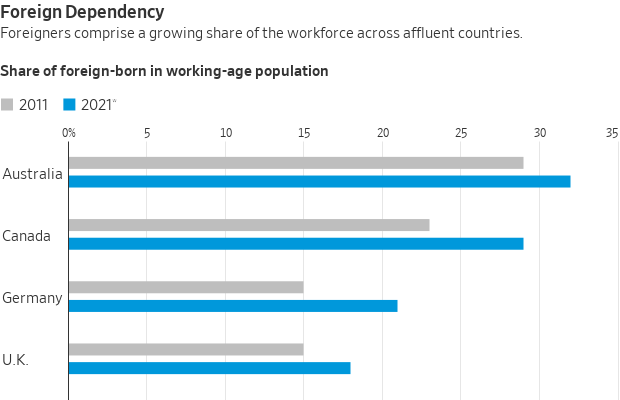
Immigration is now running two to three times above pre pandemic levels across major destination countries including Canada, Germany and the U.K. In the U.S., 3.3 million more migrants arrived than left last year, compared with a 2010s average of around 900,000.
Three-quarters of farmworkers and 30% of construction and mining workers in the U.S. today are migrants. Overall, immigrants made up 18% of the U.S. workforce in 2021, compared with 16% a decade earlier, according to the Organization for Economic Cooperation and Development, a Paris-based club of mostly rich countries.
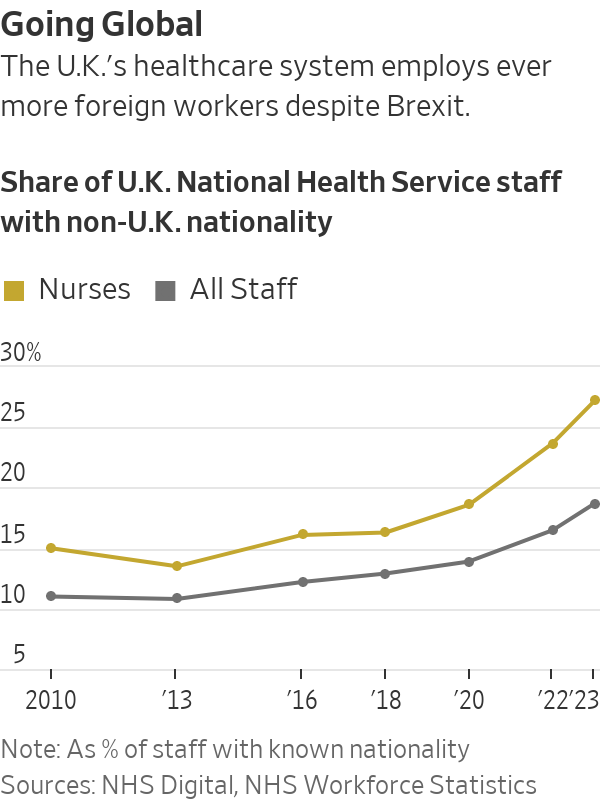
Despite promising for decades to curb immigration, the U.K. has seen a surge since its 2020 exit from the EU, as businesses scramble for employees. More than 27% of the National Health Service’s nurses are from abroad today, up from around 14% in 2013. In Germany, roughly 80% of slaughterhouse workers are migrants, unions estimate.
Downsides of over reliance
Increased reliance on low-skilled imported labor can lead to weaker productivity growth, which ultimately determines how fast economies can expand, some economic research suggests.
A 2022 study in Denmark found that firms with easy access to migrant workers invested less in robots. Research in Australia and Canada suggests that migrants could keep weak firms alive, weighing on overall productivity.
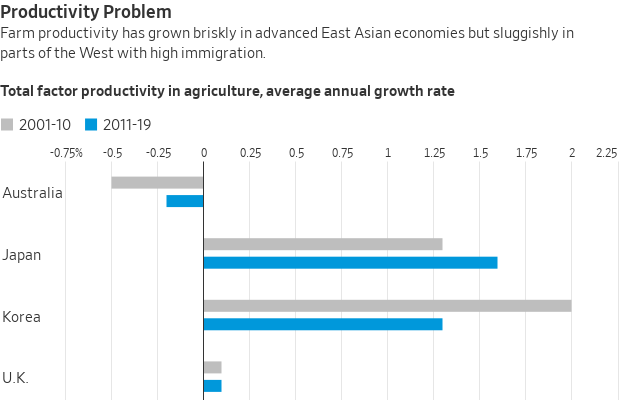
Labour productivity growth has been sluggish across advanced economies in recent years. In the U.S. and U.K. farming sectors, productivity has flatlined for a decade or longer. In Japan and Korea, which have more restrictive immigration policies, it increased by around 1.5% a year, OECD data show.
Finding the right balance between allowing some migration, which can help restore dynamism in aging countries, and avoiding over dependence is hard. In many industries, there is no obvious alternative to foreign workers.
Going cold turkey would send prices for products made from migrant labour higher. It would also leave many people in poorer countries with fewer options to pursue better lives.
Anna Boucher , a global migration expert at the University of Sydney, says that some low-skilled migration is probably necessary in the short term due to skills shortages. Without it, some childcare services in Australia would shut down and vegetables would die in the fields.
Economic research suggests that an influx of high-skilled migrants, such as scientists and engineers, can actually lift firms’ productivity and boost local workers’ wages and employment opportunities.
Economists are more divided when it comes to lower-skilled migrants. Such workers are also more easily replaced, including in industries that seem unlikely candidates for automation.
In the Czech Republic, some farmers are using artificial-intelligence-driven robots to monitor and harvest strawberries. Israeli startup Tevel Aerobotics Technologies has developed fruit-picking drones. Fieldwork Robotics, a U.K. company, recently started selling raspberry-picking robots, which stand 6 feet tall with four plastic arms.
Yet for governments, pursuing reforms that boost productivity and allow weaker firms to die is a lot harder than increasing immigration, said Dan Andrews , a productivity expert at the OECD.
“Some countries may have taken the easy way out,” he said.
Pushback from businesses
Hoping to accelerate automation in agriculture, the U.K. government is pouring money into farm technology. It is also considering abolishing rules that allow companies to pay migrant workers 20% less than the going rate for jobs, prompting protests from farmers’ lobby groups. They say farmers adopt technology quickly if it is available, but that robots are no good at picking fruit and vegetables.
“The technology that we are aiming for is five years away…we were saying that five years ago,” said Martin Emmett , a farmer and official at the National Farmers’ Union, a trade group.
In Malaysia, the government last year announced a freeze on hiring of new foreign workers. Government ministers say that over dependence on cheap foreign labour has created a detrimental cycle that allows companies to resist innovation. Local companies say they need more time to invest in automation and upgrade workers’ skills.
Some industries, including manufacturing and plantations, have since been allowed to hire foreigners following appeals, but the broader freeze on foreign workers remains in place with no end date.
In Canada, economists say the government has cast aside a carefully managed immigration system that gave priority to highly skilled workers, and ramped up significantly the intake of foreign students and other low-skilled temporary workers. By flooding the market with cheap labor, Ottawa may be propping up uncompetitive businesses and ultimately damaging productivity, according to a December report co-written by former Canadian central-bank governor David Dodge .
Economic output per capita is lower than it was in 2018 following years of record immigration, notes Mikal Skuterud , an economist at Waterloo University in Ontario. Canada has been bringing in so many low-skilled workers that it lowers the country’s productivity overall, he says.
Germany’s butcher conundrum
The debates are also intensifying in Germany, where businesses including butcher shops in the foothills of the Black Forest are becoming more reliant on imported labour.
Young people don’t want to train as butchers anymore, local businesses say, because it is unglamorous work, with low pay. Labour shortages are one reason why the number of butcher shops has roughly halved over the past two decades.
Three years ago, Handirk von Ungern-Sternberg , an official at the local chamber of handicrafts, started a pilot project to recruit butchers’ apprentices in India, taking advantage of a change in German law that made it easier to hire low-skilled workers from outside the EU. The first batch of 13 young Indians arrived in September 2022.
Now, demand is exploding. Von Ungern-Sternberg plans to bring in roughly 140 Indian workers this year. That number could triple in future, he says.
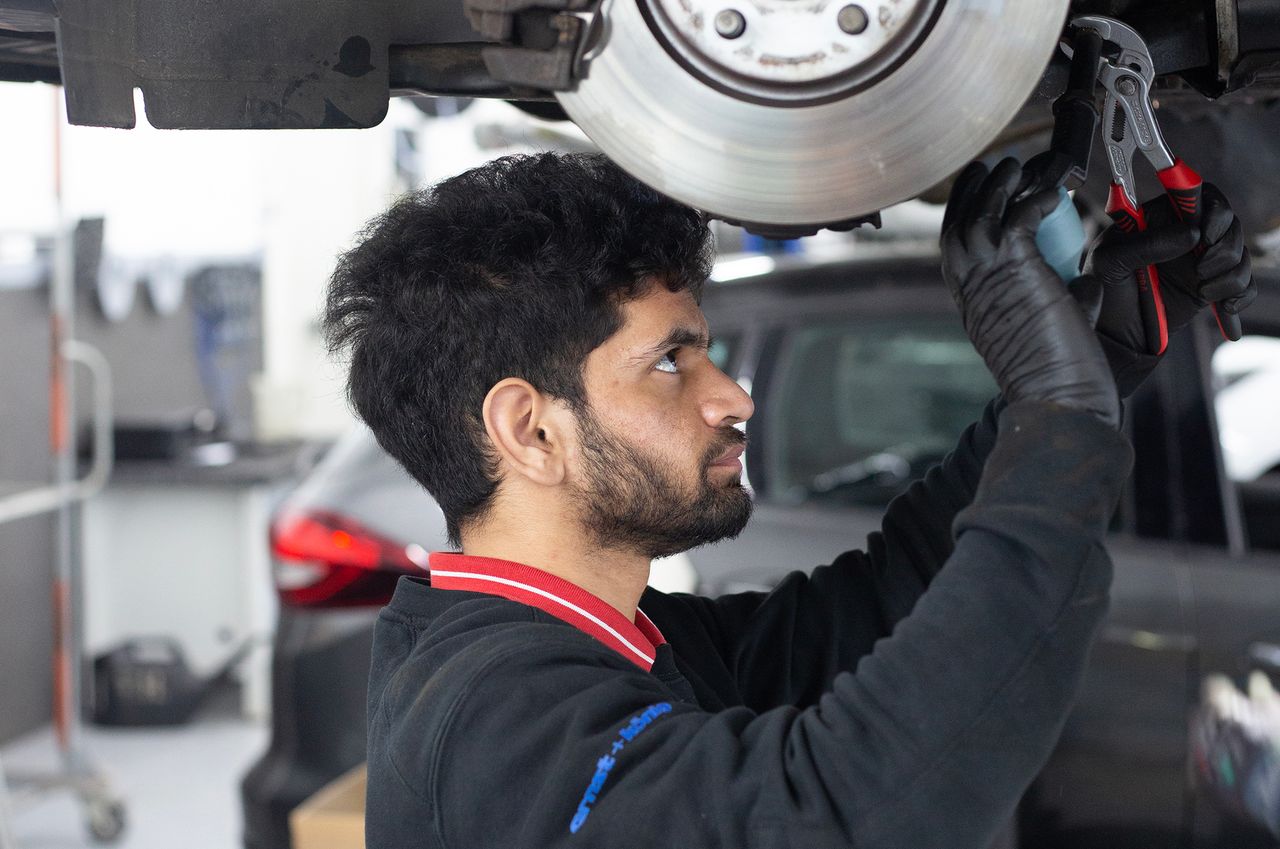
From auto mechanics to construction, local businesses are clamoring for his young Indian recruits. Chambers of handicrafts across Germany, from the Alps to the North Sea, are seeking his help in starting similar projects.
Butcher shops in Germany’s Black Forest region are becoming more reliant on imported labor. PHOTO: DOMINIC NAHR FOR THE WALL STREET JOURNAL
“We ask ourselves, where’s the limit? Are we a job company? We don’t know where the ceiling is,” von Ungern-Sternberg said.
The program also benefits consumers by helping keep butchers’ costs low. Across the border in Switzerland, where Indian workers aren’t available, meat costs nearly four times as much.
However, Swiss business owners have also been experimenting with new technologies, including sausage vending machines known as Wurstautomaten, which could reduce the need for small-scale butcher’s shops and ultimately help bring prices down.
Meanwhile, opposition to immigration is rising in Germany, which suggests the butchers’ reliance on imported labor might not be sustainable. Support for the anti-immigrant Alternative for Germany party recently hit an all-time high of 23%. Polls suggest it could emerge as the strongest political force in several German state elections later this year.
Dairy dilemma
In Wisconsin, Rosenow, the dairy farmer, says he’s skeptical of the automated milking machines that he says are advertised in farm magazines. Some neighbours experimented with robots but went back to human labor because the robots constantly needed repairs, he says.
Robots would also cost twice as much as immigrant workers and be costly to maintain, Rosenow says. With immigrants, “labor is no constraint.”
Onan Whitcomb , a dairy farmer in Vermont, disagrees. He says that when he wanted to increase production he decided not to hire immigrant workers. Instead, he spent $800,000 on four Dutch-made milking robots.
Milk production per cow has grown by 30% and the incidence of mastitis, an inflammatory disease, has declined by 80%, he says, meaning less spent on antibiotics. Whitcomb says he was able to cut 2.5 jobs, and the investment paid for itself in seven years.
“We were milking 300 cows and we went to 240, and we still made more” milk, Whitcomb said. “That’s hard to beat.”
My new Tesla was burning a $511 hole in my monthly budget. So I set myself a challenge: Could I cover the cost just by getting rid of cable, Netflix and other subscriptions I didn’t need?
The financially responsible among us might cancel streaming services between seasons of their favorite shows . I tend to add new ones and forget about the old ones, doing my share to support America’s ballooning subscription economy. People pay about $273 a month for subscriptions, which is almost $200 more than they think they do, according to a 2021 survey . (Since then, services like Disney+ and Discovery+ have raised their prices further.)
But I needed to make room for the first car payment in my 41 years. I had taken the family car-shopping when our 2001 Toyota Camry, which we inherited from my wife’s grandmother, started to go. I’m not a car guy and had never once wished I’d owned a Tesla. I booked a demo drive for the Model Y because I thought our kids would get a kick out of it.
The fact that we liked the car was almost as surprising as the fact that it was cheaper than the electric Volvo, Volkswagen and Hyundai options we saw. It felt like a spaceship compared with the Camry, which has 205,000 miles, a broken tape deck and an interior stained with blue and yellow crayon.
Our new monthly payment covered a 12,000-miles-a-year lease with no down payment. Tesla estimated I would save about $100 a month from replacing gas with electric, though I would need to drive (and charge) the car to know for sure. Tesla’s app tracks my estimated savings. For now, that left us with $411 to cut from our other monthly expenses.
My wife was on board. My kids shrugged. I got out my notebook and started making a list.
Cutting the cord
My first stop was my Xfinity bill.
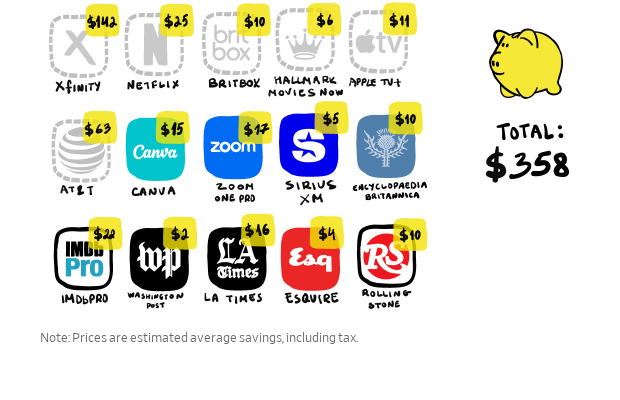
Somehow, it had swelled to $249 a month—basically half the price of the car. In addition to cable and internet, I’d been paying Xfinity for things like a landline because cell service can be spotty in my basement office. So long, landline. After cutting everything but internet, my bill fell to $107. I haven’t dropped a call yet.
Next were the streaming services that I’d been paying for but not watching much. Over the past few years, the only person in the house “watching” Netflix was me. And I wasn’t actually watching it. I was listening to episodes of “Seinfeld” in an earbud when I went to bed. The jokes and the rhythm of their back-and-forths were a pleasant send-off as I fell asleep.
I had joined the growing number of Americans ditching streaming services. I also broke up with BritBox, a streaming service that I’d counted on to watch Agatha Christie’s “Poirot,” as well as Apple TV+. I said goodbye to Hallmark Movies Now, which I’m not ashamed to admit I enjoyed every now and then.
Next up was AT&T .
Paying for cellphone service is like paying the water bill: something I did without protest and never really thought twice about. But I’d started to get curious about the ads I’d been seeing for low-cost services like Boost Mobile and Cricket Wireless. When we agreed to let our 13-year-old son have a phone, part of the deal was that he had to pay for and maintain the account himself. He got a plan with Mint Mobile. It has worked so well for him that we decided to give it a try.
We had been paying AT&T about $128 a month for two lines. Now, we’re paying Mint about $65. If there is a downside to making this move, I have yet to notice it.
I’m still paying for that?
Then my wife and I sat at our dining table going through the last couple months of transactions in our checking account. Seeing how much money we were wasting was painful. We were both paying for subscriptions to Canva, a graphic-design service.
We’ve also been paying for Zoom One Pro, which I probably haven’t used in more than a year. I attempted canceling SiriusXM, but they kept me around by dropping the cost by about $5 a month, which is nice because I have become obsessed with a channel dedicated to country artist and sometimes actor Dwight Yoakam.
Upon further consideration I axed subscriptions to IMDbPro and Encyclopaedia Britannica, which I’m sure I’ve used professionally, but…not for a while. Finally, I cut or got reduced rates on four of my digital subscriptions to news publications. I had been making monthly payments to them more often than I was reading them.
In the end, I was able to cut out about $358 in unnecessary bills and subscriptions. Added to the $100 in estimated gas savings, the cost dropped to $53 for a car we desperately needed.
And since the lease came with six months of free access at Tesla Superchargers, the Tesla app tells me I saved $164 by not pumping gas in January, exceeding the $100 I had estimated. In January at least, my car was free-ish.
“So I love and I hate what you did,” David Bach told me. The author of personal finance books like “Smart Couples Finish Rich” has long preached the merits of cutting out small, fixed expenses. But he’d rather have seen me invest the savings.
“If you’re already a millionaire, go enjoy the Tesla,” he said.
No regrets
It isn’t like we’ve had to revert to our DVD collection to entertain ourselves. We still have Disney+, Hulu, Max, the language-learning service Duolingo and, of course , Spotify. We get three print newspapers delivered and many more digital news subscriptions.
I’m reacquainting myself with some shows on the services I kept, like Billy Bob Thornton’s “Goliath” on Prime Video—featuring an exceptional performance from Dwight Yoakam.
It is possible we’ll start subscribing all over again. Americans resubscribe to about 23% of the larger streaming services they cut within three months. That share rises to over 40% after a year, according to Antenna, a subscription-analytics provider.
I get it. I subscribed to Paramount+ for Super Bowl Sunday (yes, I canceled it the following Tuesday). And I’m tempted to return to Netflix every time I get ready for bed. I still haven’t found a lullaby to replace “Seinfeld,” but at least I am the master of my (financial) domain.
I need something upbeat but not preachy, familiar, but with enough episodes that I don’t get too sick of them. I tried “Bob’s Burgers,” but Louise Belcher’s screams and the high-pitched strumming of the ukulele between scenes kept me awake.
Oh well. Reliable transportation is worth the $511 monthly payment. Come to think of it, that feels a lot like a subscription.