From a young age, Jeff Goldblum had an eye for clothes. Growing up in Pittsburgh, he wanted glasses like John Lennon’s and turtlenecks like the Rat Pack’s.
As a member of New York’s Neighborhood Playhouse studying under the legendary Sanford Meisner, he scoured vintage shops for Russian-style overcoats and aviator hats.
After his success in blockbusters like “Jurassic Park” and “Independence Day,” he went through a Japanese-denim phase and loved what he calls “I’ve-been-working-on-the-railroad-type vests.”
“I’ve swung wildly, and I’ve had a lot of bad ideas,” Goldblum said of his style on a recent Zoom.
The 73-year-old wore a bespoke green shirt from Anto, a shirtmaker based near his Los Angeles home.
On his feet were light-green socks, and handmade shoes from Florence, where he lives part-time with his wife, Emilie Livingston, and their two sons.
This month, he reprises his role as the Wizard of Oz in “Wicked: For Good,” the second installment of the film adaptation of the musical juggernaut. He insisted he’s not contracted by Universal Studios to only wear green on the press tour.
In the last decade the world has paid more attention to the actor’s off-screen style, which has evolved since he began working with stylist Andrew Vottero around 2014.
A silver-haired fixture on best-dressed lists, Goldblum often finishes his zany outfits with chunky black specs. He has collaborated with glasses label Jacques Marie Mage and formed a close relationship with Prada , walking its runway and appearing in a 2022 brand campaign.
Here, Goldblum, who regularly performs with his jazz band the Mildred Snitzer Orchestra, talks cashmere, vegan Bolognese and handshakes.
Studying with Sandy Meisner was: a portal into my more-intense interest in clothing. Everything could be a key to finding a character, behavior and discovering who you are in the story – (for example) how the shoe felt and how it made you walk.
You don’t really see: a 1970s-style long shirt collar in stores. I had this green shirt I’m wearing made at Anto in Los Angeles. I have them in a bunch of flavors, including some with Western buttons. I’m thinking about getting one in orange.
I just read: James Kaplan’s two-part biography of Frank Sinatra, whose favorite colour was orange. I’ve always liked orange.
I like: that Marie Kondo book “Tidying Up.” In my youth, my family left me alone one day in the garage. It seemed messy to me. I started to throw everything away. I was sweating under my arms with excitement. I got a big kick out of it.
My kids: like to wear my band merchandise. They sometimes help me dress. I say, “Hey, pick out what I’m going to wear.”
I’ve had to get cozy with one or two: leather jackets for parts like Ian Malcolm in “Jurassic Park.” I have a Saint Laurent motorcycle jacket that I wore the other day that’s kind of tight. I like it a lot.
I probably wouldn’t want to wear: real fur. I’ve stopped eating animals except fish. It’s part health-wise from my nutritionist and part my own feeling about it.
My favourite meal is at: Craig’s in West Hollywood. My wife and I share a chopped salad, minus the cheese, to start. They have a spaghetti squash primavera with broccoli and a spicy tomato sauce. I get it with shrimp or vegan Bolognese.
I’ve always been hypersensitive to: certain fabrics, such as wool. I’ve recently accepted—what’s that wool called?—cashmere. I don’t like things that itch. And I don’t like tags in the back of my shirt. I use a professional seam ripper to cut out tags.
What drives me crazy are: printing machines and my phone, especially how it breaks down so often. I had to deal with that this morning.
My feet must be: comfy cozy. My wife, a ballet dancer, says we’re not really working unless our feet are bleeding. I can’t accept that. I really like these handmade shoes I had made in Florence. They’re the most comfortable ever.
Florence is: a jewel box of a city. I’ve found the people delightful and the quality of life great. There are so many artisans. My favourite hat is one I purchased at the Borsalino store. I don’t know any Italian. Just a word here or there.
I don’t want to get sick so I prefer: fist bumping to a handshake. My knuckles have hurt from a too-hard fist bump. So let’s fist bump gently. Let’s just fist touch.
I have to organise my: sock drawer. It’s in the research and development stage. I’m very into socks of one kind or another. I like to experiment with a colour, which is why I have a light green pair on now. For tight shoes, I like (thin) Pantherella socks . I like a shorter sock, too. Sometimes I make it look like it’s falling down.
For a while I had an aesthetic allergy to: cobalt blue. You’d see it on a lady’s blouse sometimes, and I would go, “That hurts! It’s too bright.” But yesterday, after going to the Dodgers game with my kids, I put on a Dodgers blue cobalt sock, and I was very happy. So I’m nothing if not changeable.
I love: pockets. I recently got a minty green chore coat by the Row that I really like. Its flap pockets are deep enough that things aren’t going to fall out. I’d never even heard the term “chore coat.” It carries my wallet, keys, maybe a Kleenex, a lozenge, a little pillbox with an aspirin and some hand sanitizer.
I never used: sunscreen. But my wife has got me using Sarah Chapman sunscreen , sometimes even tinted. I’ll use a Joanna Vargas serum of some kind. I’m not sure what it’s doing, but I put it on at night. I imitate Boris Karloff (in the “Frankenstein” films) and I make a joke with Emilie that I’m going to my laboratory to work on my new longevity theorem.
My acid-reflux man said: “Take care of your vocal cords.” So I’m off caffeine. I’ll have a Ryze mushroom coffee in the morning—a scoop with hot water and oat milk. Sometimes the kids will make me a decaf cappuccino with oat milk and a sprinkling of chocolate powder, and that is too delightful.
For many decades: I’ve been totally on the natch. I’ll have a sip of red wine if Emilie says it’s really fantastic, but I don’t want to get loopy.
I get the usual: seven or eight hours of sleep. I stopped wearing my Oura ring. I’d be in bed for 8 hours and it would go, “No, Jeff, let’s call it 5½ hours that you got.” It used to say, “You’re somewhat ready for the day,” and I’d say, “Go to H-E-Double Hockey Sticks.” I threw the darn thing away. I go with how I feel.
When I wake up: I go through the little vestige of transcendental meditation I learned decades ago. I crack my bones and do this stretching routine that ends with my taking a tennis racket and going through the motion of a backhand, forehand and serve. Then I take a Centrum for Men multivitamin, play my piano and work out in our gym.
Early on I was: a lanky guy. Then I started lifting weights. I wanted to steer some of those roles that were a little nerdy—even those scientist parts—in a cooler direction.
Am I: nerdy or cool? Well, these days, according to some circles, the two have overlapped. At this point, who knows?



 5 min
5 min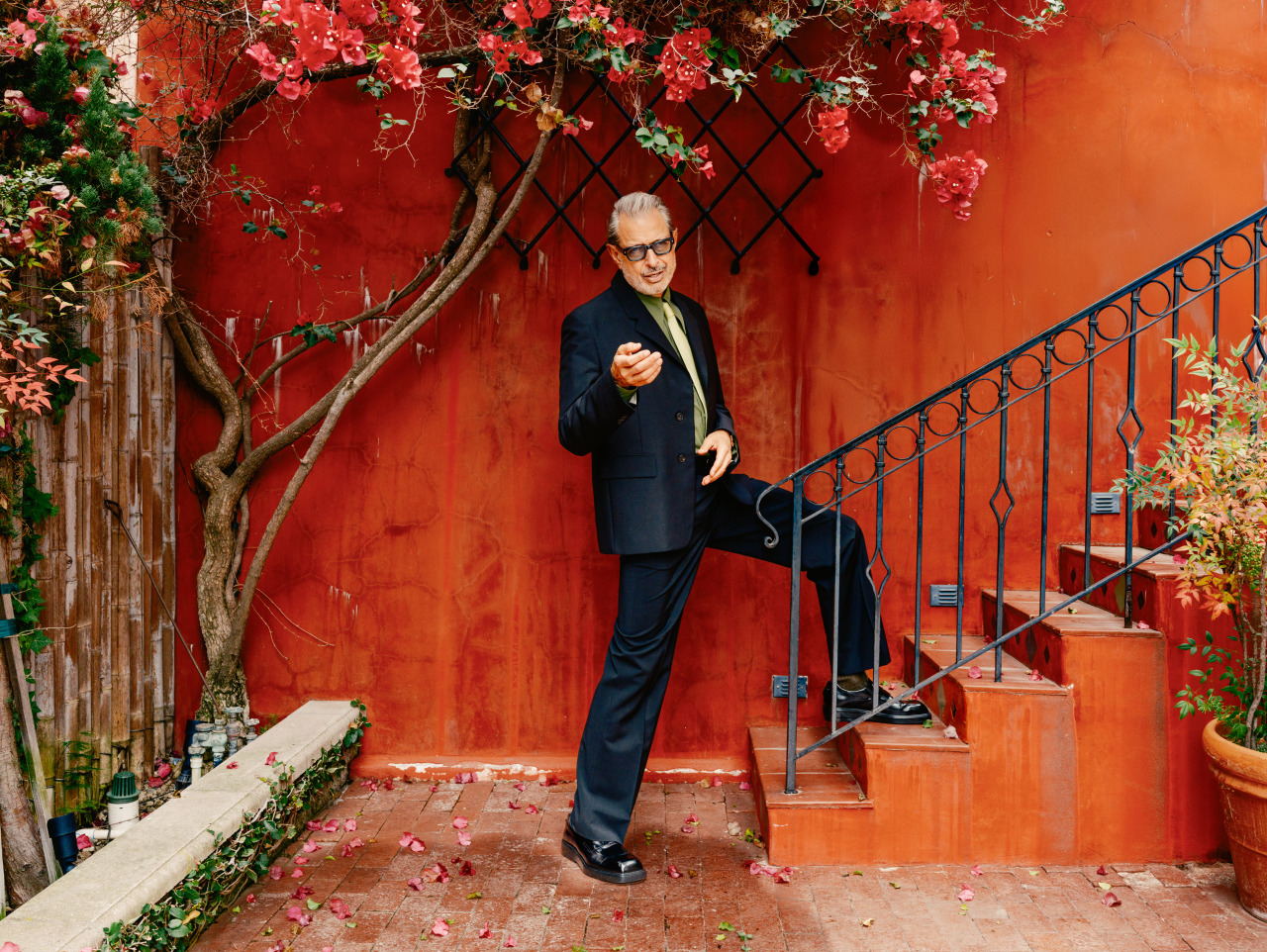
 Copyright 2020, Dow Jones & Company, Inc. All Rights Reserved Worldwide.