15 Stocks to Buy Around the World, From Our International Roundtable Experts

With wars raging again in Europe and the Middle East, and U.S.-China tensions on the boil, the political order that underpinned markets for decades is under serious threat. So, too, is the financial order, as the U.S., Europe, and even Japan exit the zero-interest-rate era, and the U.S. and China face deteriorating fiscal health. In other words, after years of relative peace and prosperity, seismic changes could lie ahead. That is an opportunity for investors.

What to do now? Barron’s sought the advice of four of the savviest market watchers we know, who took us on a virtual global tour of investment hot spots in a Nov. 3 roundtable discussion held on Zoom, and in follow-up conversations. From the bull market unfolding along the Istanbul-to-Jakarta axis to the economic liberalisation taking place in parts of Latin America and the Middle East, our roundtable panelists see reasons to cheer the global transformation under way, notwithstanding some painful dislocations. They also see plenty of well-positioned companies around the world with irresistibly priced shares.

Our international experts include Joyce Chang, chair of global research at J.P. Morgan; Louis-Vincent Gave, co-founder of Hong Kong-based Gavekal Research; Matthew McLennan, co-head of the global value team at First Eagle Investments, who oversees $86 billion; and Rajiv Jain, chairman and chief investment officer of GQG Partners, which manages $107 billion.

An edited version of the roundtable discussion follows.

So far, the war in the Middle East hasn’t ruffled U.S. investors. Why is that?

Louis-Vincent Gave: Most actors in the region have been busy trying to de-escalate. Perhaps that is why the markets have brushed this off, as horrible as the events have been. Also, the days when the Arab world would embargo oil to Europe or the U.S. [because of their support for Israel] are over, as about 75% of oil exports from Saudi Arabia, Iran, and the United Arab Emirates now go to Asia. Plus, the U.S. is broadly self-sufficient when it comes to energy.

Matthew McLennan: A cautionary note: Thucydides, in the History of the Peloponnesian War, wrote that the course of war cannot be foreseen. We must be open-minded to the nonlinearities that could arise, given the nature of war and the tendency of conflict to spread.

There is also a broader aggregation of strategic interests crystallising here that supports an anti-Western narrative. In the 1900s, [Halford John] Mackinder developed the theory that whoever controls the Eurasian heartland controls the world. There has been a clear emergence of this Heartland Axis, with the Russians inviting Hamas representatives to Moscow and [Russian President Vladimir] Putin having been invited to China to meet with [Chinese leader] Xi Jinping.

Joyce Chang: We haven’t changed our overall economic and commodities forecast [as a result of the war]. Since 1967, there have been 20 major military confrontations in the Middle East and North Africa, 11 of them directly involving Israel. Other than the Yom Kippur War in 1973, none had any lasting impact on oil prices. As of now, oil flows haven’t been impacted.

State actors are trying to de-escalate the current situation, but we worry more about the non state actors. More generally, my concern is that people think of many geopolitical and macro risks as spiking and then de-escalating. What if we are in a new period in which high and volatile interest rates or geopolitical risks become more chronic?

One risk that investors are trying to assess relates to China. What is the status of China’s economic recovery?

Rajiv Jain: The situation isn’t nearly as bad as the sentiment. Economic data seem to be improving. Commodity markets are telling a similar story. Growth is slowing, but given China’s size, growth of 2% or 3% today is more powerful than growth of 7% or 8% 20 years ago. And geopolitically, for now, both the U.S. and China seem to be trying to mend fences. On the margin, I am more positive than I had been, but we have just 8% of our portfolio in China in our emerging markets strategy.

Chang: We have raised our economic growth forecast for China to 5.2% from 4.8% at midyear. But one of the issues is China’s debt burden. Debt rose to 282% of gross domestic product at the end of last year, and it is another 10 percentage points higher this year.

China is adding one trillion renminbi [about $139 billion] to its fiscal deficit as it supports targeted public spending by local governments. We have seen this [type of] increase in its fiscal deficit only three times before. It suggests that China is shifting toward less conventional policy and prioritizing a grand scheme to deal with local government debt that is more proactive and transparent, even if it means a higher deficit and lower medium-term growth.

One of China’s key policy challenges is weakness in confidence—domestic and international, whether among corporates, households, or home buyers. The risks in the property sector, which has been in a multiyear decline, are also still significant. About 60% of the property bonds outstanding at the end of 2020 have been effectively wiped out, given the defaults over the past 2½ years. That’s a big share of the economy.

What are the ripple effects of this downturn in property?

Chang: China’s potential growth might continue to slide in the coming years from around 6% in pre pandemic years to 3.5% to 4.0% in 2025, and stabilise in this range. That is a faster slowdown compared with our 2021 estimates.

This will have reverberations, but fewer than before the pandemic. In the past, we estimated that every 1% decline in China’s growth would dent global growth by about half a percent. Now, the hit is about 0.2% of global growth, as the impact of U.S. shocks is greater than those emanating from China. However, spillovers occur across emerging markets, so we see a 0.7% hit for those that are commodity exporters.

Gave: Chinese real estate was the big growth driver for the world from 2000 to 2014. It hasn’t been for a while, due partly to the fact that trees don’t grow to the sky. Also, the Chinese government actively tried to curtail the rise in Chinese property prices, while simultaneously making life challenging for real estate developers through much tighter lending policies.

But even as Chinese real estate has had another poor year, iron ore and energy prices have held up. The next big story for global growth is the integration of the Eurasian heartland Matt mentioned. If you draw an axis from Istanbul to Jakarta, you’ve got 3.6 billion people with strong demographic and income growth, and not a day goes by without a new infrastructure spending plan.

Abu Dhabi just said it is going to spend $50 billion on infrastructure in India. Big spending on infrastructure is also the case in Indonesia, Vietnam, elsewhere in the Middle East, and even Turkey, whose shares have done just as well this decade in dollar terms as U.S. stocks. The new bull market is this Istanbul-to-Jakarta axis. That’s what is going to drive commodity growth. China isn’t imploding. We are just moving on to a bigger and better story.

What does this mean for globalisation?

Chang: Deglobalisation has been a myth. It is more that trading patterns have shifted. There is the Middle East corridor and the Latin America corridor, and also connector economies that are important in the supply chain, including Mexico, Poland, Vietnam, Indonesia, and Morocco, which is part of the electric-vehicle-battery supply chain.

Gave: For the past 30 years, if growth came from somewhere, it came from the U.S. or China. You would buy Indonesia or Brazil if China did well. That hasn’t been the case for the past three or four years.
It is also the first time in 30 years that almost every emerging market has brushed off a more hawkish Federal Reserve. In 2013, when the Fed said it was thinking about perhaps starting to tighten monetary policy,[financial] markets in Indonesia, India, and Brazil imploded. This time around, these bond markets have outperformed by 20% to 40% against U.S. Treasuries. This is an absolute game changer.

Why is that?

Gave: U.S. Treasuries are supposed to be the anchor of our financial system, and have failed at that task in the past two years. You can’t have an anchor asset that loses 20% over 18 months!

Increasingly, countries such as Chile are realising that if they are trading with Brazil, that trade doesn’t have to be in U.S. dollars. This matters tremendously because as more trade moves into local currencies, the need to keep both reserves from central banks and working capital for companies in U.S. dollars diminishes.

McLennan: The fiscal deficit in the U.S. was 3.7%[of GDP] in July 2022 and will probably be more than 7% this year by our estimates—at the peak of the economic cycle. This is a catastrophic fiscal outcome that markets have yet to fully digest because last year’s fiscal expansion [including price escalators in entitlements and spending related to the infrastructure bill and the Inflation Reduction Act] has given the illusion of resilience.

This presents great risks. We have a structural fiscal issue in the reserve currency of the world, at the same time the Americans sanctioned the ability of the Russians to access their reserves. What incentive is there for others to accumulate dollar reserves? The ratio of the gold price to the iShares 20+ Year Treasury Bond exchange-traded fund [ticker: TLT] has almost doubled since late 2021, a signal that the real value of Treasuries has declined relative to gold.

Do you see a new anchor emerging for the financial system?

Chang: No. U.S. bonds remain the anchor. Certain features of the U.S. system—specifically, its deep and liquid capital markets—are prerequisites for reserve status and do not exist to the same extent elsewhere in the world. Other countries still want to hold their savings in the dollar. Saudi Arabia, for example, is still pegged to the dollar. I wouldn’t exaggerate de-dollarisation.

That said, we have seen a shift in the commodity markets, where we estimate 20% of commodity trading is being settled in non dollars because of the Russia sanctions, and we are seeing a de-dollarisation in China of overseas assets. China shifted away from the dollar to a significant extent, even though it still has a lot of U.S. Treasury holdings. We are also seeing rising purchases of gold by emerging markets. In our longer-term forecast, we see a 2% depreciation of the dollar annually.

Jain: We have never sanctioned such a large commodity exporter before. Russia is the world’s largest exporter of fertiliser, food, and arms, so [the sanctions] have forced the world to use fewer dollars. And rather than accumulate dollars and hold Treasuries, countries might as well invest domesticallyto improve infrastructure. In the Middle East—Saudi Arabia, Bahrain, Oman, or Qatar—countries are opening up their economies. There is a sea change happening. Good policies have come from countries with poorly performing markets over the past 10 years. The game is shifting.

What does all of this mean for investment portfolios?

McLennan: We probably saw a generational low in the cost of capital in 2021. As we move away from that and think about the emerging sovereign risks in the developed world, gold is a potential hedge. But we are also more diversified than the MSCI World Index, which is nearly 70% in U.S. stocks. Our portfolio is closer to 50% U.S. and 50% foreign.

Jain: The emerging markets stake in our global portfolio is the highest it has been in 15 years, but we have nothing invested in China. We have been pouring money into Turkish stocks, including the airline Turk Hava Yollari [THYAO.Turkey]. In Indonesia, another investment, Bank Mandiri Persero [BMRI.Indonesia], is a $35 billion state-owned bank selling at nine times earnings and seeing double-digit loan growth.
While Europe is on a fast track to socialising everything—from taxes on share buybacks to nationalising utilities—emerging markets are privatising. Brazil has privatised more than 50 companies. India’s Prime Minister, Narendra Modi, has been saying the government shouldn’t be in the business of running businesses. That is music to our ears!

Which other companies are beneficiaries of privatisation?

Jain: We have been adding to Adani Enterprises [512599.India], which is valued at about $30 billion, the same as Airports of Thailand [AOT.Thailand]. Yet, Adani’s airport assets alone are worth that much over the next few years, without accounting for its other assets, such as green hydrogen, roads, data centres, and mining services. About a third of Indian air passengers go through Adani’s airports, and 40% of Indian container volume goes through its ports. The stock has compounded at an annual clip of 30% in U.S. dollars over the past 25 years but is still attractive.

How can a stock still be undervalued after that kind of growth?

Jain: Adani has one of most successful records of incubating businesses that I have seen globally: They have spun off more than $75 billion worth of companies from Adani Enterprises.

Adani Enterprises was the target of a short seller earlier this year who alleged widespread fraud, which the conglomerate has denied. What is your take on the situation?

Jain: Almost all of the allegations had been dismissed by Indian high courts previously, and were dismissed by the Indian Supreme Court a few months agoAdani Enterprises is the flagship business of the Adani Group, which just tapped the market for the biggest syndicate loan in Asia last month, funded by a dozen major global and Indian banks. Even the U.S. government has invested in Adani Group by financing a Sri Lankan port-related project it operates.

What else is attractive in emerging markets?

McLennan: Today, emerging markets are priced for imperfection, expecting either recession or sluggish conditions. The U.S. is priced for a soft landing, and the odds are that it probably won’t be soft.

Our largest stake in Mexico is FEMSA [Fomento Economico Mexicano (FMX)], which controls the network of OXXO convenience stores and the world’s largest Coca-Cola bottler. Mexico has been a beneficiary of some of these deglobalisation trends, given its proximity to the U.S., and FEMSA is a business with demonstrable competitive advantages.

What is the outlook for Europe?

Chang: There is more concern about a mild recession. The uncertainty about inflation remains high, as wage pressures could rise. More broadly, there are structural growth problems, with Germany, the “sick man of Europe,” at Europe’s core. The existing growth strategy—sourcing cheap natural gas to service insatiable demand from China—has been upended. Plus, the U.S. is aggressively pursuing industrial policy, and tariffs remain. But the core issue for Europe is consumer “malaise,” with the savings rate above pre pandemic levels.

Jain: European energy prices have skyrocketed after the Russian war. The math doesn’t work anymore for German industrials that relied on cheap Russian gas as an input. European policy makers are also hurting the automobile sector, one of their largest and most competitive industries, by banning internal combustion engines in six or seven years. The industry can’t compete with the Chinese on electric vehicles, so it is trying to start a trade war. The problem is that the entire supply chain for electric vehicles comes from China.

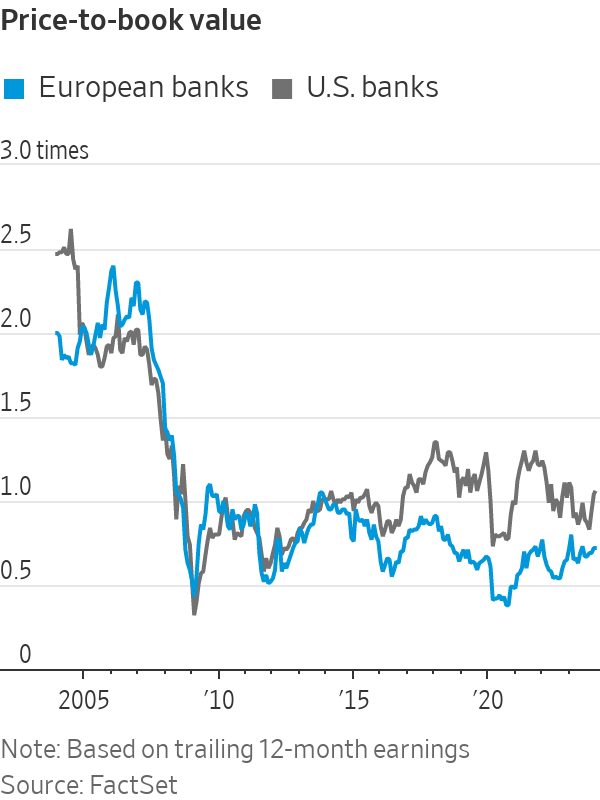
Gave: Europe has a lot of problems but two silver linings: Nobody is expecting anything good out of Europe, and European bank shares are up a lot. Big meltdowns in markets tend to come from bank troubles. The only place you find that today is in the U.S. Bank shares are getting taken to the cleaners—and that’s while the economy is growing at 4.9%. If there is going to be a crisis, it is more likely in the U.S.

U.S. bank stocks are struggling for many reasons.

Gave: Inverted yield curves, etc. But [U.S. banks] are on the other side of the $15 trillion capital wipeout in U.S. Treasuries.

McLennan: Retail banks in the U.S. have often been the canary in the coal mine. In the mid-2000s, retail banks had problems in their residential lending portfolios, and then we had the subprime crisis in 2008. The problem in the regional banks this time has been in sovereign securities, so maybe the dynamic of the next crisis is going to involve some sort of sovereign issue in the U.S.

Given the risks you’re discussing, where do you find protection in the markets?

Jain: Taking a five-year view, oil is probably the most defensive asset. Profitability has improved across the sector, and capital spending is down by more than half. In China, Brazil, and India, we have a newfound love for state-owned enterprises because governments are acting aggressively to invest.

For example, we own Petrobras[PBR] in Brazil, which is selling for 4.5 times earnings, and has a 10% to 15% dividend yield and some of the best production growth prospects over the next six or seven years. In Europe, we own TotalEnergies [TTE]; Patrick Pouyanné is one of the best CEOs in the industry. The stock trades for six times earnings, yields 5%, and the dividend is growing.

Gave: For the past 30 years, you would build your [stock] portfolio and add a U.S. 10-Year Treasury bond on the premise that if something bad happened, bonds would save the day. This has failed to work for the past three years because of fiscal trends, de-dollarisation, and a changing world.

The only asset negatively correlated to stocks and bonds is energy. Higher energy prices would dish out more pain, triggering further selling of bonds, while the consequent higher interest rates would trip up equity markets. Today, not running a heavily overweight energy position is setting yourself up for a potentially disastrous outcome.

McLennan: With so much focus on the energy transition and the cumulative level of underinvestment, the average age of producing resources has been cut in half over the past 15 years. Among our top holdings are Exxon Mobil [XOM] and SLB[SLB]. They are generating great cash flow and have balance sheets better than many sovereigns. Pricing for oilfield services can rise a lot further, and energy often becomes an important vector in an unanticipated geopolitical development.

Chang: We are also overweight commodities and energy and looking at more bond proxies, like utilities and staples. Although it isn’t our base case, if oil prices rise to $120 a barrel and stay there for two quarters, that will kill the global expansion. If oil goes to $100, you can take half a percent off global growth.

What does a slower China mean for commodities and other companies tied to its growth?

McLennan: When Japan underwent its adjustment in the 1990s, demand for certain categories, such as the cognac business, never fully rebounded. Our largest luxury investment is Richemont [CFR.Switzerland], the holding company for Cartier. If the consumption rebound in China is weak, that is going to weigh on that business. One source of comfort: Pricing has been far less aggressive in watches and jewellery than in handbags, so perhaps there could be some spillover [demand] into hard luxury such as jewellery. The company has gradually outperformed precious-metal pricing, given its measured expansion of square footage and product categories.

Jain: The Chinese are increasing their savings rates again. It has been a tough environment, with the [Covid] lockdowns and meaningful white-collar job losses. The psyche has changed. That is why we don’t like the luxury sector in Europe. I don’t think LVMH Moët Hennessy Louis Vuitton [MC.FRANCE] is returning to double-digit revenue growth anytime soon, especially now that it is a $400 billion behemoth.

McLennan: We have a barbell mind-set when faced with these types of uncertainties. For example, you can own Richemont but might also want to own companies that have already been depressed [by China’s slowdown], such as specialists in factory automation. You look for companies with strong incumbency, likeIPG Photonics[IPGP], which has a 65% market share in fiber lasers and will benefit if China recovers, but also as new factories are built elsewhere. It trades at a single-digit multiple of cash flow. It has net cash and is buying back stock.
We also want potential hedges against sovereign or geopolitical risks, such as gold bullion. We own Wheaton Precious Metals[WPM], the leading gold and silver streaming company, which has produced great returns relative to gold or silver. [Gold streamers agree to purchase a percentage of a mine’s production at a predetermined price.]

Speaking of geopolitical risks, how is slower growth likely to impact China’s approach to Taiwan?

Chang: Military conflict with Taiwan shouldn’t be a focus in the near term. The resumption of bilateral communication between the U.S. and China has reduced the risk of miscalculation and accidental conflicts, which had been a concern since former Speaker Nancy Pelosi’s visit to Taiwan last summer. Notably, at the recent Asia-Pacific Economic Cooperation summit, the U.S. and China agreed to resume military dialogue.

China is the No. 1 trading partner to 120 countries in the world. Even if it is slowing, it is going to have the largest middle class in the world. But there is a huge difference between doing business in China right now and being a portfolio investor.

If you are in China to gain exposure to the domestic market or Asia, you really haven’t changed your strategy that much. If you are in China [producing or sourcing] for the U.S. market, you might feel like you’re under more scrutiny and have had to rethink your strategy.

Gave: The view that China is doing so badly that it is going to invade Taiwan to distract people is a very Western one. China isn’t invading Taiwan. This is way beyond the capabilities of the People’s Liberation Army.

The political situation [in China] is the real issue. Following the crackdown on real estate, education, and technology, the perception among Chinese entrepreneurs and local officials is that the central government is no longer a friend but a foe. At the local level, what used to be done quickly now takes forever; that is a huge brake on growth.

What are investors missing about China?

Gave: There is a positive story: China’s trade surplus pre-Covid was roughly $25 billion. Today, it is triple that, or roughly $75 billion. China has moved up the export value chain in the past five years. It is now the biggest car exporter in the world and a world-class competitor in a number of industries that nobody associated it with five years ago, from power plants and turbines to railroads and telecom equipment. As China moves up the value chain, so do salaries, jobs, and China’s technology innovation. Making cars, nuclear-power plants, or railways is a complicated business, and China has achieved this in a way that very few other economies have.

What should investors own to be exposed to China’s maturation?

Gave: Think about the beneficiaries as China takes over industries. Tesla [TSLA] is priced as though it will be the world’s biggest car company forever, but there is no doubt that BYD [1211.Hong Kong] will be the biggest. Then, why shouldn’t Fuyao Glass Industry Group[3606.Hong Kong] be the biggest glass company in the world? I own both and think it is going to be extremely hard to compete with them.

McLennan: You have to be selective. We have tepid medium-term expectations for China’s growth. When everyone thought Japan was a mess with bad demographics, deflation, and debt, a lot of interesting companies came out of that. In China, although there are questions about the assurance of property rights long term, some of that is being discounted more than several years ago. That is why we’re starting to become more open-minded to opportunities.

We ownProsus[PRX.Netherlands], which owns about 30% of [Chinese Internet and gaming company] Tencent Holdings [700.Hong Kong]. Tencent has shifted from near-reckless expansion to a more measured approach focused on efficiency gains. Prosus trades at a meaningful discount to the value of its stakes in Tencent and other holdings [including Indonesian e-commerce company Ula, European food-delivery companies Oda and Delivery Hero [DHER.Germany], and Indian fintech PaySense among others], and is buying back stock.

Which other global themes aren’t getting enough attention?

Jain: A lot of countries are going to run tight on power. Most emerging markets can’t afford liquefied natural gas at $12 or $13 per million British thermal units. Unless we are OK with blackouts, coal will have to make a comeback. Thermal-power plants are being set up in Japan and Korea. And for all the clean energy you hear about in Europe, guess who is the biggest buyer of Colombian coal from Glencore [GLNCY]? It’s Germany! We own Glencore, which gets almost 40% of its earnings from coal.

Chang: But there are still questions about China’s economic model and whether the Chinese economy can rebalance toward domestic consumption. There are also geopolitical questions, such as whether the U.S. will take more steps to restrict China’s access to technology, incentivise companies to source domestically, or increase scrutiny of investors’ China holdings.

There is still U.S. and China exceptionalism because of the two countries’ roles in the global economy and international monetary system. The U.S. is the reserve currency, and China has a closed capital account. As a result, many of the trends we have discussed that look unsustainable, including debt burdens and high fiscal deficits, could be sustained for a while in these countries.

Thanks, all.

Return to Work Is Coming for Your Pandemic-Era Home

After three years of living in her dream home in a Texas community called Rocky Creek Ranch, Donna Rutter is giving it up to move closer to the accounting firm she bought in the nearby city of Fort Worth.

Rutter spent most of her 30-year career as a CPA for large firms in Dallas and Fort Worth. Even before Covid, she had a work style that allowed her some flexibility. She didn’t have a central office she went to every day, but she had clients she travelled to visit on site. That schedule allowed her to build a home in Rocky Creek, about 20 minutes from downtown Fort Worth.

Then the pandemic hit and she gave up travel and went fully remote. Now, with the pandemic-influenced lifestyle waning and the importance of being in the office growing, she has been drawn back into the workplace but for different reasons. In 2021, she bought her own firm, renamed Donna R Rutter CPA PC, and started working from her desk each week.

“Small businesses weren’t really set up to work remotely,” said Rutter, 59. “My clients want me in the office. They want to meet with me.”

The only problem, she said, was that her office is near central Fort Worth, making her commute about 45 minutes each way. She decided that is too long, and is moving closer to her new business. Her roughly 11-acre ranchette is now on the market for $1.75 million.

Rutter is just one of many homeowners making the decision to relocate closer to work.

According to a September report by Redfin, about 10% of home sellers in the U.S. are looking to move because of return-to-work policies, indicating that after more than three years of remote-work policies dominating behaviour in the housing market, the in-person, 9-to-5 lifestyle is picking up some steam. Average office attendance last week was 50.5% of the pre pandemic level in February 2020 across 10 major U.S. cities, including New York and San Francisco, according to Kastle, which tracks security-badge swipes into the buildings they secure.

In May and June, Redfin’s study surveyed more than 600 people across the country who were likely to sell and move within the next year, according to chief economist Daryl Fairweather. The findings follow more than a year of announcements from major corporations—including Apple, Walt Disney, Google and Tesla—calling remote employees back to the office.

In Seattle, local real-estate agent David Palmer of Redfin said that so far this year, he has received about 10% more inquiries than in 2022 from clients looking to relocate closer to the city because their jobs require a hybrid work schedule.

“I have a buyer who moved out of the city during the pandemic. He now works for Google and, long story short, he needs to commute three days a week and it’s about a two-hour commute each way,” he said. “So he’s actively looking to buy something.” Palmer’s client didn’t respond to a request for an interview.

Google has announced it will consider office attendance records in performance reviews, The Wall Street Journal reported in June. The company began calling employees back to the office a few days a week in April 2022.

Austin-based real-estate agent Matt Holm of Compass said that since Elon Musk called his employees back to the office, he has had several clients looking to move to the city to work for, or with, Tesla, where the company is headquartered. Last year, Musk told Tesla employees they are required to spend at least 40 hours a week in company offices, The Wall Street Journal reported. He sent the same message to employees of his rocket company, Space Exploration Technologies Corp., or SpaceX, which also operates in Texas.

Finding affordable housing in Austin for some of the incoming workers can be tough, Holm said. Those who can’t, often settle down in nearby markets, such as San Antonio and Killeen, because they are cheaper, he said. In October, the median sale price in the Austin metro area was about $444,000, down 6.5% from October 2022, Redfin said.

But for the employees who can afford Austin prices, Holm added, the demand has been a welcome boost to the housing market, which has seen slowed sales due to rising interest rates. On average, homes in the Austin metro area are sitting on the market for 63 days, Redfin stated, up from 53 days during the same period in 2022.

The sentiment around relocating for in-person attendance is mixed, Palmer said, “I have some clients who don’t mind, others who are a bit peeved.”

Rutter and her husband, Steve Lewis, 61, built their roughly 4,000-square-foot ranchette in late 2019. They outfitted it with vaulted ceilings, a heated saltwater pool, a dog shower and an outdoor kitchen, among other features.

While the home they have bought closer to the city is just 20 minutes from her office, it is about 1,000 square feet smaller and sits on about a third of an acre. She declined to disclose the purchase price. “We don’t have as much room,” she said, but added she is excited for a change and a shorter commute.

The couple’s ranchette is garnering interest from potential buyers, according to their listing agent, John Giordano of Compass. Rocky Creek Ranch is a desirable area because of the steady demand for ranchettes and because of its proximity to downtown Fort Worth, he said, adding that homes there rarely come up for sale.

The Bill for Offshore Wind Power Is Rising

With offshore wind projects bleeding cash, governments will have to pay more to hit their clean-energy targets. Recent auctions show just how much more.

Higher prices for steel, labor and debt financing have raised the cost of developing a wind farm by almost 40% since 2019. It is a big problem for developers like Danish energy company Ørsted, which signed power supply agreements a few years ago at prices that no longer cover today’s costs.

Developers’ struggles are having a knock-on effect on the turbine makers that supply them, including Vestas, GE and Siemens Energy. The latter’s wind unit, Siemens Gamesa, lost €4.3 billion in the company’s latest fiscal year, equivalent to $4.7 billion at current exchange rates—although its issues are mainly with faulty onshore turbines rather than offshore ones.

Germany last week stepped in with a multi-billion-euro state-backed guarantee for Siemens Energy, which told investors at a capital markets day on Tuesday that its wind division won’t make a profit until after 2026. GE says its offshore wind business will lose $1 billion this year, and the same again in 2024.

The industry’s deepest challenges are in the U.S., a market that was meant to be the next growth frontier following the Biden administration’s pledge to install 30 gigawatts of offshore capacity by 2030. Instead, developers are taking multibillion-dollar impairments on U.S. projects, or backing out entirely. According to BloombergNEF, of the 21.6 gigawatts of offshore wind power awarded or signed so far in the U.S., a quarter has been canceled and almost another third is at risk.

Governments are now responding by topping up the prices at which they auction off licenses. Britain was forced to raise its guaranteed price for offshore wind power by 66% after a September auction didn’t attract a single bid. The average price in New York’s latest offshore wind auction in October was a fifth higher than previous rounds, according to BloombergNEF, and the bill could rise further as new contracts include inflation protection that will shield developers from future cost pressures.

Paying higher, more flexible prices for fresh contracts might still end up being a cheaper solution for New York than renegotiating old ones. Developers including BP and Equinor asked for increases of 49% on average over what was agreed in their original power supply contracts. They may pull out after getting a no from the state.

Governments and companies had become used to the cost of renewable energy heading only one way. The global average levelized cost of electricity generated by offshore wind—a measure of the minimum price necessary to cover the lifetime costs of a project—has plunged by 66% since 2009, according to BloombergNEF data.

After years of becoming more competitive as a source of power, offshore wind is beginning to look expensive in some markets compared with fossil-fuel alternatives. Globally, new offshore wind projects still work out cheaper than natural gas ones and are level with coal. But offshore wind looks costly in the U.S., partly because the supply chain is so immature and will need heavy investment for several years.

The new reality makes it harder for governments to meet their net-zero targets while also keeping power costs low for the public. But densely populated areas like New York may not have much choice but to exploit offshore wind. Clean alternatives such as land-based wind and solar farms are tough to roll out where space is at a premium.

The European Union is also aware that if governments don’t do more to support local companies like Siemens Energy, Chinese turbine manufacturers that enjoy generous subsidies from Beijing will be only too happy to step in. This would help the EU stay on track with an ambitious plan to increase its offshore wind capacity sevenfold by 2030, but at the expense of the bloc’s energy independence.

Harnessing the winds out at sea is still a key part of countries’ plans to cut their carbon emissions and boost energy security. But governments can no longer pretend that these political objectives can come cheap.

Incognito Mode Isn’t Doing What You Think It’s Doing

There is an urban myth that says online shoppers who doggedly search for certain items on the web get tagged by algorithms that then cause them to see higher prices than others shopping for those same items.

The solution for many people: They choose private mode on their web browsers, believing that cloaking their identity can help them get better prices.

But while such “private” settings as Google Chrome’s Incognito mode or Apple’s Safari private browsing mode do offer some benefits, getting a better price isn’t one of them.

“All these private modes do for shoppers is basically erase your search history from the device you’re on and prevent the browser from using your cookies to see your browsing activity across different sites,” says Benjamin Barrontine, vice president of executive services at 360 Privacy, a company that specializes in protecting clients’ digital identity. This is a great feature if you share a laptop with your children and you want to hide the presents you’re purchasing for them, but companies’ pricing is typically based on a number of factors—timing, location, how much an item in that category’s company paid to rise to the top of your search results—that don’t have to do with you personally or how often you search for a product.

A Google spokesperson confirms that cookies, or information stored on your device, are remembered in the current Chrome browsing session while in Incognito mode but then deleted immediately after closing out the session. If you return in Incognito mode to make the purchase, the websites will see you as a new user and won’t remember what you left in your cart. You essentially have to start your search anew, but with the benefit of blocking anyone who shares that device from seeing what you were researching.

Ultimately, experts say, private modes give shoppers a false sense of anonymity and a feeling that they are gaming the system, when all they are doing is hiding past searches. “You should know that your internet-service provider and even your network administrator at work, if you’re searching on a work device or network, may still see what you’re searching,” says Barrontine. “Private mode is not so private, after all.”

In fact, the big tech companies most likely know with near certainty who it is that is doing this supposedly secret searching, even in private mode.

“When you go on to Amazon.com in private mode and search for a bathrobe, even if you’re not logged into the site, Amazon is 99.9% sure of who you are because of the digital fingerprint they’ve developed for you over time,” says Ken Carnesi, chief executive and co-founder of DNSFilter, a software firm that protects companies from attacks at the domain name system level. That’s because Amazon would still know how you arrived at its site based on the link you clicked, your IP address, your ZIP Code, many of your preference settings and loads of other device-specific attributes. A company spokesman declined to comment.

The tech firms may not know that it is specifically you scouring their sites, but they’d know the search came from your home, which operating system you’re using, which language is your default and other details that point to you.

“That’s why, even when you’re not in private mode later on, if you didn’t close out that private window, you may still see bathrobes being pitched to you,” Carnesi says. “All the tracking is likely still passed through to the company who paid for the ad you clicked on.”

Contrary to popular belief, pricing for highly fluctuating, big-ticket items isn’t impacted by private searches, says Kevin Williams, an associate professor at the Yale School of Management who recently published a paper looking at airlines’ methods of dynamic pricing. Williams says in the case of plane tickets, “Airline pricing doesn’t take into account any of your personal information except location,” as in the country of origin. Using a virtual private network (VPN) can obfuscate your device’s physical location, and may turn up a better fare, but might require some trial and error, Williams says.

There are some additional benefits for shoppers to using private mode, beyond hiding your searches from prying eyes. The search bar won’t auto-fill with prior searches, so you can start anew every time you open a new private window and not fall down an old rabbit hole. You can keep your searches private on a public device or borrowed computer. And you can use a credit card that will later be wiped so your children won’t have access to funds without permission.

For true privacy, consider shopping through a search engine like Brave.com, which doesn’t ever track your searches or your clicks. “Unlike with other search engines, you and your data are not the product here,” Carnesi says. And your partner will never know about that bathrobe you forgot to actually purchase.

Binance Founder Changpeng Zhao Agrees to Step Down, Plead Guilty

The chief executive of Binance, the largest global cryptocurrency exchange, plans to step down and plead guilty to violating criminal U.S. anti-money-laundering requirements, in a deal that may preserve the company’s ability to continue operating, according to people familiar with the matter.

Changpeng Zhao is scheduled to appear in Seattle federal court Tuesday afternoon and enter his plea, according to court records unsealed Tuesday. Prosecutors also unsealed a document charging Binance, which Zhao owns, with anti-money-laundering and sanctions crimes. Binance will also plead guilty and agree to pay fines totaling $4.3 billion, which includes amounts to settle civil allegations made by regulators, the people said.

Zhao has agreed to pay a criminal fine of $50 million, although that amount may be reduced based on separate civil penalties he has agreed to pay, court records show.

The deal would end long-running investigations of Binance. Zhao founded the firm in 2017 and turned it into the most important hub of the global crypto market. The criminal probe, in particular, has shadowed the company even as its market share initially grew after the collapse last year of FTX, one of its main offshore competitors.

Executives have recently fled Binance, and the exchange has laid off a chunk of its employees this year as the company struggled to come to terms with the U.S. probes.

The deal would allow Zhao to retain his majority ownership of Binance, although he won’t be able to have an executive role at the company. He is eligible to return to working at the company three years after a court-imposed compliance monitor is appointed, court records show. He would face sentencing at a later date.

The outcome resembles an earlier case that prosecutors brought against the executives of BitMEX, an exchange for trading crypto derivatives that was based in the Seychelles. Its former CEO, Arthur Hayes, pleaded guilty to violating anti-money-laundering law and was later sentenced to two years probation, avoiding a possible prison term of six to 12 months.

Striking a deal between the Justice Department and Binance had been elusive for months, the people said. Zhao recently hired a new lead attorney, William A. Burck of Quinn Emanuel Urquhart & Sullivan, to represent him before the Justice Department. Gibson Dunn & Crutcher has represented Binance.

The Justice Department declined to comment.

The deal to be announced on Tuesday doesn’t include a settlement with the Securities and Exchange Commission, which sued Binance and Zhao in June and alleged it violated U.S. investor-protection laws, the people said. Major crypto exchanges such as Binance have decided to litigate with the SEC, believing they can show that cryptocurrencies don’t qualify as the kinds of investments overseen by the SEC.

The Justice Department’s investigation looked at Binance’s program to detect and prevent money laundering and whether it allowed individuals in sanctioned countries, such as Iran and Russia, to trade with Americans on the exchange, the Journal previously reported.

A separate agreement would resolve a civil lawsuit filed against Binance and Zhao earlier this year by the Commodity Futures Trading Commission, one of the U.S. regulators that has tried to police the freewheeling global market, the people said. The $4.3 billion that Binance would pay includes amounts to address the CFTC’s claims and those levelled by agencies of the Treasury Department.

The CFTC claimed that Binance for years didn’t have a program to prevent and detect terrorist financing and money laundering. It also said Binance gave Americans access to derivatives such as futures or swaps that can only be traded in the U.S. if they are offered on regulated platforms. Binance never registered with U.S. regulators, making its risky leveraged products off-limits to American traders, the CFTC said.

A CFTC spokesman declined to comment.

Zhao resides in the United Arab Emirates and had curtailed his travel this year. The United Arab Emirates doesn’t have a mutual extradition treaty with the U.S., although last year the countries signed a treaty that enhances law-enforcement evidence sharing.

The U.A.E. remained welcoming to crypto even as countries such as China and the U.S. have cracked down on the unregulated industry. Zhao’s status was a sticking point in negotiations between the government and Binance for months, according to people familiar with the talks.

—Caitlin Ostroff contributed to this article.

As Chinese Tastes Change, Farmers Everywhere Rip Up and Replant

EA YONG, Vietnam—In the verdant highlands of central Vietnam, warehouses the size of airplane hangars dominate small farming towns, bristling with mounds of tropical fruit. The bounty is destined for a colossal market: China.

Farmers are felling coffee trees traditionally grown in this cool hilly region to plant spiky durians, pungent fruits that have become wildly popular in China. They are reaping the windfall to buy new irrigation systems, pay off loans and build shiny marble facades to their homes.

“We locals aren’t just doing well, we can even be considered rich,” said Pham Van Trung, 54, as he ate a late lunch of pork and rice wine. Trung made $81,000 this year selling durian, and said the region was swarming with Chinese buyers.

China’s appetite for foreign produce has grown in recent decades along with the wealth of its consumers. The amount of food the world’s second most populous nation imports has risen to over $200 billion a year—more than any other country—from about $15 billion two decades ago, according to the World Trade Organization. Avocado farmers in Kenya, shrimp cultivators in India, soy producers in Russia and banana growers in Cambodia are all cashing in.

While economic growth in China has slowed recently and its population is shrinking, demand for nutrient-rich foods such as beef and tropical fruit has remained high.

Last year, the Chinese noshed through more than 800,000 metric tons of imported durian and nearly six million metric tons of imported meat—both world-leading totals. It bought 90 million metric tons of soybeans from overseas last year, accounting for roughly 60% of global trade, for use in making tofu and to feed the country’s hundreds of millions of pigs.

Feeding China’s massive middle class presents a historic opportunity for countries seeking to boost the incomes of people in poor, rural areas. But it also poses a quandary: how to tap in to its huge market without becoming dependent on a trade partner that can be fickle.

In recent years, China has restricted imports of Norwegian salmon, Taiwanese pineapples, Philippines bananas and Australian lobsters. It usually cites contamination, pests or issues with quality—but Beijing’s curbs have also often coincided with political disputes.

China slapped hefty antidumping duties on Australian wine exports in 2020 after Australia called for an independent probe into the origins of Covid-19. In 2012, China halted purchases from banana growers in the Philippines, saying mealybugs had been discovered in shipments, after a flare-up between the countries in the South China Sea.

“With the size of the Chinese economy, it can always use trade to punish an exporter,” said Yun Sun, director of the China program at the Stimson Center, a think tank in Washington, D.C. Selling to China is “an opportunity, and it is a risk,” she said.

The risk is higher because when the chance to export to China’s massive market opens up, often entire agricultural belts go all in. This can lead to what Sun calls “singularification,” or the concentration of a local economy around one product, making it vulnerable to disruption.

Vietnamese farmers are felling coffee trees to plant durians for export to China. PHOTO: JON EMONT/THE WALL STREET JOURNAL

That is what appears to be happening in Vietnam’s central highlands. The region is famed for its Robusta coffee, which is sold around the world. But last year, Beijing opened the gates to large-scale imports of Vietnamese durian—and farmers here began uprooting their coffee crops. Traders flocked to snap up the produce, causing local prices to more than double this year.

Be Duc Huynh, a 26-year-old farmer who got rid of his entire coffee crop, said he makes about five times as much from a hectare of durian as he earned from coffee. He harvested four tons of durian this year, up from one ton last year—all of it destined for China.

China buys around 90% of durian exports from Vietnam, which also sells much of its dragon fruit, bananas, mangoes and jackfruit to its giant neighbour. In recent months around 60% of Vietnam’s fruit and vegetable exports have gone to China, up from one-third a decade ago, according to official figures compiled by data provider CEIC.

During the autumn harvest time, the village air carried the sharp smell of the fruit. Families stacked mounds of durian in front of their homes to entice traders, who thwacked the durian shells with knife handles to test for quality. Hard means it is too young; soft means it is ripe and can sell for a higher price.

On a recent afternoon, durian trader Nguyen Thai Huyen dug into the flesh with her painted-pink fingernails, tasting bits of durian to determine their ripeness. Huyen posts snappy videos on TikTok of her visits to plantations and the mountains of durian she has on offer.

“A few years ago people considered durian a crop to reduce poverty,” she said. “Now it is the million-dollar crop.”

She has tried selling to Japan, but said buyers there only take small amounts. She isn’t especially worried about being too reliant on China, though. She says durian’s popularity has room to grow in the country, where many are still unfamiliar with the fruit.

Vietnam’s government is less certain. Earlier this year the agriculture ministry issued a warning about what state media called reckless durian cultivation, saying many farmers were abandoning traditional crops such as coffee and rice and planting durian in areas unsuited to it. Agriculture experts cited in state media have encouraged farmers to develop alternative markets to China and try to sell more of their produce locally.

Traders say that is easier said than done. The fruit has few takers outside of the region, and recent high prices put durian out of reach of many local Vietnamese.

Still, farmers say they want to be careful. In September, some fruit exports including durian were halted after Beijing complained about mealybugs and other pests. It reminded farmers of a major disruption in January 2022 when truckloads of Vietnamese produce rotted after China sealed off its southern border to contain the spread of Covid-19.

H’Meng, a farmer who goes by one name, has planted hundreds of durian trees in recent years. Now, she said, she is planning to grow more coffee. The prices are more stable, she said, because the market for coffee isn’t focused on one nation.

“I’m worried about becoming too dependent on China,” she said.

The Pay Raise People Say They Need to Be Happy

People are often convinced their lives would improve if only they could climb a few rungs on the income ladder.

They are right, to an extent. Many studies have found a link between income and happiness, both in terms of day-to-day mood and longer-term life satisfaction. Having more money would help many people afford necessities, and on average, richer people report being happier.

Exactly how much more money do we think we need to be happy? A new survey from the financial-services company Empower put the question to about 2,000 people.

In the survey, most people said it would take a pretty significant pay bump to deliver contentment. The respondents, who had a median salary of $65,000 a year, said a median of $95,000 would make them happy and less stressed. The highest earners, with a median income of $250,000, gave a median response of $350,000.

Employers are planning on an average pay increase of 3.9% in 2024 for nonunion employees, according to a survey from the consulting firm Mercer. In the Empower survey, Americans said that to be happy, they would need almost a 50% raise.

Just how much happier a 3.9% or 50% raise would make any given person is hard to determine, researchers said.

One study, published in the journal Proceedings of the National Academy of Sciences last year, found that people who randomly received $10,000 tended to get a happiness boost that lasted at least six months. (The $2 million given out in the study was provided by a wealthy couple, who the researchers estimated generated 225 times more happiness than if they had kept the money themselves.)

Another, from the Review of Economic Studies in 2020, looked at lottery winners in Sweden whose prizes were mostly between $100,000 and $500,000. They reported higher levels of satisfaction with their lives more than a decade after their windfall, compared with lottery players who won no prize or a small one.

The magnitude of a raise’s effect, though, might not be life-changing.

“The impact of money on happiness isn’t as large as people typically assume,” said Elizabeth Dunn, a psychology professor at the University of British Columbia and a co-author of a book on money and happiness. “Happiness is determined by so many different factors that changing any one thing, it’s hard to have a huge impact.”

Happiness for sale

About seven in 10 respondents in the Empower survey said they strongly or somewhat agreed with the statement: “Having more money would solve most of my problems.” Similar proportions of people in each income bracket felt that way, including those with salaries of $200,000 or more.

Dunn said that many people might be happier if they focus on the best ways to use the money they have, rather than on getting more of it.

“That’s something that we know makes a difference and that people have control over in the immediate term,” she said.

Dunn said many people over emphasise money, relative to other variables, as a path to contentment. Her research indicates that those who give priority to time over money tend to be happier in life.

A little bit more

And as soon as someone does reach a new pay tier, they often start focusing on the next one as their target recalibrates.

“They might imagine that once they get the higher salary, then that’ll be enough,” said Matt Killingsworth, a senior fellow at the University of Pennsylvania’s Wharton School who studies the causes of happiness. “In reality, once they get there, they’ll probably want a little bit more.”

Even very wealthy people think like this. A 2018 study asked millionaires to rate their happiness on a scale from one to 10 and, if they didn’t say 10, predict how much money they would need to move one point higher. Slightly over half of those with a net worth of $10 million or more said their wealth would need to increase by at least 50%.

“It’s part of what makes humans amazing,” said Killingsworth of the impulse to continue advancing. “But it also means we rarely look at an aspect of our life and say, ‘That’s absolutely perfect.’”

The Improbably Strong Economy

The economy is still generating jobs. A year ago, a lot of economists and Federal Reserve policy makers thought that it would be shedding them by now.

On Friday, the Labor Department reported that the U.S. added a seasonally 150,000 jobs in October from the previous month, versus September’s gain of 297,000 jobs. Some of that step down was due to auto workers’ strikes, which have since been resolved but temporarily caused workers to not draw paychecks.

Average hourly earnings rose 0.2% from a month earlier, putting them 4.1% higher than a year earlier. That was the smallest year-over-year gain since June 2021, though unlike then wages are now outpacing inflation.

One takeaway is that the job market is moderating, but not buckling—a message reinforced by a variety of other data, including low levels of weekly unemployment claims and layoffs. Another is that the Federal Reserve is probably through with tightening: Futures markets on Friday morning indicated that the chance of the central bank raising its target range on overnight rates at its December meeting was below 10%. The yield on the 10-year Treasury note, which briefly hit 5% less than two weeks ago, continued to retreat Friday, falling to 4.53% midmorning.

This wasn’t the sort of job market the Fed expected. When policy makers offered projections last December, they forecast that the unemployment rate would average 4.6% in this year’s fourth quarter, versus the 3.7% rate (since revised to 3.6%) they had seen in the November 2022 job report. That was tantamount to a recession forecast, though they didn’t put it that way, since such a large increase in the unemployment rate would count as a strong signal the U.S. is in a downturn. Friday’s report showed the October unemployment rate at 3.9%.

Economists got it wrong, too. In October of last year, forecasters polled by The Wall Street Journal estimated the unemployment rate at the end of 2023 to be at 4.7%, on average. They also put the chances of a recession within the next 12 months at 63%. By last month, they dropped the recession chance to 48%. Available data show that, as a group, economists have never forecast a recession before it has actually started. Now it looks as if the one time they did forecast one, they were either wrong or early.

It is easy to make fun of other people’s past forecasts, but considering the hurdles the economy has had to clear, it really is striking that it has done so well. A year ago there was some hope that the continued recovery in the service sector, and service-sector jobs, might help take up the slack as the goods sector adjusted to slowing demand. But there was also the concern that the service sector could run out of steam before the goods sector found its footing.

Another worry: That the excess savings that Americans had built up after the pandemic struck would run out, and that would cut into their ability to spend. But recent revisions to the available data suggest there was more money left in the tank than thought.

To these, add that inflation has cooled despite the addition of 2.4 million jobs so far this year, and gross domestic product is expanding much faster than economists expected. Plus, at least so far this year, the economy has made it through a regional bank crisis, a sharp increase in both short- and long-term borrowing costs, and the resumption of student-debt payments.

The jury is out on what happens next. The cooling in the job market could turn into a lurch lower, for example, as the full effect of the Fed’s past rate increases begins to take hold. Inflation, which is still too high, could accelerate, prompting the central bank to further tighten the screws.

But the chances of the economy avoiding a recession seem stronger now than they did even a few months ago. A lot of that would be down to luck, but it would nonetheless be something worth celebrating.

China Unleashes Crackdown on ‘Pig Butchering.’ (It Isn’t What You Think.)

It’s called “pig butchering.”

Armies of scammers operating from lawless corners of Southeast Asia—often controlled by Chinese crime bosses—connect with people all over the world through online messages. They foster elaborate, sometimes romantic, relationships, and then coax their targets into making bogus investments. Over time, they make it appear that the investments are growing to get victims to send more money. Then, they disappear.

In recent months, China has unleashed its most aggressive effort to crack down on the proliferation of the scam mills, reaching beyond its territory and netting thousands of people in mass arrests. Its main target is a notorious stretch of its border with Myanmar controlled by narcotics traffickers and warlords.

For decades, frontier fiefdoms such as those in Myanmar have been havens for gambling and trafficking of everything from drugs to wildlife to people. Now, they are dens for pig-butchering operations.

The scammers operate out of secretive, dystopian compounds, many of which are run by Chinese fugitives who fled their country to places where it was easier to flout the law. They cheat Chinese citizens out of billions of dollars each year, as well as victims across the globe. The U.S. Treasury Department in September warned Americans about the scams.

In addition to remote hillside towns in Myanmar, these heavily guarded enclaves are also found in gambling hubs such as Cambodia’s Sihanoukville and Poipet. Cambodian authorities have carried out sporadic raids with China’s help, but the problem has persisted.

For Beijing, it is a significant source of embarrassment that Chinese criminals are at the centre of scams ensnaring people the world over, said Jason Tower, Myanmar country director for the United States Institute of Peace, an independent research organisation founded by the U.S. Congress that specialises in conflict mitigation.

China is “quite sensitive to the narratives that could potentially emerge,” he said. “These are largely Chinese crime groups which China, for years, did very little to check.”

The operations flourished during the Covid-19 pandemic when border trade stopped and internet use surged. They have also fuelled a human-trafficking crisis.

Many of the scammers entrapping people are themselves victims of human trafficking, lured abroad by fake job ads and held captive by withholding pay and passports. The United Nations human-rights office says more than 120,000 people may be forced to work as scammers in Myanmar, with another 100,000 in Cambodia.

One Malaysian trafficking victim told The Wall Street Journal that he was trained to spend weeks or months “fattening” his victims by gaining their trust before “butchering” them. His story was similar to those told by others lured into working in the scam mills. After responding to an ad on a job-recruitment website, he said he accepted an offer for a customer-service role in Cambodia. Once there, he was driven to a prison-like complex in Sihanoukville and forced to work as a scammer under threats of violence.

He said he had a handler who trained him, supplying him with a smartphone preloaded with fake social-media accounts, a “victim list” containing contact information of potential targets and various scripts designed to break the ice and build their trust. After several weeks, he said he convinced a driver who brought people and supplies to the compound to help him escape.

Regional migration researchers have documented trafficking from dozens of countries. Many victims come from Southeast Asia but some from as far as Brazil and Kenya.

“China is starting to signal that enough is enough,” said Inshik Sim, a Bangkok-based lead analyst for the U.N. Office on Drugs and Crime’s regional operations.

In August, China launched a “special joint operation” with three nearby countries and increased pressure on armed groups that oversee remote parts of Myanmar, convincing them to hunt down, round up and repatriate almost 5,000 Chinese nationals suspected of illicit activity.

Chinese authorities have zeroed in on several border areas that are part of Myanmar but are fully controlled by armed groups. These places have often drawn large investments from Chinese nationals—both legal and illicit. Many Chinese people, including notorious fugitives, live in these enclaves, where the Mandarin language and Chinese currency are commonplace.

The Wa Self-Administered Division, located along China’s southwestern border, is of particular interest to China, in part because Beijing has so much leverage over it. The area is home to the ethnic minority Wa people, who claim the territory as their ancestral home. China has been the group’s main benefactor for decades; historians say they helped the Chinese Communist Party flush out enemies who fled across the border in the 1950s and ’60s. The area later became a major economic gateway to resource-rich Myanmar.

Independent researchers say its de facto leadership, the United Wa State Army, commands a force of more than 20,000 people armed with modern Chinese equipment such as portable surface-to-air missiles and armored vehicles.

The area has been a major source of opium for almost two centuries, and in recent decades has become a leading producer of synthetic drugs such as methamphetamine. The U.S. Treasury blacklisted the UWSA in 2003 under the Kingpin Act, and has sanctioned dozens of people and businesses linked to the group, calling it “the largest and most powerful drug trafficking organisation in Southeast Asia.”

The UWSA and other criminal networks have increasingly turned to scamming in addition to the drug trade.

According to a 2022 report in Chinese state media, authorities blocked 2.1 million fraudulent websites and some $51.6 billion in suspicious transactions over the previous year. Beijing has warned citizens to look out for dubious rebate offers, investment schemes and unsolicited contact from anyone claiming to represent a company or law enforcement.

The first sign of a serious cleanup came in early September, when China worked with the UWSA to orchestrate two days of raids that ended with more than 1,000 suspects being marched across the border into Chinese custody. Then China upped the ante, taking aim at the group’s leadership.

On Oct. 12, China’s Ministry of Public Security said arrest warrants had been issued for two senior Wa officials accused of leading scam networks: the state’s construction minister Chen Yanban and a mayor named Xiao Yankui. Four days later, the UWSA said both had been stripped of their roles. Their whereabouts is unknown.

The same day, Chinese authorities said they had transferred 2,349 “telecommunication fraud” suspects from Myanmar two days prior—the single largest such handover. China says 4,666 suspects have been repatriated from Myanmar since the crackdown began earlier this year.

“This is by any measure a major operation, which speaks to the impact on China and Chinese citizens, and the seriousness with which Beijing is approaching this,” said Richard Horsey, senior adviser on Myanmar for the International Crisis Group, a Brussels-based think tank specialis ing in conflict prevention.

While China may be turning up the heat on cybercriminals along its border, experts say scamming is so lucrative that the ringleaders are likely to simply look for more fertile ground—areas in weak states where law enforcement is lax.

“These groups are not going to go away easily,” said Tower, of the U.S. Institute of Peace. “They’re sitting on a massive source of capital and there are many fragile places in the world that they’ll be able to exploit.”

CHINA’S ECONOMY SHOWS SIGNS OF STABILIZING—AND A SLOWER RECOVERY

China’s economy is showing signs of stabilising but the improvements are decelerating. That could leave it in an L-shaped recovery—where the economy doesn’t see an upturn—that is unlikely to excite investors.

The iShares MSCI China ETF (ticker: MCHI) is down 11% so far this year. China’s recovery from three years of Covid restrictions has underwhelmed, there are concerns about the country’s longer term growth prospects, and geopolitical tensions loom.

While most analysts expect China to hit its 5% economic growth target, that may keep officials from bigger stimulus efforts, resulting in a recovery that is still anemic.

Indeed, a spate of October data from independent research firm China Beige Book show areas such as the property market still struggling to find a bottom, while there has been a slowdown in consumer spending.

Housing sales have softened in October from a month earlier and commercial real estate has had its worst showing this year. Both factory production and domestic orders also slowed.

Consumer spending is cooling, with households pulling back from big-ticket items including cars and appliances. They also are reducing their revenge spending on travel and dining out in recent months, according to China Beige Book.

Still, analysts are feeling more confident Beijing will do what is needed to create some stability, especially after it approved an additional $1 trillion renminbi government bond issuance to support infrastructure investment.

The debt will be issued not by local governments but by the sovereign, pushing headline deficit to 3.8% of GDP. It is a surprise move indicating political will to put a floor under economic activity, but also the latest signal of pain in the economy, says TS Lombard’s Rory Green in a note to clients.

Central authorities are trying to put a floor on equities, with reports Central Huijin Investment Limited—which is a part of the sovereign-wealth fund—bought exchange-traded funds. And authorities are trying to limit weakness in the yuan as part of stimulus efforts, he adds.

The next guideposts are a Politburo meeting in November and a Central Economic Work Conference in December that could offer clues to next year’s growth and fiscal outlook.

Green expects more emphasis on reallocating resources to technology sectors aligned with Beijing’s efforts to become more self-reliant, and a possible plan on how officials resolve local government debt burden.