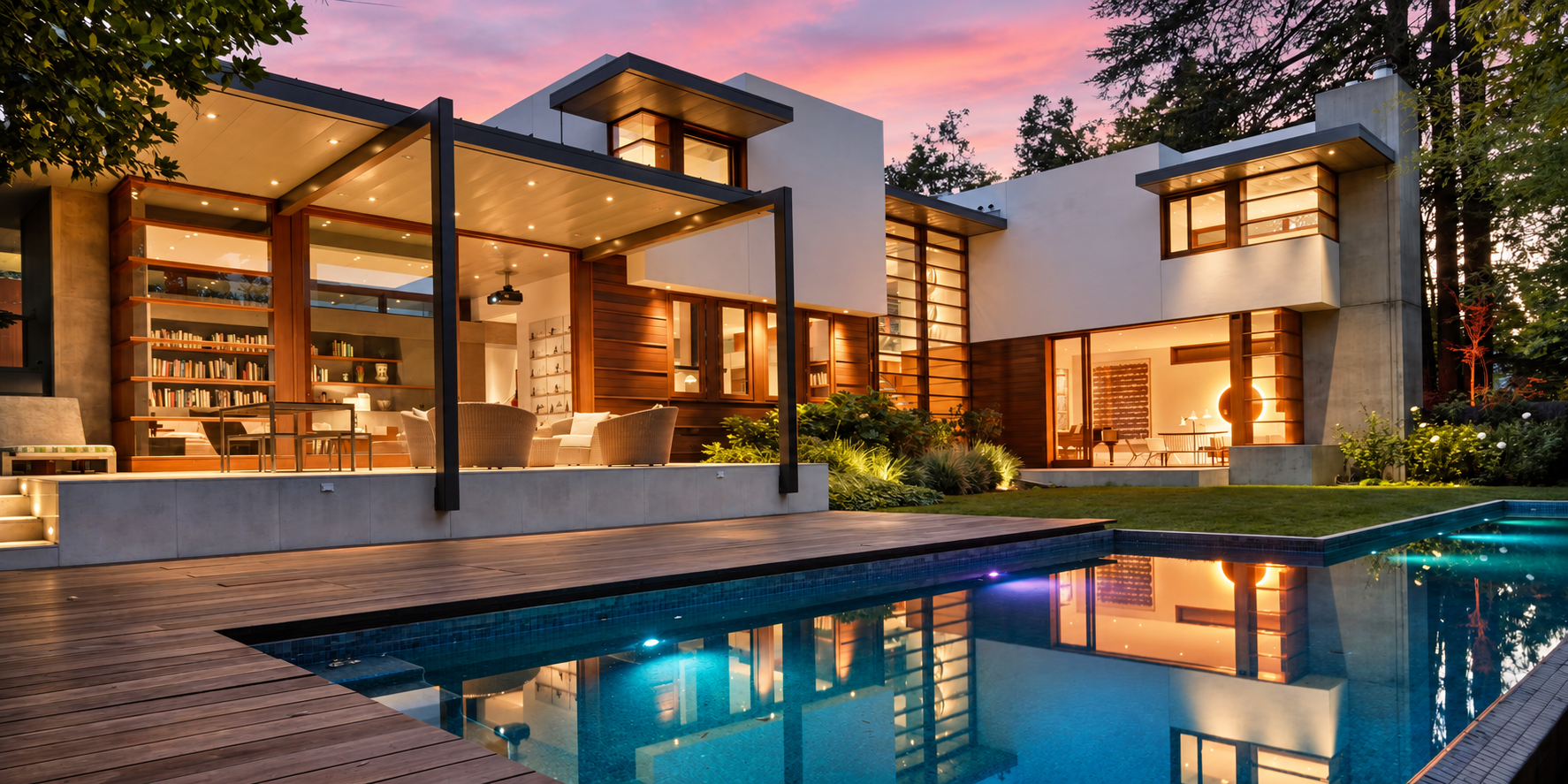
Quirky Architectural Mansion Asking $7.69 Million in Palm Springs Puts a Spin on Old Hollywood Glamour
The house channels mid-century modern style with numerous quirks, including a glass window backsplash in the kitchen and a floating office
By LIZ LUCKING
Wed, May 15, 2024 10:01am 2min
This Palm Springs home is on the market for $7.69 million. DESERT VIEWS PHOTOGRAPHY
An architecturally impressive abode in Palm Springs, California, that combines mid-century style with Old Hollywood glamour has hit the market for $7.69 million.
Despite appearances, the desert getaway was actually built in 2012, by Sean Lockyer of Studio AR&D. This marks the first time the home has been on the market since its creation.
Desert Views Photography
“The goal with this project was to blend modern elegance and iconic mid-century architectural techniques,” Lockyer said.
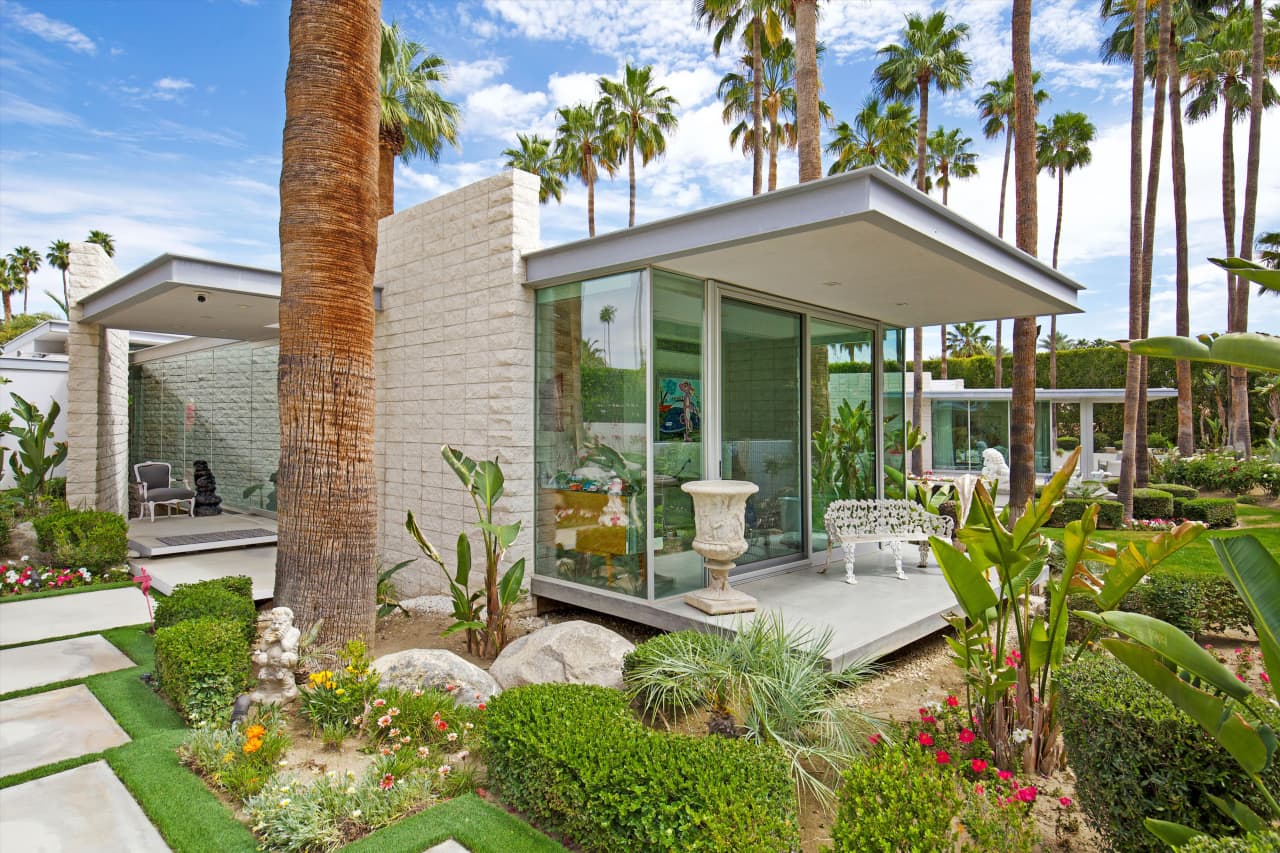
By implementing “classic mid-century nods like floor-to-ceiling expanses of glass, aggregate block construction and a cantilevered steel roofline, the residence is unable to be dated and could easily be misjudged in age,” he added.
Desert Views Photography
The heart of the 7,000-square-foot home is its glass-encased great room, complete with a recessed living area and a double-sided fireplace that extends through the glass walls and to the adjacent covered outdoor living space, according to the listing with Todd Monaghan and Keith Markovitz of TTK Represents of Compass, who brought the home to the market earlier this month.
The owners, who couldn’t be reached for comment, paid $700,000 for the underlying property in 2009, records with PropertyShark show.
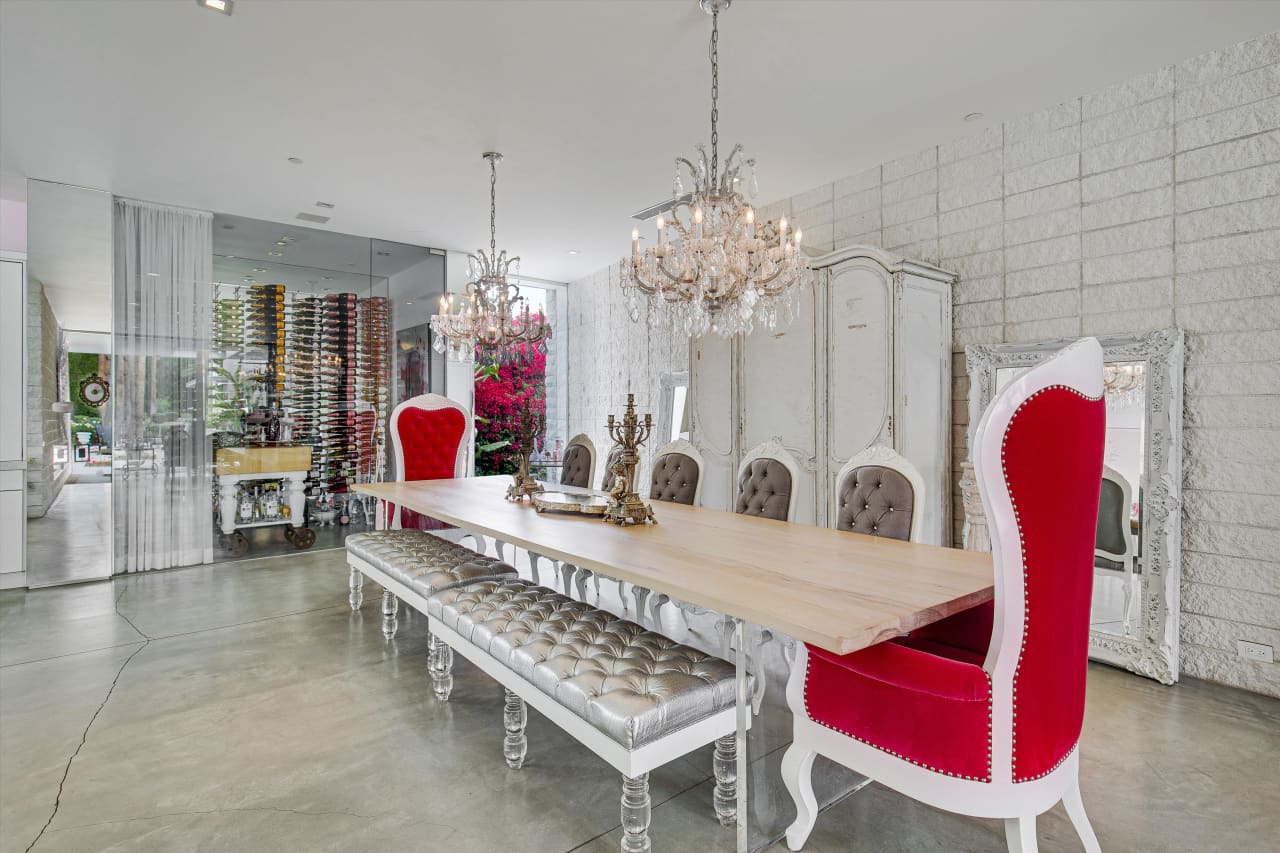
The single-story house also boasts an office that appears to hover over the ground, a media room, a wine room and an open kitchen that swaps the traditional backsplash with glass.
Desert Views Photography
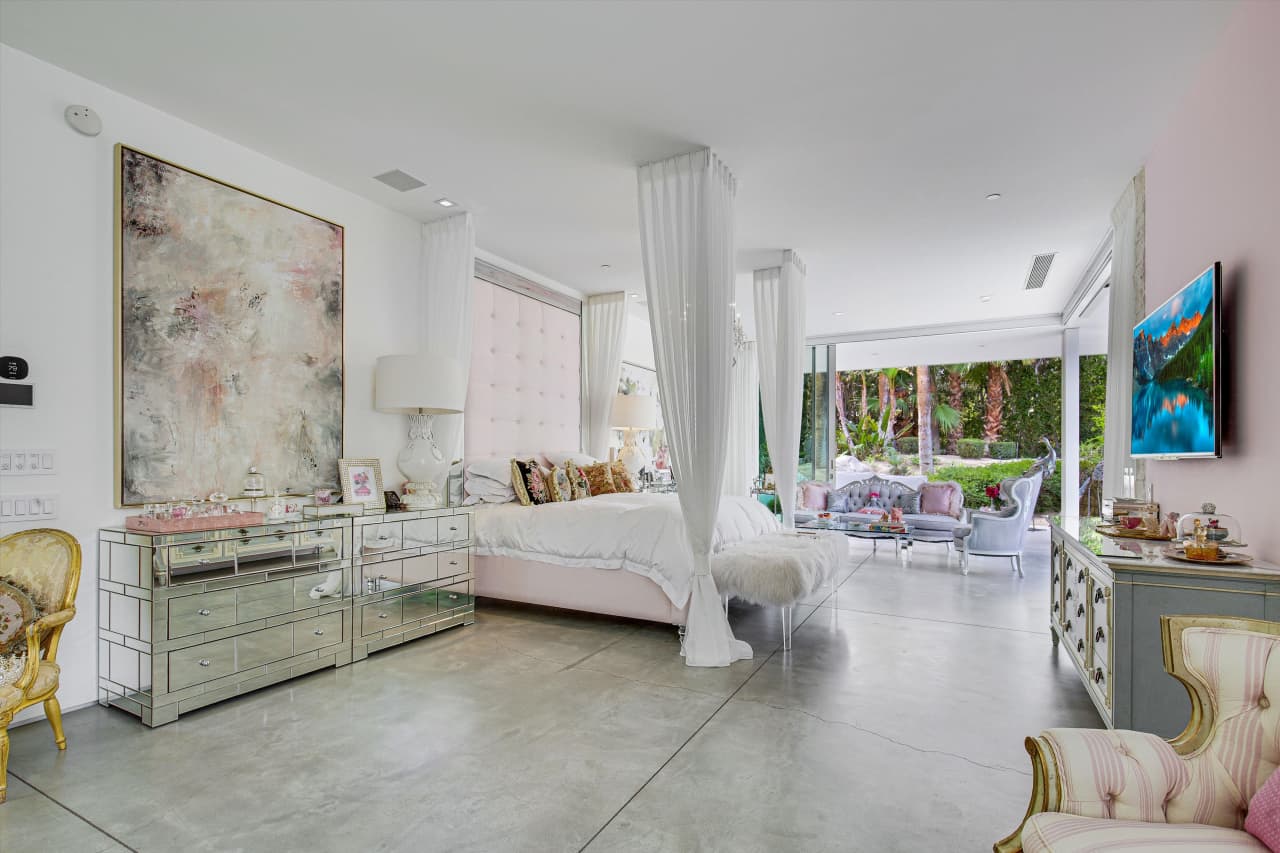
There are four bedrooms, including a primary suite that occupies an entire wing of the house, and the pool sits in the centre of the home, visible from nearly all angels.
Desert Views Photography
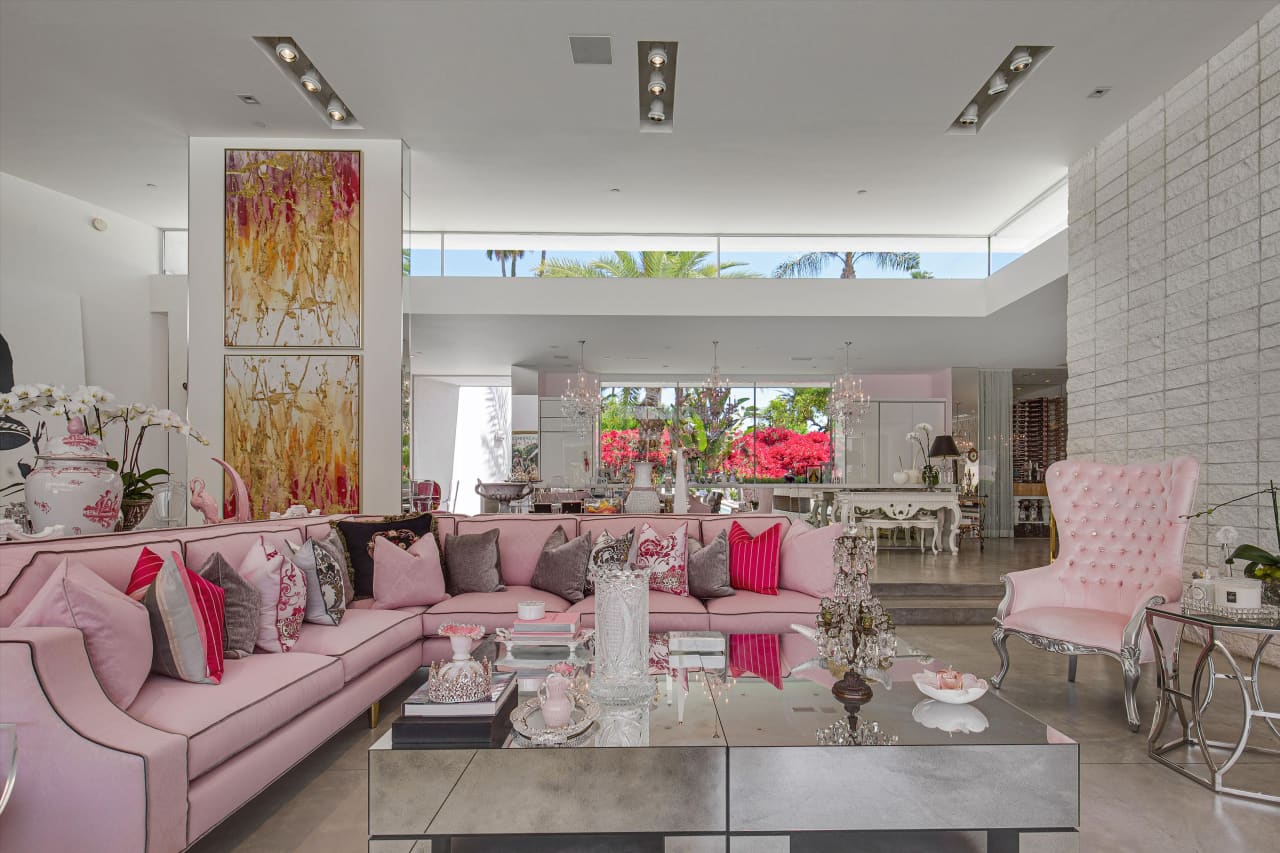
The interior design, meanwhile, takes inspiration from Hollywood Regency decor.
The property is “among the best homes I have experienced in Palm Springs,” said Markovitz.
Copyright 2020, Dow Jones & Company, Inc. All Rights Reserved Worldwide. LEARN MORE
The Australian leather house has opened an immersive four-day pop-up in Manhattan, unveiling its Bloom Collection and redefining what a product launch can look like.
Following the successful launch of its Palais Collection, MAISON de SABRÉ has unveiled a new modular handbag system offering more than 720 styling combinations.
Related Stories
Property
A Modern Home in Silicon Valley Lists for $44 Million
By E.B. Solomont 24/09/2026
Property
$8.1 billion, 10,000-home community set for Dubai neighbour Sharjah
By Ruba Jaajaa 21/09/2026
Property
The 60-Year-Old Real-Estate Agent Giving History Lessons on Instagram
A five-bedroom Palo Alto home designed by Steven Ehrlich is listed for $44 million, making it the city’s most expensive listing. Built around a dramatic concrete spine, the home features four courtyards and a pool.
By E.B. Solomont
Thu, Sep 24, 2026 3min
For years, tech entrepreneur Asher Waldfogel and his wife, Helyn MacLean, dreamed of building a modern house in Palo Alto, Calif.
The couple, however, worried about clashing with the Mediterranean-style architecture typically associated with their neighborhood of Old Palo Alto.
So they tapped architect Steven Ehrlich to create a design that paid homage to its surroundings with stucco, mahogany and titanium zinc cladding. They spent $20 million over several years building the house, completed in 2005.
Designed for indoor-outdoor living, the house has matching mahogany paneling and limestone both inside and out. Arthur Sharif/Sotheby’s International Realty
The dining room is between an outdoor garden and the staircase. Arthur Sharif/Sotheby’s International Realty
Now looking to be closer to their adult daughter on the East Coast, they are putting the five-bedroom home on the market for $44 million—the most expensive listing in Palo Alto.
Waldfogel is an angel investor who co-founded Redback Networks, a telecommunications-equipment company. MacLean previously had a career in fundraising.
The kitchen and family room open to the garden and pool. Arthur Sharif/Sotheby’s International Realty
Cast alcoves and mahogany shelves house the couple’s books and ceramics. Arthur Sharif/Sotheby’s International Realty
The couple purchased the roughly 0.4-acre site for $7.1 million in 2000 and demolished a circa-1930s Spanish Colonial home. The house they built pinwheels around a central staircase. It has 7,900 square feet of livable space, with four distinct courtyards and a pool.
A key feature of the home is a cast-in-place concrete wall, or spine, that is two stories high and about 80 feet long. “There’s a little bit of controlled chaos in what comes out of the form,” unlike a perfectly uniform surface, Waldfogel said. “If you want that, you do it in plastic.”
Ehrlich said it took a few tries to get the concrete wall right. Arthur Sharif/Sotheby’s International Realty
‘It’s a really hard material to tame,’ Ehrlich said of concrete. Workers learned as they went, and Waldfogel and Helyn grew to appreciate the imperfect material. Arthur Sharif/Sotheby’s International Realty
A central staircase is housed in a glass tower. Arthur Sharif/Sotheby’s International Realty
Waldfogel said he and his wife are thinking about the next phase of life now that their daughter is grown, although they have not decided where they will move. They also have a home in Sun Valley, Idaho.
“Right now we’re just trying to emotionally let go and decide what to do next,” he said.
Arthur Sharif/Sotheby’s International Realty
Two wings of the house are connected by horizontal planes. Arthur Sharif/Sotheby’s International Realty
Palo Alto, an epicenter of venture capital and tech startups in Silicon Valley, is home to some of the country’s biggest tech titans. Sales volume and prices are rising, with a median sale price of $3.5 million for the three months ending in August, up 5.8% year-over-year, according to real-estate brokerage Redfin.
Arthur Sharif of Sotheby’s International Realty—San Francisco Brokerage has the listing.



 2 min
2 min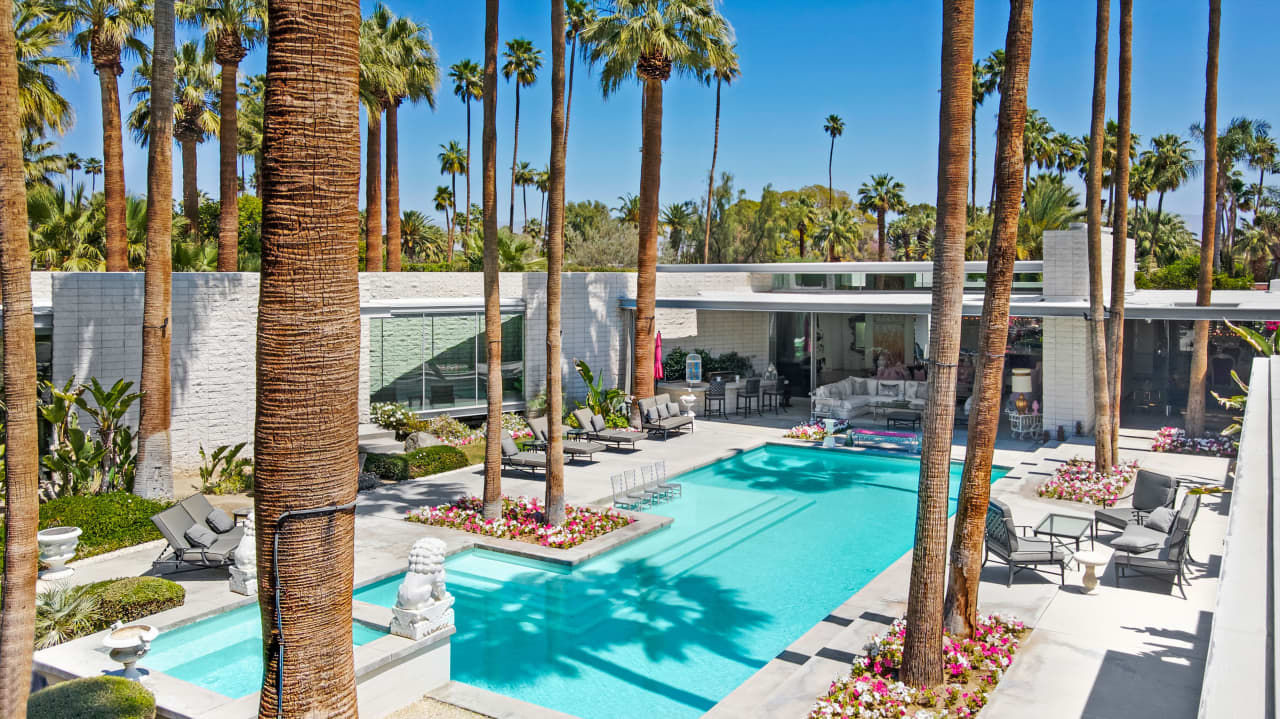
 Copyright 2020, Dow Jones & Company, Inc. All Rights Reserved Worldwide.