Eclectic House With a James Bond-Style Garage on the Portuguese Riviera Lists for €10 Million
The house, with a pool, a wine cellar and cinema, is in Estoril’s gated Quinto Patino community.
If you’re looking to run into Cristiano Ronaldo, this six-bedroom villa near the coastal Portuguese town of Cascais, where the footballer lives, might up your chances.
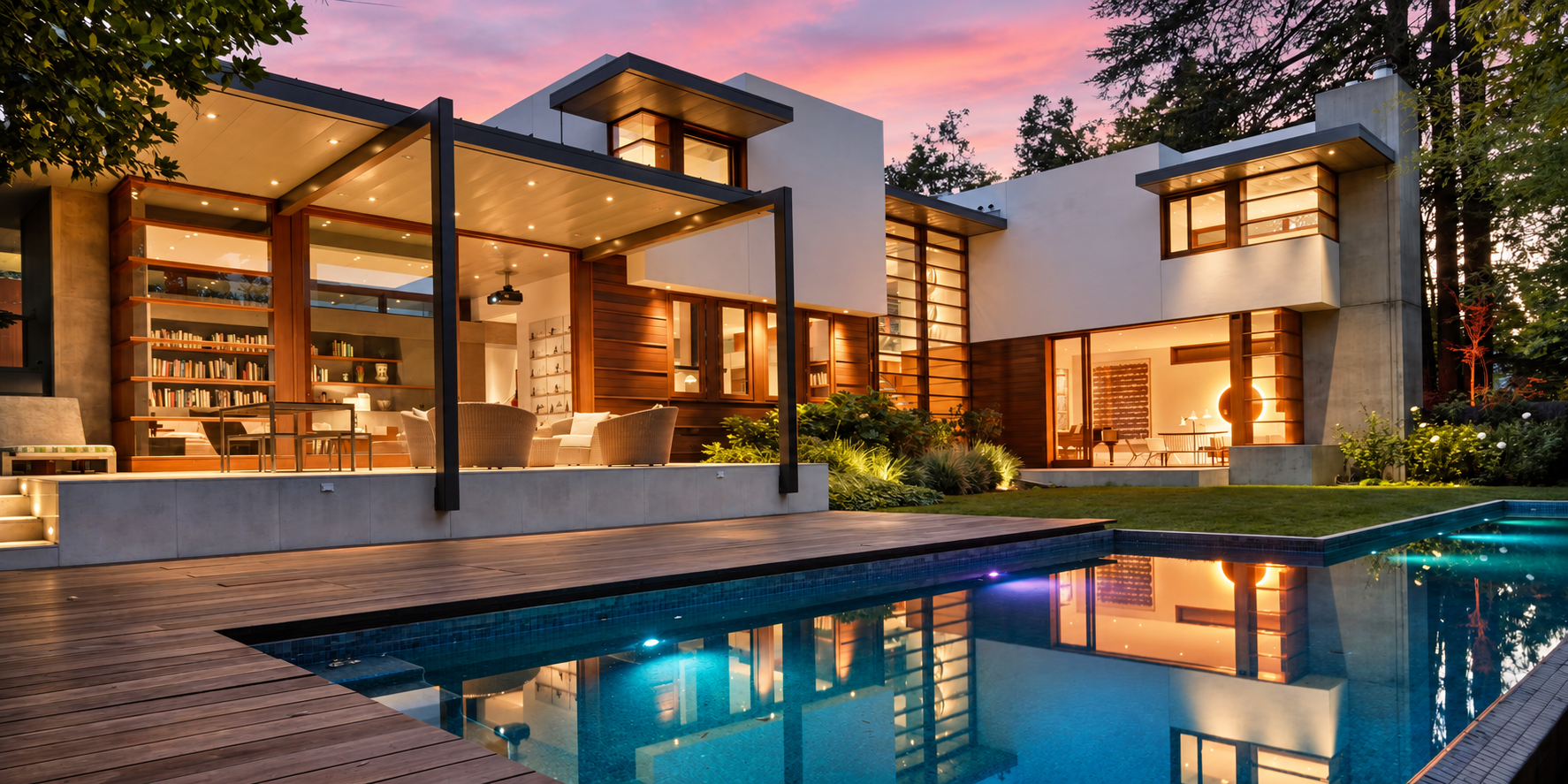
The detached home, which came to market earlier this month asking €10 million (US$11.79 million), is within the gated Quinta Patino community in the town’s Estoril suburb, and comes with a private green-tiled pool, its own wine cellar and cinema, as well as a moody six-car show garage.
The eclectic house comes with a little French flair, including a grey mansard roof, as well as arched windows and a cream-stucco facade.
The interiors showcase a mix of modern floor-to-ceiling windows as well as more old-school elegance, including black-and-white checkered flooring, extensive crown moldings, a wood-paneled library and classic columns in between arched windows.
There are six bedrooms across 7,000 square feet, as well as a wine cellar, game room, a pergola and easy transitions between the indoors and outdoors.
“This residence was created for the way people truly want to live, with light-filled spaces that flow naturally from the kitchen and dining areas out to the garden and pool,” said listing agent Yared Hagos of Nest Seekers International via email.
Cascais is located in the Portuguese Riviera, roughly 30 minutes from Lisbon, and features sandy beaches, resorts and other visitor attractions.
“This property represents the best of both worlds, complete privacy in one of Portugal’s most prestigious gated communities, and yet you’re just minutes from the beach, the golf courses, and Lisbon’s cultural scene,” Hagos wrote.
Cascais is also one of many Portuguese cities to have benefited from the popularity of the country’s real estate among foreign investors, particularly its high-end homes , according to Hagos. Mansion Global could not determine the identity of the seller.
“With six consecutive months of rising buyer demand and price growth now exceeding 15% annually, prime areas like Lisbon, Cascais and the Algarve are seeing international buyers compete for an increasingly scarce supply of high-end homes,” he said.
The Portuguese Riviera also has seen an influx of celebrities in recent years, including most notably, soccer legend Cristiano Ronaldo, Mansion Global previously reported.
Following the successful launch of its Palais Collection, MAISON de SABRÉ has unveiled a new modular handbag system offering more than 720 styling combinations.
Automobili Lamborghini and Babolat have expanded their collaboration with five new colourways for the ultra-exclusive BL.001 racket, limited to just 50 pieces worldwide.
Kit Braden, an executive at French beauty empire L’Occitane, has spent every winter for the past 13 years at the stone vacation home.
A historic Barbados estate with a 300-year-old villa and 11 acres overlooking the Caribbean Sea is now for sale with a guide price of $22.5 million.
The seller is Kit Braden, chairman of the U.K. branch of French beauty empire L’Occitane Group, whose family has spent every winter for the last 13 years at the island property, known as Fustic Estate.
“It’s very much a family house,” Braden said. “We love having a lot of people there. It’s a collection point to keep everyone together.”
The main villa dates to 1712, though it’s been reimagined and expanded substantially over the years.
It spans 13,000 square feet and features seven en suite bedrooms across three wings, as well as expansive verandas, stone courtyards and rows of louvered doors in gay Caribbean pastels.
In the 1970s, when the home was owned by Charles Graves—brother of British poet Robert Graves—it was reimagined by stage designer Oliver Messel, one of the foremost theater designers of the last century. Messel expanded the home, added a lagoon pool with a natural waterfall and other theatrical features, according to Braden.
“The whole place is a little bit magical,” he said.
The home sits about 350 feet above the water, and surrounded by lush gardens that slope towards the water.
“We look down through our garden—which is about 12 acres of tropical gardens and palm trees and wonderful old mahogany trees—onto the Caribbean,” Braden said.
He and his wife first saw the property on New Year’s Eve 2013, during a quick trip from where they were staying in Grenada.
The couple spent an hour walking the perimeter, some of it still untouched jungle, in the pouring rain.
“By the time we got back, I had fallen in love with it,” Braden said.
His wife, however, wasn’t so sure. But in Braden’s telling, a second visit in sunnier weather with two of their children brought her around.
“She had to be talked into that it was a jolly good idea; now she absolutely loves it,” he said.
When they bought the property, the edge that runs along the waterfront was a jungle, so they cleared the ridge and transformed it into gardens.
They also bought an additional sea-level parcel with two beach cottages, giving the property direct access to the water and the town below via a five-minute walk.
The property also has a 15-person staff, a reflecting pond, an outdoor pavilion suitable for yoga and a commercial grade kitchen that can serve more than 100 guests, according to a brochure from Knight Frank, which posted the listing in March. They did not provide further comment.
For Braden, the property is special because of its natural beauty, its proximity to the town of Saint Lucy and its history—which dates way way back to when the island of Barbados was first formed via tectonic activity.
“It was basically tectonic plates that collided about a million years ago so the seabed is the top of the hill,” Braden said. “We’re on coral rock.”
As a result, Fustic Estate includes an extensive network of caves that were likely used by the Arawaks, a Venezuelan fishing tribe that followed the fish to these islands about a thousand years ago.
“If the fish were good they’d camp here,” Braden said. “There’s evidence that they stayed there in those caves, they lived there in good winters.”
Now it’s someone else’s turn to live on the land shared by Arawaks, the plantation owners of 1712, Charles Graves and the Braden brood.