
Clearance Rates Hit New Highs In Sydney
With the median house price sold in the Harbour City tipping $1.6 million.
By Terry Christodoulou
Mon, Mar 1, 2021 4:31am < 1 min
< 1 min


With the median house price sold in the Harbour City tipping $1.6 million.
< 1 min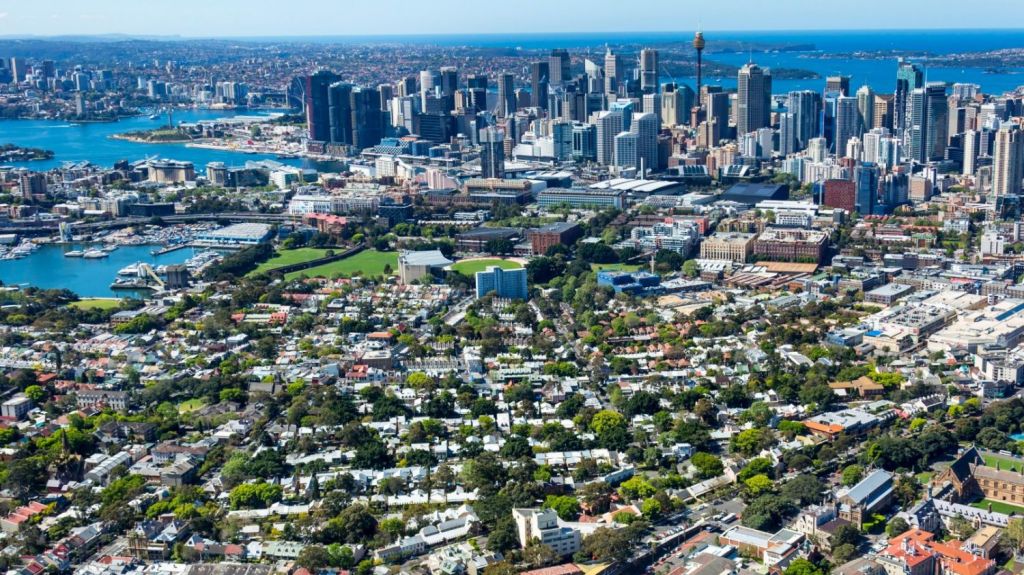
Covering off the last weekend of summer, clearance rates from around the country’s top markets were high this weekend, as Sydney reported a record weekend clearance rate of 90.0% – higher than the previous weekend’s 87.3% and the 85.8% reported for the same weekend last year.
Sydney recorded a median price for houses sold at auction on the weekend of $1,645,000, lower than last weekend’s $1,692,500 but 14.2% higher than the $1,440,000 recorded over the same weekend last year.
Sydney’s Central Coast, North West, Northern Beaches and Upper North Shore fared best, with the city’s West performing weakest with an albeit solid 82.1%. Units cleared slightly below that of houses at 88.9%.
Melbourne also continued to recover from its recent lockdown reporting its highest clearance rate for three weeks of 82.0%, higher than the previous weekend’s figure of 79.6% and the 80.4% reported over the same weekend last year with a median price of $1,002,500.
Encouragingly for Melbourne, auction numbers again increased sharply to 1211 compared to the previous weekend’s 1004. However, listing numbers have still fallen from last year’s figures of 1384 for the same weekend last year.
Sydney featured 734 auctions this weekend compared to last year’s 911.
Around the country, Brisbane saw a clearance rate of 73.4%, down from last week’s 83.0% but up on last year’s 65.8%. Adelaide was reasonably steady at 85% from last week’s 87.5% and up on last year’s 71.1% while Canberra was also consistent performing at 85.9% from last week’s 85.2% and up from 70.3.%
Data powered by Dr Andrew Wilson of MyHousingMarket.com.au
The Australian leather house has opened an immersive four-day pop-up in Manhattan, unveiling its Bloom Collection and redefining what a product launch can look like.
Following the successful launch of its Palais Collection, MAISON de SABRÉ has unveiled a new modular handbag system offering more than 720 styling combinations.
A five-bedroom Palo Alto home designed by Steven Ehrlich is listed for $44 million, making it the city’s most expensive listing. Built around a dramatic concrete spine, the home features four courtyards and a pool.
3 min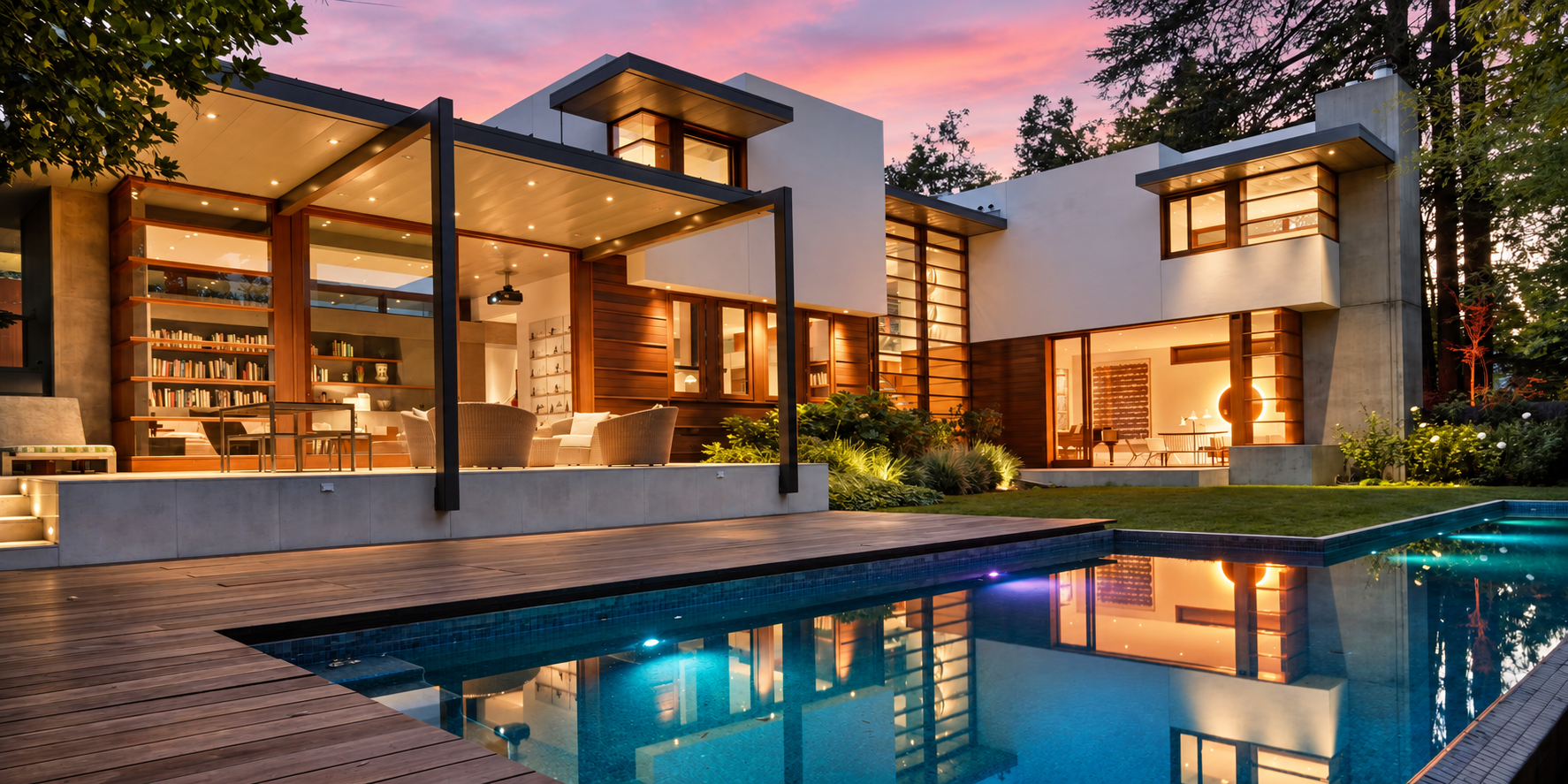
For years, tech entrepreneur Asher Waldfogel and his wife, Helyn MacLean, dreamed of building a modern house in Palo Alto, Calif.
The couple, however, worried about clashing with the Mediterranean-style architecture typically associated with their neighborhood of Old Palo Alto.
So they tapped architect Steven Ehrlich to create a design that paid homage to its surroundings with stucco, mahogany and titanium zinc cladding. They spent $20 million over several years building the house, completed in 2005.
Now looking to be closer to their adult daughter on the East Coast, they are putting the five-bedroom home on the market for $44 million—the most expensive listing in Palo Alto.
Waldfogel is an angel investor who co-founded Redback Networks, a telecommunications-equipment company. MacLean previously had a career in fundraising.
The couple purchased the roughly 0.4-acre site for $7.1 million in 2000 and demolished a circa-1930s Spanish Colonial home. The house they built pinwheels around a central staircase. It has 7,900 square feet of livable space, with four distinct courtyards and a pool.
A key feature of the home is a cast-in-place concrete wall, or spine, that is two stories high and about 80 feet long. “There’s a little bit of controlled chaos in what comes out of the form,” unlike a perfectly uniform surface, Waldfogel said. “If you want that, you do it in plastic.”
Waldfogel said he and his wife are thinking about the next phase of life now that their daughter is grown, although they have not decided where they will move. They also have a home in Sun Valley, Idaho.
“Right now we’re just trying to emotionally let go and decide what to do next,” he said.
Palo Alto, an epicenter of venture capital and tech startups in Silicon Valley, is home to some of the country’s biggest tech titans. Sales volume and prices are rising, with a median sale price of $3.5 million for the three months ending in August, up 5.8% year-over-year, according to real-estate brokerage Redfin.
Arthur Sharif of Sotheby’s International Realty—San Francisco Brokerage has the listing.


