Page 60 – Kanebridge News

FIRST IT WAS QUIET QUITTING, NOW WORKERS ARE FACING OFF WITH THEIR BOSSES

More and more Americans aren’t feeling great at work.

Half of workers aren’t engaged on the job, putting in minimal effort to get by, according to research by Gallup released Tuesday. Employee engagement in the U.S. declined for the second year in a row. There is also a growing share of the workforce that is disengaged, or resentful that their needs aren’t being met. In some cases, these workers are disgruntled over low pay and long hours, or they have lost trust in their employers.

“Employers are just not as in touch with employees,” said Jim Harter, chief workplace scientist at Gallup and lead author on the report. Some of the recent shift in attitude stems from workers having unclear expectations from their managers.

Workers’ frustrations have been building since 2021, after Gallup-measured U.S. worker-engagement levels hit their highest level on record in 2020. In the spring and summer of 2020, as Covid-19 spread and there was social unrest in the wake of George Floyd’s murder, executives at many companies had town halls and listening sessions with employees, communicating organisational mission and keeping workplace relationships strong.

This year, more companies are trying to bring workers back to offices as bosses fret about worker productivity and loyalty.

Gallup surveyed more than 60,000 people in the U.S. to compile the report, which has tracked Americans’ sentiment about their jobs since 2000, and says engaged workers are more productive and tend to stay at their jobs for longer.

“If you feel like your employer isn’t giving you what you need to do your work, you’re going to be much less loyal—and looking for other work,” said Harter.

The remote work divide

Gallup’s findings come amid backlash from workers, many of whom have recently stepped up protests against in-office requirements as companies change pandemic-era policies.

Workers at insurer Farmers Group called to unionise, and some pledged to quit after a new chief executive said he would require most workers to be in-office three days a week. Amazon.com workers demonstrated at lunch recently against a hybrid-work policy with three days in the office a week.

An employee’s relationship with a direct boss is more important to engagement than where people work, said Harter. One way to build these connections is for managers to have meaningful conversations with their employees, preferably at least once a week.

Working on trust

Many employees see shifts away from flexible schedules and remote work options as a signal that executives don’t trust them to do their jobs outside of the office. Others say benefits to remote work they experienced during the pandemic, including more time with family and cutting back commutes, are now critical to their happiness.

The employers making more in-office work a requirement are, in part, motivated by trying to bolster workers’ loyalty, which they correlate with longer retention, said Katy George, a senior partner and chief people officer at McKinsey & Co.

Kyle Pflueger, 34 years old, was hired in 2020 to work remotely as a product manager. He met his co-workers in person just a few times over the years and never felt fully connected to his work or colleagues, but as the breadwinner for his family, he needed the pay, retirement benefits and health insurance.

Pflueger left his full-time job this month to focus on his independent projects.

“I wasn’t feeling particularly happy with the work that I was doing,” he said. He now works full time for himself, building and maintaining websites for businesses.

Looking for less stress

Workers also said they were more stressed this year than last, according to Gallup’s survey. American workers are among the most stressed, tied with workers in Canada and parts of East Asia.

Workplace stressors include low salaries, long hours and a lack of opportunity for advancement, according to an October report from the U.S. Surgeon General. The report also warned that workplace stress can be bad for mental health, disrupt sleep and raise one’s vulnerability to infection.

Michele Spilberg Hart, who directs marketing for a Boston-area health nonprofit, said that she has told her staff to take time off when they aren’t feeling well mentally or physically. Their work isn’t life-or-death, and taking breaks can help people come back with more energy and better ideas, she said.

“They cannot do good work and be healthy if they’re not taking care of themselves first,” she said. “If you don’t take care of yourself, nobody else will.”

WE ASKED WORKERS WHY THEY’RE NOT COMING BACK TO THE OFFICE

What’s still keeping American workers out of the office?

At a time when restaurants, planes and concert arenas are packed to the rafters, office buildings remain half full. Thinly populated cubicles and hallways are straining downtown economies and, bosses say, fragmenting corporate cultures as workers lose a sense of engagement.

Yet workers say high costs, caregiving duties, long commutes and days still scheduled full of Zooms are keeping them at home at least part of the time, along with a lingering sense that they’re able to do their jobs competently from anywhere. More than a dozen workers interviewed by The Wall Street Journal say they can’t envision returning to a five-day office routine, even if they’re missing career development or winding up on the company layoff list.

Managers say they will renew the push to get employees back into offices later this year. The share of companies planning to keep office attendance voluntary, rather than mandatory, is dropping, according to a survey released in May of more than 200 corporate real-estate executives conducted by property-services firm CBRE, one of the largest managers of U.S. office space.

A battle of wills could be ahead. The gap between what employees and bosses want remains wide, with bosses expecting in-person collaboration and workers loath to forgo flexibility, according to monthly surveys of worker sentiment maintained by Nicholas Bloom, a Stanford University economist who studies remote work.

Escalating expenses

One reason workers say they’re reluctant to return is money. Some who have lost remote-work privileges said they are spending hundreds, or in some cases thousands, of dollars each month on meals, commutes and child care.

One supercommuter who treks to her Manhattan job from her home in Philadelphia negotiated a two-day-a-week limit to her New York office time this year. Otherwise, she said she could easily spend $10,000 a year on Amtrak tickets if she commuted five days a week.

Christos Berger, a 25-year-old mortgage-loan assistant who lives outside Washington, D.C., estimates she spends $2,100 on child care and $450 on gas monthly now that she is working up to three days a week in the office.

Berger and her husband juggled parenting duties when they were fully remote. The cost of office life has her contemplating a big ask: clearance to work from home full time.

“Companies are pushing you to be available at night, be available on weekends,” she said, adding that she feels employers aren’t taking into account parents’ need for family time.

Rachel Cottam, a 31-year-old head of content for a tech company, works full time from her home near Salt Lake City, making the occasional out-of-town trip to headquarters. She used to be a high-school teacher, spending weekdays in the classroom. Back then, she and her husband spent $100 a week on child care and $70 a week on gas. Now they save that money. She even let her car insurance company know she no longer commutes and they knocked $5 a month off the bill.

Friends who have been recalled to offices tell Cottam about the added cost of coffee, lunch and beauty supplies. They also talk about the emotional cost they feel from losing work flexibility.

“For them, it feels like this great ‘future of work’ they’ve been gifted is suddenly ripped away,” she said.

Parent trade-offs

If pandemic-era flexible schedules go away, a huge number of parents will drop out of the workforce, workers say.

When Meghan Skornia, a 36-year-old urban planner and married mother of an 18-month-old son, was looking for a new job last year, she weeded out job openings with strict in-office policies. Were she given such mandates, she said, she would consider becoming an independent consultant.

The firm in Portland, Ore., where Skornia now works requests one day a week in the office, but doesn’t dictate which day. The arrangement lets her spend time with her son and juggle her job duties, she said. “If I were in the office five days a week, I wouldn’t really ever see my son, except for weekends.”

Emotional labor

For some, coming into the office means donning a mask to fit in.

Kenneth Thomas, 42, said he left his investment-firm job in the summer of 2021 when the company insisted that workers return to the office full time. Thomas, who describes himself as a 6-foot-2 Black man, said managing how he was perceived—not slipping into slang or inadvertently appearing threatening through body language—made the office workday exhausting. He said that other professionals of colour have told him they feel similarly isolated at work.

“When I was working from home, it freed up so much of my mental bandwidth,” he said. His current job, treasurer of a green-energy company, allows him to work remotely two or three days a week.

Lost productivity

The longer the commute, the less likely workers are to return to offices.

Ryan Koch, a Berkeley, Calif., resident, went to his San Francisco office two days a week as required late last year, but then he let his attendance slide, because commuting to an office felt pointless. “I’m doing the same video calls that I can be doing at home,” he said.

Koch, who works in sales, said his nonattendance wasn’t noted so long as his numbers were good. When Koch and other colleagues were unable to meet sales quotas in recent weeks, they were laid off. Ignoring the in-office requirement probably didn’t help, he said, adding he hopes to land a new hybrid role where he goes in one or two days.

Jess Goodwin, a 36-year-old media-marketing professional, turned down an offer to go from freelance to full time earlier this year because the role required office time and no change in pay.

Goodwin said a manager “made it really clear that this is what they’re mandating right now and it could change in the future to ‘you have to be back in five days a week.’”

Goodwin, who lives in Brooklyn, N.Y., calculated that subway commutes to Midtown Manhattan would consume more than 150 hours annually, in addition to time spent getting ready for work.

Goodwin’s holding out for a better offer. She said she would consider a hybrid position if it came with a generous package and good commute, adding: “And I would also probably need something in my contract being like, ‘We’re not going to increase the number of days you have to come in.’”

The designer’s Mind: Delving into the Best Interior Design Books

There’s no shortage of design inspiration online but nothing beats the joy of spending an afternoon immersing yourself in a good interior design book. Edited, carefully curated and, above all, designed, these titles take you behind the scenes of some of the world’s most beautiful interiors in a considered way. Think of it like the difference between listening to a few tunes on Spotify versus releasing a thoughtfully crafted studio album. We’ve assembled our top six of interior design books on the market right now for your viewing and reading pleasure.

1. Interiors beyond the primary palette

Arent & Pyke: Interiors Beyond the Primary Palette : Arent & Pyke, Arent, Juliette, Pyke, Sarah-Jane: Amazon.com.au: Books

Step inside the world of award-winning interior design duo Juliette Arent and Sarah-Jane Pyke in this, their first compendium of their work. A ‘best of’ over more than 15 years working together, it’s a masterclass in working with colour and pattern as seen through 18 projects from around the country. With a focus on the idea of home as sanctuary, this hefty tome offers insight into the mind of the designer with points on where to find  inspiration, meeting client briefs and the importance of relationships. Thames & Hudson, $120

2 House of Joy

House of Joy - Playful Homes and Cheerful Living - gestalten EU Shop

If there was ever a book title for our times, then this is it. With a subtitle of Playful Homes and Cheerful Living, this book champions fun in interior design, with bold and bright homes from around the world to delight and inspire. While there’s a good dose of the unexpected, like a disco ball in the garden, there’s no mayhem in these spaces. Instead, they’re beautifully executed to tempt even the most colour shy. Gestalten, $105

3. Abigail Ahern Masterclass

Abigail Ahern's Masterclass :HarperCollins Australia

Some design books are beautiful to look at, and that’s it. This is not one of those books. A master of colour and pattern, UK designer Ahern offers a practical foundational guide to beautiful interiors, mixing form with function in her latest book, Masterclass. Find the inspiration you need to create a gorgeous home. HarperCollins, $65

4. Interiors Now!

Looking for a visual crash course in international design trends with longevity? This is the book for you. Featuring homes across the globe, from New York to Auckland via Avignon, the biggest dilemma for readers is settling on a style. Many of the projects are owned by designers and creatives, lending a dynamic edge to this tome, now in its 40th year. Taschen, $50

5. Home by the Sea

Home by the Sea, The Surf Shacks and Hinterland Hideaways of Byron Bay by Natalie Walton | 9781743798256 | Booktopia

For many Australians, the ocean holds an almost hypnotic appeal. Home by the Sea by Natalie Walton lets you imagine, for a little while at least, what it’s like living the dream in a beach shack in Byron Bay. The book tours 18 homes in and around the region and the hinterland owned by artists, designers and makers. With photography by Amelia Fullarton, it champions the good life. Hardie Grant, $60            

6. The Layered Interior

The Layered Interior - Greg Natale

Released last year, this is the third volume from award-winning interior designer Greg Natale. Different in format from his earlier books, the eight projects featured are Australian but with a slight Euro-centric focus. The writing is conversational, almost intimate, inviting the reader into the most luxurious spaces beautifully captured by photographer Anson Smart. This coffee table tome is perfect for dreamers and doers alike. Rizzoli, $110


How can I improve my interior design knowledge?

To be an interior designer, most people have completed a bachelor’s degree or advanced diploma. However, anyone can improve their interior design knowledge by listening to or reading about the design process, as well as taking short courses in design from a reputable design school. Look for online tutorials or interior design books that provide step-by-step guides to creating beautiful spaces and follow interior design social media accounts to get you started. If you want to learn more, you can contact industry bodies such as the Design Institute of Australia for next steps.


What should I read for interior design?

While interior design is often considered a visual medium, there is a lot to understand about the way spaces flow and the balance of materials required. If you have a casual interest, look for design books that appeal to your personal style, which will offer tips on using colour, pattern and texture. For further information, opt for books explaining the main principles of interior design which will discuss questions of balance, scale and proportion, as well as form and function.


Can I teach myself interior design?

In an age where information on most topics is widely available online, yes, you can teach yourself the rudimentaries of interior design. However, a reputable course or degree will provide you with set tasks to test your knowledge and skills before going out into real world experiences. There are several options to qualify as an interior designers, including university and TAFE courses, as well as private colleges.


Best Floor Lamps for Modern Living: Embrace Contemporary Illumination

It’s that time of year when getting off the lounge seems like way too much effort. Instead, a comfortable chair, a good book and a warm beverage beckon. Making sure your living space works, whether you’re looking to create zones within an open plan, or you want to read without straining your eyes, depends on your choice of lighting. As well as being up to the task to create mood and function, these floor lamps make a style statement. We’ve selected the best, from classic designs to timeless contemporary to ensure your living areas are inviting, as well as inspiring.


Tote Standing Lamp

Tote Floor Lamp - Tide Design - Tide Design - Handmade Furniture

The classic shapes of the Tote standing lamp by Tide Design have been given a clean, contemporary feel with the added warmth of natural timber. It’s the perfect shape for those who love tradition with a side of biophilic design. Available in three timbers, from $1,430 from Workshopped.


Foscarini Twiggy floor lamp

Twiggy Floor Lamp White by Marc Sadler for Foscarini | Replica Lights

Made from coated fibreglass , coated metal and aluminium, the impossibly flexible Foscarini Twiggy floor lamp is ideal over lounges and cosy corners. From a design perspective, it breaks up strong lineal shapes associated with modular sofas. Plus, it creates pools of light perfect for zoning, $2,885 from Space.


Cliff 02 Lamp

Cliff 02 Lambert&Fils Floor Lamp - Milia Shop

The tripod base of the brass and black matte Cliff 02 lamp from the Lambert & Fils workshop adds extra stability with a contemporary edge. A study in minimalism, the brass finishes deliver a jewel-like finish to the supporting rods, $4,380 from Living Edge.


Copenhagen SC14 Lamp

Copenhagen SC14 Floor Lamp – Cult - Design First

Perfect for creating visual warmth on cold nights, the Copenhagen SC14 lamp by &Tradition emits a soft ambient light with the control of a dimmer option and opal glass shade, $2,448 from Cult


Alma Lamp

Visual Comfort Kelly Wearstler Alma Floor Lamp — Oscar and Mila

US designer Kelly Wearstler’s stunning Alma lamp has the solidity of a white marble base and the allure of an antique burnished brass base. The cylindrical head of the pharmacy floor lamp can rotate 20 degrees left or right to best direct light, $2,079 from Montauk Lighting.


Tonone Bolt 2 Arm Floor Lamp

This lamp is right at home in any room in the house, from the living room to the kids’ bedrooms. Adjustable at two points to allow a change of height, as well as direction, it has a steel base and rods with an aluminium shade. It’s also available in a range of colours suitable for contemporary or traditional interiors, $1100 from Mondopiero.

What light is best for living room lamps?

Lamps are an ideal way to create a sense of warmth in your living room but it’s critical to choose the right light bulbs to avoid your spaces looking like a convenience store. The colour temperature of lights are measured in Kelvins, with 2700k-3000k considered warm and 4000k-5000k considered cool light.


How much should you spend on a floor lamp?

The good news is floor lamps are available at a wide range of price points. Like most furniture, however, you get what you pay for. Prices for a reasonably good floor lamp start from $200 up to $5000 or more. Ensure it has at least a 12-month warranty.


What type of floor lamp gives off the most light?

This will depend on the type of lightbulb you use, as well as the style of lamp shade. Light intensity is measured in lumens and watts. A standard 40w lightbulb emits 450 lumens, while a 60w bulb emits 800 lumens. LED (light emitting diodes) lights output the most light in the most energy efficient way. A wider lampshade design will allow the light to extend its reach.

HOW AI WILL CHANGE THE WORKPLACE

Artificial intelligence has been affecting how we work for some time—helping to craft job postings and evaluate applications, judging how efficiently we complete jobs and, for gig workers, determining assignments and pay.

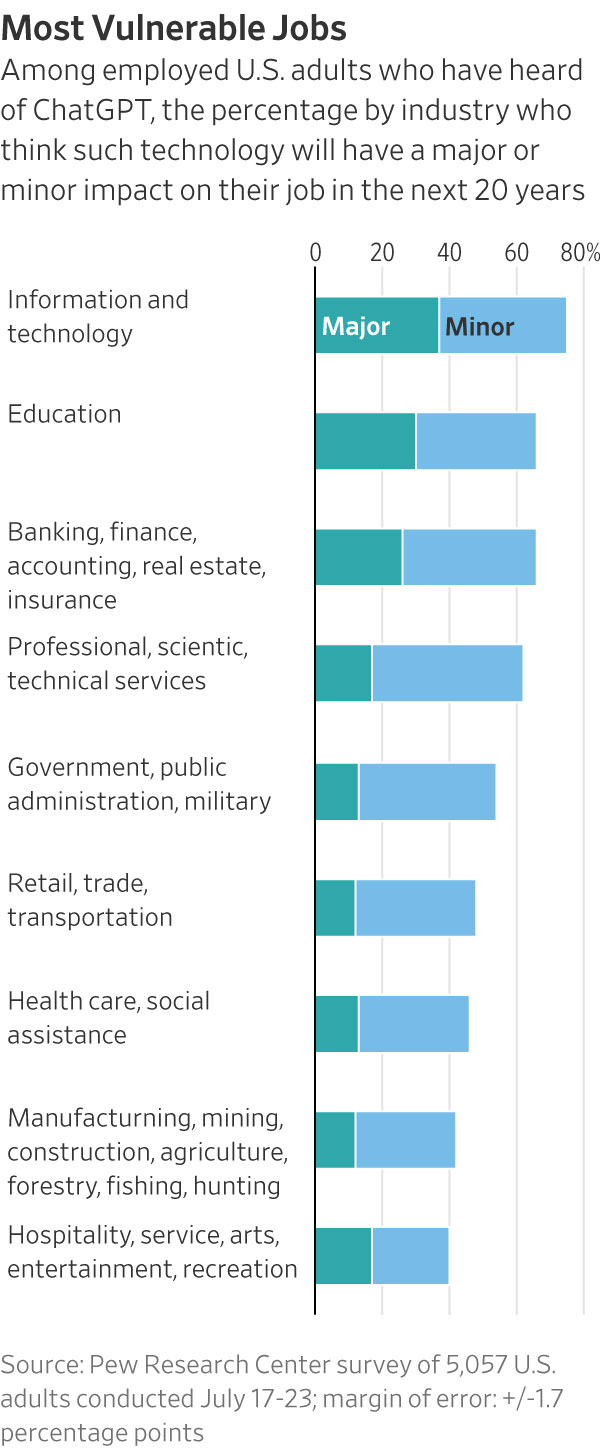
But in the past year, and especially the past six months, generative AI has supercharged the potential of technology to help, hinder or reorient how we work. Visual tools like DALL·E 2 and Midjourney may drastically change graphic design. Large language-model text generation, beginning in earnest with the release of ChatGPT, promises to affect every activity that involves touching a keyboard.

To learn more about how the worlds of work and AI will interact, we spoke with experts in computer science, human resources, recruiting, corporate leadership, psychology and more. Here are some of their predictions.

Automating ideas

AI will continue the current process of automating parts of workers’ jobs. But while today’s automation is often described as applying to dull, dirty and dangerous tasks such as moving parts in a factory or warehouse, generative AI brings a new dynamic: Primarily, it supports knowledge work by providing the ability to create first drafts of documents, emails, presentations, images, video, product designs, etc.

So, knowledge workers might spend more time editing than creating, particularly as generative AI is embedded into all the software products they use today. For instance, instead of an email system just typing ahead a few words, it could draft several paragraphs. Customer-relationship-management software could suggest topics to discuss with a sales prospect and even a script to follow. And a salesperson could describe a presentation in natural language, and draft slides could be created, accessing corporate data and images to fill out details.

But there are some GenAI applications where the potential to have transformative impact really comes to the fore: For example, in research and development, some experiments using generative AI to support writing software code have shown very high levels of increasing productivity. But that doesn’t mean we’ll need a lot fewer software engineers, because the world needs more software. Generative AI also has the potential for improving the productivity of contact centres. There already were technologies that could automate interactions with customers; generative AI has the potential for making these interactions feel much more natural.

—Michael ChuipartnerMcKinsey Global Institute

Flatter organisations

Artificial intelligence is likely to flatten many organisations due to its ability to automate work activities. Right now, most organisations have entry-level people who perform routine tasks, midlevel individuals who supervise them and high-level employees who set the direction of the organisation.

That organisational structure will no longer be necessary. AI can automate many of the tasks performed by entry-level workers. Accounting features, purchase orders and job requisitions are already being automated, and workplaces no longer need people who manually compile or analyse information.

As generative AI becomes more widely deployed, even more tasks will be automated. In addition, job supervision and assessment won’t need as much human oversight. Customers can rate employees on how well they perform basic tasks and allow people to get the services they want. Using data analytics and AI, companies can use the responses to weed out low-performing workers and reward their top individuals. The end result will be fewer layers of management and a smaller number of employees overall in the organisation.

—Darrell Westsenior fellow, governance studiesBrookings Institution

How human are we? Machines will tell us

In the past, managers turned to software to judge workers on technical matters—counting keystrokes or time away from the screen. Now companies are using machines to judge how much empathy their employees show.

I was recently sent a “management tip of the day,” advice on how to prepare for a job interview conducted by an artificial intelligence—a process that is all too common these days. A good score required that I appear “natural” with the machine, defined as injecting “authenticity and humanity to the interview.” It seemed a through-the-looking-glass request. A machine would be judging me on qualities that only human beings can exhibit.

The AI judgments don’t end with interviews. It is increasingly common for corporations to use AI programs to monitor employee empathy on the job. For instance, in call centres, AI programs coach and score workers on an empathy scale to judge their performance with callers.

With the addition of ChatGPT to a full suite of office products, texts, emails and calls, there is no limit to the interactions that may be judged by pretend-empathy machines. They will pretend to understand jealousy, competition, depression and insecurity, all the messy human feelings that come up in the life of a firm.

When machines test us on how we respond to such human complexities, high scores may go to those who exhibit qualities that machines value most—consistency and a bias toward tidying up what seems messy. Those who don’t stack up may lose their jobs.

It is backward thinking: Technology redefines human empathy as what machines can understand. Having built the machines that will judge us, now we will train ourselves to please the machines.

—Sherry Turkleauthor and Abby Rockefeller Mauzé Professor of the Social Studies of Science and TechnologyMassachusetts Institute of Technology

A threat to ethics

We are already seeing the rise of digital assistants that speak with a human voice and can use human appearance and social intelligence to negotiate disputes, brainstorm business strategies or conduct interviews. But our research illustrates that people may act less ethically when collaborating via AI.

Traditionally, teammates establish emotional bonds, show concern for each other’s goals and call out their colleagues for transgressions. But these social checks on ethical behaviour weaken when people interact indirectly through virtual assistants. Instead, interactions become more transactional and self-interested.

For instance, in typical face-to-face negotiations, most people follow norms of fairness and politeness. They feel guilt when taking advantage of their partner. But the dynamic changes when people use an AI to craft responses and strategies: In these situations, we found, people are more likely to instruct an AI assistant to use deception and emotional manipulation to extract unfair deals when negotiating on their behalf.

Understanding these ethics risks will become an active focus of business policy and AI research.

—Jonathan Gratchprofessor of computer scienceUniversity of Southern California

An edge for the aged

AI will enable older workers to be seen, even by those with ageist eyes, as young again.

Younger adults tend to excel at work that uses fluid intelligence that involves analysis and solving discrete problems quickly. Older workers are thought to exhibit greater crystallised intelligence—the capacity to leverage experience and knowledge gained over years to quickly see patterns, nuance and emotional insights, and the capacity to determine which problems should be addressed and which are just noise.

AI is likely to provide a kind of augmented intelligence to older workers, enabling experienced professionals to fully leverage their talent and skills.

For example, AI will be an invaluable collaborator with physicians, speeding the collection and organisation of critical information such as patient symptom history, genetic profiles, medication interactions, as well as past successful treatment plans for similar conditions, etc. These systems will enable physicians of all ages to gather information quickly, but older doctors will be better equipped to apply their years of experience and knowledge to validate AI diagnoses and treatment recommendations.

AI will be more than a collaborative assistant to older workers. It will also be a valuable coach. The sheer growth and velocity of knowledge and technology is making training and upskilling essential. Unfortunately, many employers don’t invest in older-worker education. Now AI applications are being deployed in workplace education to address individual learning and knowledge gaps, helping older workers remain current and competitive.

—Joseph F. Coughlindirector of AgeLabMassachusetts Institute of Technology

Navigating new tech

Today, most organisations suffer from a “digital dexterity gap,” where the workforce is largely unable to keep pace with fast-changing technology. Organisations have more technology than their employees are comfortable using, creating barriers to efficiency and productivity growth.

AI services strip away complexity. By using conversational interfaces and natural-language processing, AI removes the need for workers to master complex computer functions and menus. People simply describe what is needed, in nontechnical language, and refine their requests to get better output.

An employee, for example, could give an AI historical data and say, “Find and rank all the variables that will determine the market potential for this new product.” Before conversational interfaces were developed, getting the information would require a lengthy and complex series of interactions.

—Matt Cainvice president and distinguished analystGartner

An opportunity for building talent

As AI takes over routine tasks, there will be a temptation to cut the whole tier of entry-level employees: Summarising documents, answering routine emails, writing basic computer code and solving simple logistical challenges are all tasks that AIs can do about as well as an inexperienced human, and at much lower cost.

But employers still need an on ramp for new hires. If you stop hiring entry-level employees, you’ll have to do all your midlevel hiring from outside the organisation. And if every organization pares back on entry-level hires, it will get harder and harder to find experienced midcareer talent anywhere.

That’s why it pays to cultivate your own long-term talent pool by hiring green employees, but rethinking how they are tasked and trained. Instead of piling your juniors with grunt work and trusting that they’ll learn through observation, assign them more challenging tasks, like drafting reports instead of just summarising them—the explosion in AI research and writing tools means that kind of work is now well within the grasp of inexperienced hires. With more active coaching and mentoring, these green employees can grow into valuable colleagues, much more quickly.

—Alexandra Samueldigital-workplace speaker and co-author of “Remote, Inc.”

The danger of following blindly

So many jobs involve writing standard responses—thank-you notes to customers, responses to job applicants and unfortunately term papers—that AI is instantly and easily used in almost every white-collar role.

The concern isn’t that the responses produced aren’t original or creative. How creative does a performance appraisal need to be? It is that if ChatGPT writes the report, the “author” hasn’t thought about it, hasn’t weighed the arguments and then come to their own conclusions in the text. They cannot explain to someone why the report says what it does, but they now have to live with its conclusions.

What happens when the ChatGPT report fails to include proprietary information that you could have found if you searched yourself, and it changes the conclusions? How do we explain to a subordinate why the appraisal written by ChatGPT gave them a lower score compared with last year, even though their performance seemed to be the same? The temptation to use it without thinking through the arguments and explanations could lead to big mistakes.

—Peter Cappelli and Sonny Tambeprofessor and associate professorWharton School of the University of Pennsylvania

Big-picture thinking

Workers are already using ChatGPT to craft the perfect Facebook ad or tools like Descript to edit videos, but AI will get incorporated in more upstream work. AI will be in the boardroom, brainstorming sessions and planning meetings.

Imagine an AI system that runs global simulations and impact analyses for 5,000 different budget plans. Or an AI that proactively writes new code for you when it discovers that you have a bottleneck in your sales planning. Or a proxy AI trained on customer research that allows you to have simulated conversations with your target market. We’re moving from task-oriented AI to goal-oriented AI, and enterprises are looking to leverage it safely, securely and ethically.

—Allie K. MillerAI entrepreneur, adviser and investor

Money management and the human touch

Many asset-management companies are now offering hybrid advisory services—involving both human advisers and algorithms—to their clients. But these new services are unlikely to reduce the demand for human advisers.

Instead, automation is expanding the market for financial advisers by making it more cost effective to serve clients with lower levels of wealth. Human advisers can now cater to more clients, since certain tasks, such as addressing simple customer queries and constructing portfolios, can be automated. As a result, asset managers are now hiring more human advisers instead of laying them off.

In addition, the requirements for a financial adviser’s success are changing. As more portfolio management is turned over to algorithms, technical portfolio-allocation skills are becoming less significant. However, it is becoming more important for advisers to explain how algorithms operate and assist investors in navigating turbulent market conditions. Our research shows that human advisers are still essential for customer satisfaction and retention because of their ability to reduce clients’ discomfort from interacting with algorithms and reducing clients’ uncertainty regarding the algorithms’ performance.

—Alberto Rossifinance professor and director of the AI, Analytics and Future of Work InitiativeGeorgetown University

Navigating the corporate-benefits maze

AI-powered “concierge” systems will reduce or eliminate the frustrating search for answers that many employees endure today when seeking services from their employer. These systems will help employees make the most of their benefits, stay compliant with policies or simply find out information about their colleagues, organisation structure or customers that can sometimes be difficult to unearth in large organisations. When do my health benefits renew? What is my current deductible? What is the policy for meal expenses in New York?

What’s more, in the hybrid work environment, AI-driven concierge tools will book conference rooms, optimise the location of colleagues in the office so they can better collaborate, and help office managers manage capacity and services.

—Joe AtkinsonU.S. chief products and technology officerPwC

Don’t forget human judgment

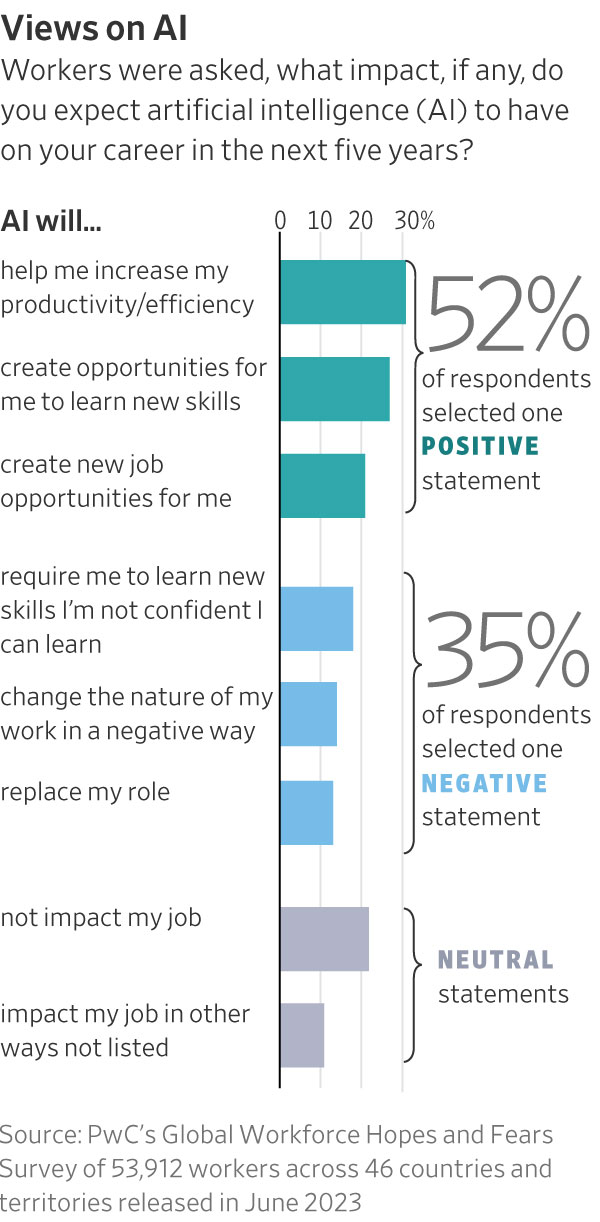
At its best, AI will drive better collaboration and productivity. It will help employees turn notes into documents and documents into presentations. Yet human judgment is key to unlocking AI’s power. Our data reveals that only around half of employees believe they know when to question the results of automation or AI—the other half don’t think they have that skill. But generative AI is already known to hallucinate—make up false facts—and employees who blindly follow its outputs risk failing.

So, companies must equip employees with the skills and inclinations needed to successfully use AI. Rather than acting on the AI’s meeting summary alone, employees must understand that talking to human colleagues who attended the meeting isn’t optional. They must also learn to proofread AI-produced text, confirming cited facts with outside sources. And governance structures must ensure that AI-produced content always includes a human in the loop before it is used.

—J.P. Gowndervice president and principal analystForrester

Machines get into human resources

The emergence of AI tools and data analytics is transforming the way organisations discover, assess and select talent. If trained with the right data, AI models can also compare candidate profiles to a company’s most successful employees, identify professionals with a proven record and determine who is most likely to consider a job change.

For example, for certain roles, high performers’ profiles include a broad range of skills that are relevant to multiple roles, while for other functions, optimal skill sets are much more narrow and specific. Our data indicates that the comparison of a candidate’s skills to those of high performers produces the most predictive indicator of future success, particularly on contract jobs.

Also, AI models can be further enhanced by incorporating individual performance data for employees or contractors who have previous experience with an employer. There is a wealth of such data available to talent solutions firms that employ hundreds of thousands of contractors annually.

Ultimately, though, it is important to think of AI as a tool—not a substitute—for the human art of recruiting. Assessing and selecting talent requires insight about a candidate’s communication skills, attitude and determination level and what it takes to succeed.

—M. Keith Waddellpresident and CEORobert Half

A productivity boost

Early research suggests that while generative AI is likely to boost the productivity of all workers, it may benefit low-skilled workers more. A randomised field experiment by Microsoft reported that generative AI enabled a 55% decrease in average task-completion time for software developers, with the most benefit for older developers and those with less programming experience. Similarly, a study from MIT reports that ChatGPT’s use in professional writing raises average productivity and quality for low-ability workers more than their high-ability peers.

In an ongoing experimental study with M.B.A. students who were tasked with writing business reports, I found that ChatGPT’s availability not only increased productivity but also student satisfaction. More students expressed a desire to write when a tool like ChatGPT was available. In short, the impact of generative AI might not just be a general increase in productivity but also a narrowing of the productivity gap between low-skilled workers and high-skilled ones.

—Kartik HosanagarJohn C. Hower ProfessorWharton School of the University of Pennsylvania

A tool for hackers

It is the classic email scam: An employee receives a bogus note that appears to be from their manager, telling them to transfer funds to some account. For this to be convincing, the attacker needs to access the company’s computer systems to learn about the firm and the target, including their personal details.

AI makes this scamming much easier—and more dangerous.

By getting access to companies’ internal emails and nonpublic reports, hackers can use AI to generate very convincing messages. For example, the message might start with: “Fred, it was great to have dinner with you and your wife last Wednesday, we should do that again. Meanwhile, I need you to…”

Or how about a phone call or videoconference with your boss? Deep fakes make it possible to imitate the voice and even the image of your manager.

AI may also lead to smaller and smaller targets for scams. If it takes lots of manual labor to create customised spear-phishing emails, it is not worth it for hackers to cheat people out of $100. But if AI makes it trivial and cheap to create phoney emails, no one is too low on the totem pole to be ignored.

All this raises the level of skepticism that we must have substantially. Procedures will have to be put in place to validate the authenticity of who you are dealing with. In many cases, a phone call might be sufficient. A somewhat deeper approach might be a phone call to the boss’ administrative assistant, in addition to a boss—a bit like doing multifactor authentication on the computer. In extreme cases, a face-to-face meeting might be necessary.

—Stuart Madnickprofessor of information technologiesMIT Sloan School of Management

Spotting the skill gaps

AI helps organisations build for the future by automatically detecting employee, team and organisation wide skills—and identifying ways to address gaps before management is even aware of them.

For roles like nurses, software developers and marketers, necessary skills are constantly changing, and it can be tough for organisations to keep track of what is needed. Nurses, for instance, must become familiar with an ever-increasing number of tech platforms, as well as data analysis to help patient outcomes.

As these needs evolve, AI can help keep track of what skills organisations need and predict what they might need next. For instance, a business could use AI to scan job descriptions in its industry to look for trends. The AI might notice that lots of marketing jobs now require employees to understand new types of analytics—and your employees must understand them, too, or miss out on important strategic insights.

—Mahe BayireddiCEO and co-founderPhenom

WHAT EVERYONE—EXCEPT THE US—HAS LEARNED ABOUT IMMIGRATION

Migration to affluent countries is at record highs, and some nations short of workers are overcoming political opposition to open their borders even wider, hoping to fill jobs and ease inflation.

Government actions to attract foreign nationals for skilled and unskilled jobs have spread from Germany to Japan and include countries with longtime immigration restrictions and some with a populist antipathy to streams of foreign workers.

The U.S. remains an outlier. Hundreds of thousands of migrant workers have arrived through back channels, but the country isn’t openly welcoming more legal workers, despite the tight labor market. That hesitancy carries economic costs, including persistent worker shortages and wage inflation, according to economists and some U.S. officials.

Unemployment is at a record low 4.8% across the 38 largely affluent countries that make up the Organization for Economic Cooperation and Development. These and other nations report a long list of open positions from truck drivers to baggage handlers to miners.

Beyond being needed to fill pandemic-driven labor shortages, migrant workers are in demand to fill the gap left by retiring baby boomers and declining populations, economists and Western officials say. “The labor forces of richer countries are hollowing out,” said Michael A. Clemens, an economics professor at George Mason University.

Governments across affluent countries are balancing the economic need for more workers with the political reality that very few electorates are enthusiastic about high levels of immigration.

In Europe and North America, the working-age population is expected to decline from 730 million to 680 million over the next two decades, according to United Nations estimates. Such places as South Korea and Taiwan stand to lose more than half their workforce over the coming decades. The working-age population in sub-Saharan Africa, meanwhile, will increase by 700 million by 2050, according to U.N. projections; in Latin America and the Caribbean, the U.N. estimated an increase of 40 million by midcentury.

For many wealthier countries, labor surpluses abroad are hard to resist. The global labor imbalance, in effect, is driving foreign workers into the open arms of nations that need them.

Around five million more people moved to affluent countries last year than left them, up 80% from pre pandemic levels, according to a Wall Street Journal data analysis. The Journal examined 10 countries that received most of the migration, including the U.S., Germany, the U.K., Canada, Australia and Spain. Migration experts say it is the highest number ever reported. That total includes about two million refugees from Ukraine. Even excluding that surge, net migration was significantly higher than 2019 levels, according to the data.

Germany is rewriting immigration laws to bring in more college graduates as well as blue-collar workers under a new points-based system. Points will be awarded based on age—younger people receive more—educational qualifications, work experience and German-language competency. Canada announced plans late last year to take in nearly 1.5 million more migrants by 2025. Western Australia recently sent a delegation to the U.K. and Ireland to recruit tens of thousands of workers, including police, mechanics and plumbers.

South Korea plans to admit 110,000 low-skill foreign workers this year to work in industries such as farming and manufacturing, up nearly 60% from last year’s quota. Japan, which is opening new visa paths for high-skilled foreign workers, announced in April plans to offer blue-collar workers—including those at factories and farms—a chance to extend their stay and even bring their families. Both countries have been longtime skeptics of immigration.

Spain amended its laws last year to allow more foreign workers from outside the European Union to fill blue-collar jobs left open by a shrinking working-age population. José Luis Escrivá Belmonte, Spain’s minister of inclusion, social security and migration, estimated that his country will need to add 300,000 foreign workers a year to keep the economy running and support the national pension system.

Spain’s unemployment rate is 13% and has been around that level or higher for 15 years. Mr. Escrivá said unemployed Spaniards tended to be age 50 or older and not necessarily suited to fill open jobs needed in sectors such as agriculture, construction or film production.

José Antonio Moreno Díaz, an official at Spain’s Trade Union Confederation of Workers’ Commissions, which represents over a million workers, including migrants, said training opportunities for higher-paying jobs should be offered to citizens. “We are not against bringing in real needed foreign workers,” he said. “But let’s pay attention to unemployed people in the Spanish labor market.”

Opponents in various countries warn of citizens losing jobs to outsiders willing to work for less money. Some say the cost of providing newcomers with healthcare, education and other public services outweighs the economic benefits, especially for low-skill workers who pay little in taxes.

Others argue that such immigration is a quick fix that slows economies in the long term.

“Labor shortages are very healthy,” said Mikal Skuterud, an economics professor at University of Waterloo in Ontario, Canada. “They force employers to use existing workers more efficiently and invest in technology, that’s all good stuff.”

Finland and Greece are building hundreds of miles of new land barriers to prevent illegal migrant crossings. In Italy and Sweden, voters recently elected governments with a more restrictive approach to immigration, and both are planning reforms to slow both legal and illegal migrant arrivals.

More jobs, higher pay

The U.S. hasn’t made any significant immigration reforms in 33 years, and the last serious attempt in Congress dates back a decade or more. Few issues are so politically divisive in Washington, making any chance of a policy overhaul seem unlikely, according to immigration experts.

Despite restrictive immigration policies, migrants seeking work in the U.S. are finding jobs more quickly and at higher pay than at any time in recent memory. Tens of thousands of people crossed into the U.S. from Mexico illegally and were arrested over the past 10 days, while some 20,000 were detected by various forms of surveillance but not caught, the U.S. Border Patrol chief wrote on Twitter.

In the U.S., the limit on H-1B visas available for highly skilled workers has changed little since 1990. Presidential administrations over the past 15 years have clamped down on illegal border crossings without creating new legal immigration pathways, prompting more urgent discussions about immigration policy and the labor shortage, said Giovanni Peri, chairman of the economics department at the University of California, Davis where he directs the Global Migration Center, whose recent research favours more immigration.

U.S. Border Patrol agents made a record 2.2 million arrests along the Mexican border in the 2022 fiscal year, up from 1.65 million arrests in 2021. The migrant crossings were driven, in part, “because the U.S. economy is screaming out for their labor,” said Mr. Clemens, the economist.

New channels have recently opened. More than 300,000 Ukrainian refugees entered the U.S. since Russia invaded Ukraine last year, many through a Biden administration program called Uniting for Ukraine. That number is more than the total number of refugees admitted into the U.S. through legal channels over the previous seven years. In North Dakota, energy companies are tapping Ukrainians to fill jobs in the Bakken oil fields.

Around 450,000 migrant refugee workers—largely from Afghanistan, Ukraine, and Latin America—entered the U.S. legally in 2021 and 2022 and are working under temporary government protections in industries with labor shortages, according to an April report by FWD.us, a pro-immigration think tank. Those workers are estimated to have filled about a quarter of total job openings this year in such industries as construction, food services and manufacturing, the report said.

The labor shortage is pushing inflation in affluent countries where employers, competing for workers, are raising wages to hire and keep them. “I do think more migrant workers would reduce the inflation rate,” said Spencer Cox, the Republican governor of Utah, which has a 2.4% unemployment rate, slimmer than even the U.S. rate of 3.4%.

Gov. Cox and Republican Gov. Eric Holcomb of Indiana, which is also short of workers, want to rally other governors in a long-shot proposal for Congress to give states a measure of authority over legal immigration.

The U.S. and other countries are divided about how to limit illegal immigration while keeping a pathway for a flow of potential employees for various industries. A plurality of Americans think the U.S. should admit fewer migrants, according to recent Gallup polls.

To gather bipartisan support for increased legal immigration, especially for skilled workers, Utah Gov. Cox said the government needs to demonstrate better control over the U.S.-Mexico border. “Scenes of tens of thousands of migrants streaming across the border in a way that could threaten national security,” he said, “make it harder to have that higher-level conversation.”

Learning the ropes

Mathias Senn, a butcher in Germany’s wealthy Black Forest region, posted job ads in newspapers and online, seeking to replace four of 10 employees who were preparing to retire. “There were no interested people,” he said. “Nothing at all.”

Last year, Mr. Senn hired an apprentice from India, taking advantage of a new law that allowed businesses to hire unskilled people from outside the EU. Local business associations are helping hundreds more workers arrive from India. India’s unemployment rate is around 8%, compared with about 3% in Germany.

Mr. Senn’s 22-year-old apprentice, Rajakumar Bheemappa Lamani, makes about 940 euros a month, around $1,020, while learning the ropes. Mr. Lamani said it was difficult to save money because of the high cost of living, but he hoped to stay.

Mathias Senn, right, a butcher in southwest Germany, and his apprentice Rajakumar Bheemappa Lamani from India. PHOTO: DOMINIC NAHR FOR THE WALL STREET JOURNAL

Germany needs to add around half a million immigrants a year in the next decades as the baby boomer era draws to a close, said Herbert Brücker, head of migration research at the Institute for Employment Research, a federal agency. “We have in Germany about two million vacancies, an absolute peak historically,” he said.

Young people in Germany aren’t interested in manual work, said Joachim Lederer, a butcher in Weil am Rhein, a town of 30,000 by Germany’s borders with France and Switzerland. His son, who studied and worked at the University of California, Berkeley, and Cornell, is a professor of mathematical statistics.

Mr. Lederer recently hired an apprentice from India who had studied computer science, and he has anointed a young Italian immigrant to take over the butcher shop when the time comes.

The U.K. added a record half-million new migrants in the year ended June 2022, even after exiting the EU, which made it more difficult for EU citizens to obtain visas.

Alan Manning, former chair of the U.K. Migration Advisory Committee, which consults government officials on immigration policy, said people accepted the idea of allowing foreign workers if their skills are needed. But some “get anxious about immigration when they perceive it to be out of control,” he said.

Amjed Nizam, a Sri Lankan design engineer trained in Hong Kong, looked for an exit overseas when Sri Lanka’s economy imploded last year. The 29-year-old discovered a new U.K. program that grants two-year work visas to recent graduates of top universities, even without a job offer.

U.K. authorities approved Mr. Nizam’s online application within three weeks, he said. He arrived late last year, found a job with a broadcasting company and now lives in London with his wife and daughter.

Paul Papalia, a government minister in Western Australia, said the region desperately needs workers in both public and private sectors to serve the mining industry, which is booming from global demand for battery-powered vehicles that rely on locally mined lithium, cobalt and nickel.

Mr. Papalia led a delegation in March to pubs and other spots in the U.K. to try to lure as many as 30,000 British workers with the prospect of better salaries and sunny weather. Nearly 70,000 job seekers expressed interest so far, including 1,100 applications to join the police force, he said.

Only about a fifth of Australians supported more immigration, according to a poll last year by the Lowy Institute, a nonpartisan think tank in Sydney. Mr. Papalia said voters in his state nonetheless support his recruitment efforts. “They ask, ‘Where are the people who are going to help us build our house?’ ”

WHY REMOTE WORK COULD LEAD TO LESS INNOVATION

Do chance encounters among employees of different Silicon Valley companies in coffee shops, restaurants and other public places lead to innovation? The answer is yes, say researchers who examined such “knowledge spillovers” in a study that may have implications for today’s work-from-home culture.

The researchers—Keith Chen of the University of California, Los Angeles, and David Atkin and Anton Popov of the Massachusetts Institute of Technology—tracked the locations of 425,000 phones using commercially available cellphone-location data. Though the data is anonymous and linked only to the unique ID number of each phone, the researchers surmised where the phone owners worked by looking at where the phones spent large parts of the workday, using a map of buildings occupied by Silicon Valley companies that have filed patents.

Examining instances where phone owners went outside the office and ended up near someone from another Silicon Valley company, they found 218 million episodes in which two workers from different companies were in the same place between September 2016 and November 2017.

For their study, they considered only situations in which both people were near each other for at least a half-hour, and used a probability technique to eliminate meetings that might have been arranged in advance. They also assumed that many of these people bumped into someone they already knew, such as a former colleague.

Sharing knowledge

Such chance meetings “may spark a conversation that leads to a transfer of knowledge or a collaboration,” the researchers wrote.

Next, the research team pulled up patent applications filed by the companies of the employees. Such applications list relevant patents from other companies in so-called patent citations. Patent citations are “one measure of which firms are influencing each other and how firms are sharing ideas,” says Prof. Chen, who studies behavioral economics and strategy at UCLA’s Anderson School of Management.

The researchers then worked backward in time. They looked for places where employees of a patent-filing company may have crossed paths with workers from companies cited in the patent application.

“We rewind the clock to a year before when they would have been developing this technology,” says Prof. Chen. “What school were they dropping their kids off at, what mall were they shopping at, what bar do they frequent. And you infer who was at that bar when they were there,” based on the phone-location data.

The goal, Prof. Chen says, is “to connect workers of the firm that is going to file the patent, at the establishment where we infer that patent was innovated, with what other workers they were interacting with.”

Next, the researchers calculated the overall number of such citations that appear to have been linked to unplanned encounters. The upshot: The researchers say that without these encounters, there would have been about 8% fewer cross-firm patent citations in the period covered by the phone-location data.

“There is a tremendous correlation between my workers’ meeting a lot with your workers, and my workers’ citing your workers’ patent,” says Prof. Chen.

The innovation boost from the encounters, by the team’s calculations, is about twice as large as a similar effect found by other research that looked for knowledge transfer based on whether two companies’ offices are near each other, Prof. Chen says.

Their study comes with some caveats. The researchers don’t know whether these employees actually spoke when they were in the same location, or, if they spoke, what they talked about. And they don’t know whether the workers’ jobs would have facilitated a tech discussion—they might have involved a Google HR staffer and an Apple maintenance person.

Still, the report shines a light on what some experts have long suspected: that random conversations involving people in similar industries can increase innovation.

Enrico Moretti, an economics professor at the University of California, Berkeley, says the study “significantly advances our understanding of knowledge spillovers and how they shape the geography of innovation.” Prof. Moretti, who says he has been working on the topic for 25 years, says, “I find this paper to be one of the most direct and convincing pieces of evidence on this question. It provides important insights into why Silicon Valley-style clusters of innovation exist.”

Remote work’s impact

Though the study involved cellphone data from before Covid, the researchers say it has implications for an era when many people work all or part of the time from home.

The researchers looked at people who occasionally worked from home in the study period, based on where their phones were located during daytime hours, and then at how that affected their probability of attending planned or serendipitous meetings with someone from another company who didn’t work from home, Prof. Chen says.

Looking at two hypothetical companies, the researchers extrapolated that if one-half of employees at each business work from home, their meetings of all types—serendipitous and planned—would fall 35% and patent citations between the companies would decline almost 12%.

“We think this means information exchange between firms is decreasing,” Prof. Chen says. “It is worrying. These businesses co-locate for a reason. If they can’t learn from each other, we think that is a big deal.”

“Presumably,” he adds, “an even bigger effect is the harm that it does to serendipity and flow of information and innovation within the firm.”

BUFFETT AND MUNGER ON SUCCESS, TOXICITY AND ELON MUSK

The question was a philosophical one: How should you avoid major mistakes in business and life?

Warren Buffett, the 92-year-old chairman and chief executive of Berkshire Hathaway, paused briefly.

“You should write your obituary and then try to figure out how to live up to it,” Mr. Buffett said. “It’s not that complicated.”

At Berkshire’s annual shareholder meeting on Saturday, an event that draws thousands to Omaha, Neb., each spring, Mr. Buffett and his longtime business partner, Charlie Munger, spent hours weighing in on topics as varied as the recent banking turmoil to artificial intelligence and the future of the U.S. As is typical at such gatherings, the executives also doled out plenty of advice on management practices, career choices and how to enjoy a good life.

In prior years, Mr. Munger has heaped scorn on consultants, compensation specialists and what he described as make-work activities inside U.S. companies. This weekend, he directed his ire at wealth managers.

“Having a huge proportion of the young and brilliant people all going into wealth management is a crazy development in terms of its natural consequences for American civilisation,” Mr. Munger said. “We don’t need as many wealth managers as we have.”

He added: “I don’t think a bunch of bankers, all of whom are trying to get rich, leads to good things.”

Mr. Buffett, for his part, said he wanted to see greater accountability inside banks, saying that the recent crisis in the industry illustrated why executives and board members should face consequences if a business encounters problems.

“If the CEO gets the bank in trouble, both the CEO and the directors should suffer,” Mr. Buffett said. “You’ve got to have the penalties hit the people that cause the problems, and if they took risks that they shouldn’t have, it needs to fall on them if you’re going to change how people are going to behave in the future.”

Over hours of questions from investors and others, the two billionaires often peppered their answers with recommendations on how to navigate business. Mr. Buffett advised that people pay attention to how others might try to manipulate them.

He also encouraged those in attendance to resist the temptation to criticise or vilify others.

“I’ve never known anybody that was basically kind that died without friends,” Mr. Buffett said. “And I’ve known plenty of people with money that have died without friends.”

Mr. Munger said that success comes from steering clear of toxic people.

“The great lesson of life is get them the hell out of your life—and do it fast,” Mr. Munger said.

When hiring some of his top leaders over the years, Mr. Buffett said he has tried to suss out someone’s talents and not focus on whether they attended a prestigious institution.

“I have never looked at where anybody went to school in terms of hiring,” Mr. Buffett said. “If somebody mails me a résumé or something, I don’t care where they went to school.”

One of Mr. Buffett’s top lieutenants, Ajit Jain, studied at Harvard Business School, “but he isn’t Ajit because he went to those schools,” Mr. Buffett said.

Mr. Buffett graduated from the University of Nebraska-Lincoln and later studied under the legendary value investor Benjamin Graham at Columbia University. Mr. Munger, who is 99 years old, studied mathematics at the University of Michigan and meteorology at the California Institute of Technology, and went on to earn a law degree from Harvard University.

On artificial intelligence, Mr. Buffett said he had been impressed at generative AI’s abilities to summarise legal opinions and potentially take on other tasks, though he said he also worried about its potential consequences. “It can do all kinds of things, and when something can do all kinds of things, I get a little bit worried because I know we won’t be able to uninvent it,” Mr. Buffett said.

Mr. Munger said he was skeptical of some of the hype around artificial intelligence. “I think old-fashioned intelligence works pretty well,” he said.

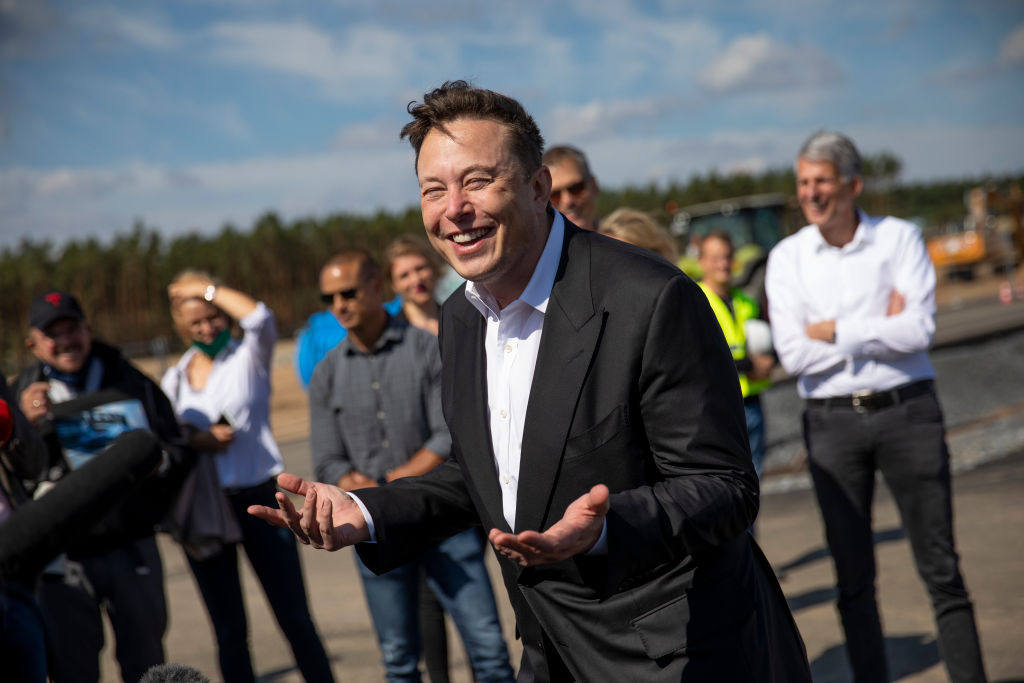
Near the end of the meeting, an audience member asked the two billionaires to weigh in on Elon Musk, the SpaceX and Tesla CEO who took control of the social-media platform Twitter last year.

Mr. Buffett called Mr. Musk a “brilliant, brilliant guy,” who had a much different approach in dreaming about the future than the Berkshire executives. Mr. Buffett has often said he takes a hands-off approach to managing Berkshire’s subsidiaries, which range from the insurer Geico to the restaurant chain Dairy Queen. Mr. Musk is known for weighing in on the details at his companies.

“He would not have achieved what he has in life if he hadn’t tried for unreasonably extreme objectives,” Mr. Munger said of Mr. Musk. “He likes taking on the impossible job and doing it. We’re different: Warren and I are looking for the easy job.”

Mr. Buffett said he didn’t want to compete against Mr. Musk, to which Mr. Munger added: “We don’t want that much failure.”

Mr. Musk tweeted Saturday that he appreciated the “kind words from Warren & Charlie.”

UNDERWHELMING CHINESE STOCK MARKETS SHOW CONCERN OVER RECOVERY

One mystery in global markets this year is that while China’s economy appears to be rebounding strongly, its stock market hasn’t been doing as well.

The MSCI China index has risen only 1.8% so far this year, underperforming many of the major markets. The S&P 500 index, for example, has gained 7.7%. Stocks listed in Shanghai and Shenzhen have done a bit better—the CSI 300 index has gone up 4.9% in 2023. That seems to be in contrast to the rebounding economy, after China scrapped its strict “zero-Covid” pandemic restrictions in December and scaled back its regulatory crackdown on its technology companies.

China’s gross domestic product grew 4.5% from a year earlier in the first quarter and, more significantly, consumption has also come back strongly: retail sales jumped more than 10% in March from a year earlier. Crowds were everywhere in Chinese scenic spots in the recent five-day “Golden Week” holiday. Total domestic trips during the holiday rose 19% from the same period in 2019, according to official figures. Tourism revenue also recovered to pre pandemic levels.

Of course, the rally in Chinese stocks late last year already priced in a big part of the recovery. The MSCI China index surged 34% in the last two months in 2022, after rumours of reopening started to circulate.

Yet earnings growth so far has been disappointing. For nearly 80% of Chinese listed companies that have reported their first-quarter results, profits only grew an average 1% year on year, with around 69% of them having missed consensus earnings estimates, according to Goldman Sachs. About 77% of A-share shares—companies listed in Shanghai and Shenzhen—revised down their earnings guidance for 2023, according to Bank of America.

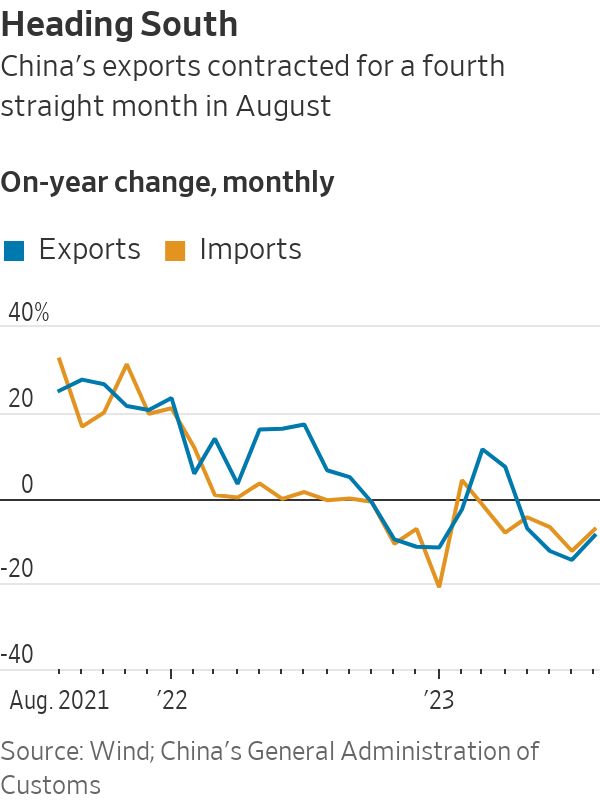
Earnings growth will likely improve ahead, especially against a lower base last year, when lockdowns across the country battered the economy. The struggling housing sector also seems to have stabilised. But a big question that remains is how long the consumption bounce could last. The export sector may suffer with a potential recession looming in the U.S. and Europe. China’s job market, especially for younger workers, is still quite weak. That partly explains why investors have jumped back into shares of state-owned enterprises—a more stable choice in an uncertain time.

Chinese stocks have rebounded substantially from their lows last year, but are still way off their peaks in early 2021, when China appeared to have avoided the worst of the pandemic. A more sustained market recovery would require a more broad-based revival of earnings growth.

A MANSION IN HONG KONG’S EXCLUSIVE PEAK NEIGHBOURHOOD POISED TO SET A PRICE RECORD

A new mansion in an exclusive Hong Kong neighbourhood known as The Peak is said to have an offer for HK$1.2 billion (US$153 million) from a mainland Chinese buyer. If the deal goes through, the sale will translate to HK$255,000 per square foot, a record for a residential property in Asia.

The mansion, located on Barker Road, the same street as Alibaba founder Jack Ma’s HK$1.5 billion mansion, has 4,700 square feet of living space across four levels and features sweeping views of Victoria Harbour and city skylines, according to Chinese-language daily Hong Kong Economic Times (HKET).

The mansion was built on the site of a Grade II-listed, Spanish-style villa, known as Villa Blanca. The villa was owned by Hong Kong businessman Haking Wong, most famous for his commercial optical products, for nearly two decades from 1978 to 1998.

CSI Properties acquired the villa in 2011 for HK$200 million, and paid another HK$103.2 million four years later to expand the site, according to the public filings.

The developer began marketing the mansion earlier this year. A buyer from mainland China has offered HK$1.2 billion and the deal is expected to close soon, HKET reported, citing market sources.

CSI Properties did not immediately respond to a request for comment, and Mansion Global could not independently confirm details about the potential buyer or sale.

The current unit price record for a residential property in Asia was set in 2021, when an apartment at a development called Mount Nicholson sold for HK$140,800 per square foot, or a total of HK$639.8 million.

Hong Kong, where prime properties on average cost more than HK$34,700 per square foot, was ranked as the world’s second most expensive market following Monaco, according to a recent report by Knight Frank.

Bloomberg was the first global media to report the sale.

This article originally appeared in Mansion Global.