Page 59 – Kanebridge News

How to Play the Property Meltdown in Five Charts

Is the pain over yet for U.S. commercial real estate? The answer might be yes for stocks but no for the assets they own.

A record $205.5 billion of cash is earmarked for investment in U.S. commercial real estate, according to dry-powder data from Preqin. But good deals may not be available for another six to 12 months. Here are some trends investors can watch for signs of when it is the right time to buy.

How Much Are Values Down Already?

U.S. commercial property prices have fallen 16% on average since their peaks in March 2022, according to real-estate research firm Green Street. Unlike the 2008 crisis, when a lack of credit hurt the value of all real estate, today’s downturn has hit some types of properties much harder than others.

Unsurprisingly given remote working, offices are the worst performers, having lost 31% of their value since the Fed first began raising interest rates. The discount isn’t as enticing as it sounds, as troubled buildings need heavy investment to bring them up to a standard that will attract tenants, or to be redeveloped for new uses.

Meanwhile, prospects for snapping up America’s e-commerce warehouses at knockdown prices look slim. Warehouse values are down just 8% from peaks to reflect higher financing costs, and top industrial stocks like Prologis don’t look cheap either, trading close to net asset value.

Apartments might be a better bet for those hunting for distressed assets. Prices for multifamily apartment buildings have fallen by a fifth since March 2022. Some owners who paid top dollar for properties during the pandemic using short-term, floating-rate debt may be forced to sell if mortgage repayments become unmanageable when their interest rate hedges expire.

Property Sellers Are Still Demanding Yesterday’s Prices

Sellers are holding out for prices that are no longer realistic. MSCI’s bid-ask spread reflects the difference between what U.S. property owners are asking for and what buyers are willing to pay.

As of July, the gap for multifamily apartments was 11%, the widest it has been since early 2012, when the property market was still recovering from the 2008 crash. The gap for office and retail is a bit narrower at around 8%. Price expectations are closest for industrial warehouses, where sellers want just 2% more than buyers are willing to pay.

The market will be sluggish until one side caves. In the second quarter of 2023, investment in U.S. commercial real estate was down 64% compared with a year earlier, according to data from CBRE.

As the bid-ask gap narrows, it will signal that valuations are approaching more sustainable levels. But this will take some time. It was five years after the 2008 crash before buyers and sellers saw eye to eye on prices on the hardest-hit assets like apartments—although the adjustment should be much faster this time.

What Could Force Sellers to Slash Prices?

The number of properties that slip into distress will be key for bargain-hunters.

So far, there haven’t been many forced sales. Only 2.8% of all office deals in the U.S. in the second quarter were distressed, according to MSCI.

This may be because loans haven’t matured yet. “Owners don’t want to take a loss but once there are refinancing issues, they will have that come-to-Jesus moment with lenders,” says Jim Costello, chief economist at MSCI Real Assets.

Even if forced sales are still rare, the value of U.S. property in distress—in default or special servicing—is rising. In the second quarter, an additional $8 billion of assets got into distress, bringing the total to $71.8 billion, according to MSCI. Including properties that look at risk, the pool of potentially troubled assets is more than double this amount.

Investment-grade corporate bond yields suggest that property prices have further to fall

Owning commercial property is a bit like owning a corporate bond, only slightly riskier: You bet on the solvency of a tenant, with more uncertainty about the value of the capital you’ll get back. For at least the past 20 years, investors in U.S. real estate have required a return premium of 1.9 percentage points over the yield on investment-grade corporate debt, according to Green Street’s director of research, Cedrik Lachance.

Right now, real estate only offers a 1.3 percentage point premium. For the relationship to return to normal and make property attractive again, U.S. real-estate prices need to fall a further 10% to 15%.

The share prices of listed property companies also point to further falls

Publicly traded real-estate stocks provide a live read of sentiment toward property markets. In the U.S., listed property companies currently trade at a 10% discount to gross asset values, based on Green Street data. This is a good proxy for the size of the price falls that investors still expect in private real-estate values.

Investors can also keep an eye on property stocks for signs of improvement. “Listed real estate is a leading indicator for private in downturns and also recoveries,” says Rich Hill, head of real estate strategy and research at Cohen & Steers, who points out that there are already green shoots. At the end of June, REITs had risen in value for three consecutive quarters and were 13% above their lowest point in the third quarter of last year. Based on how long it usually takes for a recovery to feed through to the private market, property values could hit the bottom within six to 12 months.

All this suggests the best strategy is to buy property stocks but to wait to purchase physical real estate. “If you want to bottom fish in real estate now, do it in the public markets,” says Green Street’s Lachance.

CHRISTIE’S RESTRUCTURES CLASSICAL ASIAN SALES TO FOCUS ON THE ARTS OF INDIA

Christie’s will feature classical Indian art created from the third century through the beginning of the 20th century in a standalone sale for the first time this September.

The online auction is a break with the traditional approach of including Indian, Himalayan, and Southeast Asian art in one sale and responds to collectors of modern and contemporary Indian art who are “interested in following art history backwards,” finding links in the art of recent time to the faraway past, says Tristan Bruck, head of sale.

The previous model better suited “an old-fashioned collector who was buying works in all three sub-niches,” Bruck says. “A collector who bought Indian paintings, for instance, was likely to also go out and buy a Tibetan thangka (or tapestry).”

The Arts of India sale, open from 10 a.m. Sept. 13 to 9 a.m. Sept. 27, is paying particular attention to works that transition Indian art from the classical to the modern era, a period that until now hadn’t received close attention, he says.

Maqbool Fida Husain, Untitled (Naga), circa 1971
Christie’s Images Ltd. 2023

In the midst of the online offering, on the morning of Sept. 20, Christie’s also will hold a live sale in New York of mostly modern but also contemporary South Asian art, which is predominately from India in addition to Pakistan, Bangladesh, and Sri Lanka.

Christie’s expectation is that collectors who attend, or dial into the modern and contemporary sale via phone or online, might be intrigued to also take a look at the online sale, where earlier Indian works provide inspiration for colours, style, and themes by 20th-and 21st-century artists. The auction house will also display the works together in its Rockefeller Center galleries in New York.

Collectors “realize that this art wasn’t created in a vacuum,” says Nishad Avari, Christie’s head of South Asian modern and contemporary art. “There’s thousands of years of tradition that modern and contemporary artists in the region drew on and continue to draw from.”

Consider Maqbook Fida Husain’s Untitled (Naga), a massive work of five female figures and a serpent (or naga) painted around 1971. The painting portrays four of the women with breaks at the neck, hips, and knees, alluding to physical forms expressed in temple sculpture of the Gupta Empire from the fourth- to early sixth century, Avari says.

The painting, expected to achieve between US$700,000 and US$1 million, likely was created to commemorate the launch of a monograph of Husain’s work that was published by Harry N. Abrams, who acquired the painting, Christie’s said in a catalog note. Abrams, a vast collector who also published art and illustrated books about Old Masters through artists such as Robert Rauschenberg, had displayed the work in his offices and later in his family’s home for more than 50 years.

A very large and important Pichvai of Vishvarupa Amidst A Lotus Pond, India, Rajasthan, 18th-19th Centuries
Courtesy of Christie’s Images Ltd. 2023

Going further back in time within the Arts of India sale is a Pichvai painting of Vishvarupa—a form of the god Krishna—painted in the 18th to 19th century. The work, originally a temple banner, is a traditional Indian form and concept, “but by the 19th century you can see artists are working with different types of perspective,” Bruck says. They are also using a more modern color palette, with vibrant pinks and blues, and the canvas is large—about six by eight feet.

“This could go in a gallery with the modern works, which are on these large canvases,” Bruck says. The painting “tells a great story alongside 20th-century work, being able to see the origin of a lot of these concepts.”

The Pichvai—a term that refers to devotional folk art paintings—is estimated to achieve at least US$120,000.

Another popular category are so-called company-school paintings that came out of India’s princely courts beginning with the imperial Mughal around 1600 through to the 19th century, when they were commissioned by British administrators, Bruck says.

Each court had its own style that may have been influenced by other courts and changed over time, he says. The works, often called miniature paintings because of the small, precise figures and scenes they depicted, were typically created in albums, or series, making them highly collectible.

Until recently, a group of collectors had focused solely on this sector somewhat in isolation, but Bruck says, Christie’s is seeing an “explosion of interest” in court painting albums, such as an illustration from the “Bharany” Ramayan series that is being offered in the upcoming sale.

A collector “can see what the other pages from that album have sold for and sort of put them together as an album in [their] mind and ideally collect more than one or try to get a few from the set,” Bruck says. The fact they exist within series also gives collectors confidence in what to pay, he adds.

Sayed Haider Raza, Rajasthan, 1983
Christie’s Images Ltd. 2023

The Bharany Ramayan work in the sale, titled The Monkey Army Intruding Upon a Demon’s Cave, from “Punjab Hills, Kangra or Guler, first generation after Nainsukh or Manaku,” from 1775-1780, is being offered for a minimum of US$80,000. A Patna court painting of a marriage procession at night, from around 1810 and painted in a more European style, is being offered for a minimum of US$10,000.

For many collectors, those price points are more accessible than, for example, the estimated US$250,000 they would pay for a work by Sayed Haider Raza, whose Rajasthan, 1983, is included in the modern and contemporary sale. The structure and primary-colour palette of Rajasthan, in fact, is intentionally drawn from court paintings, Avari says.

“The way in which their discrete sections, cells, in which he paints and the way in which he surrounds it with the red border is a direct reference to Pahari or Rajasthani (court) painting,” he says.

When collectors can see the court paintings that inspired a modern work they own, and they can acquire them for far less, “why not hang them side-by-side?” Avari says.

HONG KONG MEGAMANSION HITS THE MARKET FOR HK$2.2 BILLION, THE CITY’S PRICIEST LISTING

A Hong Kong megamansion with views of Repulse Bay has hit the market for a whopping HK$2.2 billion (about US$281.1 million), making it the city’s priciest listing.

The residence is also among the most expensive homes on the market in the world, pricier than the $250 million penthouse at Central Park Tower in New York City, currently the U.S.’s most expensive publicly listed property. In addition, earlier this year, a new mansion in an exclusive Hong Kong neighbourhood known as The Peak reportedly sold for HK$1.2 billion from a mainland Chinese buyer, Mansion Global reported.

The more than 18,000-square-foot residence was completed in 2019, but protests in the city and the Covid-19 pandemic kept the developer from listing the home. Now that they are ready to sell, however, property prices are cooling, according to Victoria Allan, managing director at Habitat Property, which listed the property last week.

“2022 was a rough year in Hong Kong,” Allan said, noting the city shutdowns. “Now that the city is open again, Hong Kong Chinese and mainland Chinese are actively buying for self use. As prices soften, we expect activity to increase as buyers [secure] property for self use at reduced prices.”

For the seller, that may mean being negotiable to a lower price, she noted. Still, the sheer size of the house, its proximity to the water and its location in the tony Repulse Bay neighborhood is likely to attract buyers who are finally able to return to Hong Kong, Allan said. In addition, high-end real estate is very limited in supply because of the island city’s limited building space, she added.

The residence features oversized black casement windows and marble floors and bathrooms, listing photos show. An imperial staircase leads to the main level that has an open layout, and there’s also an elevator.

With 11 bedrooms and eight bathrooms, the house is “ideal for families,” the listing said. There are several outdoor areas, including a roof deck with water views and a lap pool surrounded by a lounging area.

HABITAT PROPERTY

The underlying property was previously occupied by an apartment building, and was purchased by local property firm First Group Holdings in 2014 for HK$350 million, The Business Times reported, citing government data. Representatives from the developer were not available for comment.

Despite falling home prices, Hong Kong’s strict lending requirements have protected the market from the effects of rising interest rates and property owners from being over leveraged, Allan said. “This has helped keep the market more stable, and rising rates have not had as much of an impact on values as other global markets.”

PININFARINA REVEALS ITS RADICAL ‘LUXURY UTILITY VEHICLE’ COMPLETE WITH GLASS DOME AND 1950S INSPIRATION

There are many advantages to unveiling high-end cars this week at Pebble Beach this week, where the average attendee will find the vehicles well within their means. And so it is with the venerable Italian coachbuilder-turned-automaker Pininfarina, founded by Battista “Pinin” Farina in 1930.

The PURA Vision design concept to be shown at Pebble was developed in-house at Pininfarina. Most onlookers would call it an SUV, or at least SUV-adjacent, but Pininfarina calls it a Luxury Utility Vehicle (e-LUV). The first design element to capture the eye is the glass dome that sees the door glass and windshield flowing uninterrupted into the roof. The side glass opens up in gullwing fashion but the doors stay put and open in “suicide” fashion, with the rear doors rear hinged to allow easy access to the back seat.

The PURA Vision looks like no other car, or at least no recent one. It sits high on huge 23-inch wheels, with slab sides and a low and aerodynamic “pillbox” upper body that recalls some chopped 1950s customs. And a 1950s design was an inspiration, the Lancia Florida I and II concepts of 1955 and 1957 respectively. The Florida I sedan also had suicide doors and no vertical roof support structure between the doors, known as a “B” pillar. Another inspiration, the gorgeous Pininfarina-designed 1953 Alfa Romeo 6C 3000 Superflow concept, had a similar glass dome roof and a futuristic look. There are very slim horizontal LED lights at the back that extend into the curved rear hatch. The interior is relatively simple, with controls on a console-mounted tablet.

Pininfarina’s Battista Edizione Nino Farina is a tribute to the founder’s race-winning nephew. Pininfarina photo

Dan Connell, the chief brand officer for Pininfarina, describes the car as “beautiful, but in an unexpected form.”

Currently, Pininfarina offers the Batista, a US$2.2 million electric supercar based on the ultra-fast Rimac Nevera, and in the process of developing the PURA Vision, the company “kept the Battista owners and other admirers of the brand close,” Connell says. “We had a private showing for them, and some were skeptical—but their minds were blown by what they saw.”

The company’s second production vehicle, code-named B95, is the first Pininfarina to reflect the PURA Vision design philosophy, Connell says. Details will be revealed during B95’s formal debut at the Quail: A Motorsports on Saturday. It’s sure to be a very exclusive car with a big price tag.

Pininfarina will also have the Battista Edizione Nino Farina on its stand at Pebble. First shown at the Goodwood Festival of Speed in England last July, it’s a special edition of the Battista presented as a tribute to the first Formula One World Champion, Nino Farina, who was Battista Farina’s nephew. Setting it apart are unique paint colors, special gold wheels, and body side graphics. An aluminium door plate celebrates the younger Farina’s racing wins. Only five of the high-end electric cars will be built. It’s the second limited-edition Battista, after the Anniversario model.

Simplicity is the watchword in the PURA Vision’s interior. Pininfarina photo

Pebble Beach is always a parade of new model reveals. The “House of Maserati” is celebrating the 75th anniversary of the GranTurismo (GT) model. Both the electric Folgore GT and the Trofeo versions, powered by a three-litre twin-turbo Nettuno V6, are to be sold in the U.S. Two one-of-a-kind GTs, the Luce and Prisma, will be on display at the Quail. Also seen will be the MC20-based Maserati MCXtrema, with 730 horsepower and a build of just 62 cars. Lotus will be giving rides in the 2024 Emira sports car, the final gas-powered Lotus with both four-cylinder and V6 power. Prices start at US$77,100. Rolls-Royce will show a one-of-a-kind car created for a customer.

Other cars to be shown at Pebble include: the Acura ZDX electric crossover, a “world-first new model” from Aston Martin, the Bugatti Chiron Super Sport Golden Era, the Hennessey Venom Revolution Roadster (with a 17-pound removable carbon fiber hardtop), the world premiere of the new Mercedes-AMG GT, the second Lamborghini electric concept, and the Infiniti QX Monograph Concept.

FROM HANDBAGS TO CLASSIC CARS—THE VALUE OF COLLECTIBLES IS UP 7% ANNUALLY

Novice collectors should focus their investing efforts on what brings them happiness amid wider economic uncertainty and unpredictable returns, according to Knight Frank’s Luxury Investment Index, released Tuesday.

The index—which tracks 10 luxury collectibles: art, watches, jewellery, coins, wine, classic cars, coloured diamonds, handbags, furniture, and rare whisky—found that as a whole, the value of these collectibles rose 7% in the 12 months to the end of June.

While that outpaces the returns on some other assets, including prime property in central London (down 1% over the same time), the FTSE 100 Index (up by 5%), and gold (up 1%), it was the weakest annual performance for collectibles since the second quarter of 2021, Knight Frank said.

“Economic uncertainty and higher interest rates will cast a long shadow on luxury collectibles,” said Knight Frank’s Andrew Shirley, editor of the index. “Novice collectors should focus on what brings them joy, perhaps that’s more important now that value appreciation is far from guaranteed in these asset classes.”

Art topped the index by a long shot, growing in value by 30% in the year through the end of June, according to Art Market Research’s (AMR) All Art index, which uses data from auction sales worldwide.

However, those gains may have already peaked.

“The auction season’s spring sales are the first measure of market confidence and recent results suggest growth is already starting to slow,” AMR’s Sebastien Duthy said.

Following art, watches (10%), and jewellery (10%) rounded out the top-three best-performing collectibles of the past year.

Rare bottles of whisky were the only asset in the index to see values drop in the short term—down 4%—but collectible tipples ranked as the strongest 10-year performer, with prices rising 322% over the last decade.

“Bottles of rare whisky have had a far more sedate time from a performance perspective over the past three years,” industry consultant Andy Simpson, of Rare Whisky 101, said in the report. “Higher value (more than £5,000 (US$6,370)) bottles have re-traced recently due to a myriad of geo-political, social, and economic reasons.”

WHY ECONOMIES HAVEN’T SLOWED MORE SINCE CENTRAL BANKS HIT THE BRAKES

The world’s central banks raced at an extraordinary pace over the past year to cool inflation, but it hasn’t proved enough—yet.

Economic growth remains mostly solid and price pressures strong across affluent countries despite sharply higher interest rates.

Why haven’t growth and inflation slowed more? Much of the explanation lies in the pandemic’s weird effects and the time it takes for central-bank rate increases to curb economic activity. Additionally, historically tight labor markets have fuelled wage gains and consumer spending.

First, the unusual nature of the pandemic-induced 2020 recession and the ensuing recovery blunted the normal impacts of rate hikes. In 2020 and 2021, the U.S. and other governments provided trillions of dollars in financial assistance to households that were also saving money as the pandemic interrupted normal spending patterns. Meanwhile, central banks’ rock-bottom interest rates allowed companies and consumers to lock in low borrowing costs.

Households and businesses continued to spend heavily in recent months. Families tapped their savings, which were replenished by solid income growth. Businesses kept hiring thanks to pandemic-related labour shortages and large profits.

“There are just a lot of embedded pandemic-era forces that are working against this tightening,” Tom Barkin, president of the Federal Reserve Bank of Richmond, told reporters last week.

Two industries traditionally sensitive to interest rates—autos and construction—offer examples.

Pandemic-related shortages of semiconductor chips limited the supply of cars for sale, leading eager buyers to pay higher prices for the vehicles available. Although U.S. construction of single-family homes tumbled last year, construction employment grew over the past 12 months. Fuelling job growth were supply-chain bottlenecks that extended the time needed to finish homes and a record amount of U.S. apartment construction, which takes longer to complete.

U.S. single-family housing construction has rebounded recently thanks to historically low numbers of homes for sale. Many households refinanced during the pandemic and locked in low mortgage rates—a good reason to stay put. “I didn’t fully anticipate how much the move in interest rates would convince people not to put their houses on the market,” Barkin said.

Normally, the Federal Reserve’s rate increases force heavily indebted consumers and businesses to rein in spending because they have to pay more to service their loans. But consumers haven’t overextended themselves with debt over the past two years; household debt service payments accounted for 9.6% of disposable personal income during the first quarter, below the lowest levels recorded between 1980 and the onset of the pandemic in March 2020.

“A lot of the imbalances you might anticipate at this point in the cycle just have not had the time to build up,” said Matthew Luzzetti, chief U.S. economist at Deutsche Bank.

Second, government spending has continued to bolster growth, cushioning economic shocks that proved less catastrophic than expected. While Europe’s energy crisis helped to tip the region into a shallow recession over the winter, the region skirted the deep downturn that some analysts had forecast. European governments pledged up to $850 billion to support spending.

This year falling oil and natural-gas prices have pumped up economic growth by putting money into consumers’ pockets, boosting confidence and easing pressures on government budgets. The price of a barrel of oil has fallen by nearly half in the past year, from around $120 to less than $70—below its level before Russia’s 2022 invasion of Ukraine sent prices soaring.

The reopening of China’s economy supported activity in the country’s many trading partners, while weak domestic growth prompted Beijing this month to provide new stimulus.

In the U.S., fiscal policy has provided more oomph for the economy this year. Federal funding continues to flow from President Biden’s roughly $1 trillion infrastructure package approved in 2021 and two pieces of legislation signed last year that provide hundreds of billions of dollars to boost renewable-energy production and semiconductor manufacturing.

A rock waiting to drop

Third, it takes time for higher interest rates to ripple through the economy and cool growth and inflation. The Bank of England first raised interest rates from near zero in December 2021, while the Fed and the European Central Bank lifted off in March 2022 and July 2022, respectively.

By some estimates, the first two-thirds of the Fed’s rate increases only restored rates to a level that was no longer pushing on the gas pedal, while the last third slowed the economy by pressing the brakes. The upshot is that policy has restricted growth for just eight or nine months, Atlanta Fed President Raphael Bostic wrote in an essay published last week.

Chicago Fed President Austan Goolsbee compared the potential coming impact of the Fed’s 5 percentage points in rate increases to the unseen hazards faced by Wile E. Coyote, the unlucky cartoon character. “If you raise 500 basis points in one year, is there a huge rock that’s just floating overhead…that’s going to drop on us?” he said in a recent interview.

Dario Perkins, managing director at the research firm TS Lombard, said higher rates are slowing growth in ways that aren’t obvious, such as by causing employers to cut unfilled jobs or companies to forgo expansion. “It might appear that monetary policy isn’t working when, in fact, it is,” he wrote in a recent report.

Climbing the last mile

To be sure, some central banks might not have done enough to cool demand. The ECB, for example, increased its key rate to 3.5% this month, but it is still negative when adjusted for inflation—potentially a stimulative level.

Many economists still anticipate a recession over the next six to 18 months, either because of past rate increases or those to come.

Just how much higher to raise rates is hard to judge because of mixed signals about economic activity. In the U.S., hiring has been strong, but average hours worked declined in May and the number of people filing for state unemployment benefits has climbed in recent weeks to its highest levels since late 2021.

Falling energy and grocery prices helped lower U.S. inflation to 4% in May from a four-decade high last summer of around 9%, according to the Labor Department’s consumer-price index. The breadth of price increases has narrowed. In May, less than 50% of all prices in the CPI rose by more than 5%, down from 80% of the index at one point last year.

Central bankers remain anxious, however, because measures of so-called core inflation, which exclude volatile food and energy prices, have declined much less. Those readings tend to better predict future inflation.

Central banks in Norway and the U.K. announced half-point interest-rate increases last week to address persistent inflation. Central banks in Canada and Australia recently resumed rate increases after pausing, pointing to higher service-sector inflation and tight labor markets.

The Switzerland-based Bank for International Settlements, a consortium of central banks, warned in a report released Sunday that reducing inflation to many central banks’ 2% target could be harder than expected.

Easy gains from lower energy- and food-price inflation have been banked. The longer high inflation lasts, the more likely it is that people will adjust their behaviour and reinforce it, the BIS said. In that scenario, central banks might find they need to cause a sharper downturn to force inflation down to their goal.

“The ‘last mile’ may pose the biggest challenge,” the BIS said.

DON’T BE A JERK AT WORK. (BUT DON’T BE TOO NICE, EITHER.)

How nice should you be at work?

We’ve supposedly moved on from the era of the militaristic chief executive who barks orders and threats. Most of us agree: We don’t like jerks. Be kind, we implore our kids.

Then we get to the office. We’ve got direct reports to rally, colleagues in other departments to convince and bosses who claim they want honest feedback. Speak with hesitation and you’re ignored. Handle your team with kid gloves and you’re a pushover, not a force to be reckoned with.

“I, personally, think you’re too nice a person to be in the job that you’re in.” That’s what Rep. Greg Murphy (R., N.C.) told Katherine Tai, the lead trade negotiator for the U.S., this spring during a hearing. His comments summed up feedback so many of us, especially women, have heard. We’re too bubbly or kind. We deploy too many apologies or exclamation marks. Yet when we do too little of all that, we’re overly aggressive.

“I want to be a nice person,” Sarah Kleinberg, the director of operations at a healthcare consulting firm, told me. She has realised, though, that being nice often makes others feel good, without actually moving a project forward or prompting a team member to improve.

“You have to have the level of confidence to be beyond people-pleasing,” she says.

‘Customer-service voice’

Many people, desperate not to offend, resort to what speaking coach Samara Bay calls “customer-service voice.” It’s that high-pitched, upspeak-y tone meant to inform the barista, I think you might be out of oat milk?

What are we saying when we use that tone? “I’m not powerful, don’t worry,” Bay says.

Making yourself non intimidating and as small as possible might work earlier in careers, she adds, making the people in charge feel secure. But as we ascend, or try to, the wavering voices can confuse others. Do it enough and people might question whether you’re leadership material, Bay says.

She recommends a vocal exercise for speaking more confidently. Pretend that you’re introducing yourself—“Hi, my name is Rachel”—while throwing a pretend ball against the wall. Match your vocal pitch to the ball’s trajectory. When you throw the ball down to the ground, you’ll hear your voice droop in energy along with the ball. Then throw the ball up, and notice the way your words sound as if you’re half taking them back. Last, throw the ball straight and allow your words to follow through, too.

“It’s the weirdest feeling to say something and mean it all the way to the end,” Bay says. “It feels brave.”

No hedging allowed

When pitching an idea, don’t undercut yourself with hedging language, says Bob Bordone, a negotiations coach. He cringes at questions like: “Would you be willing to consider letting me work remotely on Fridays?”

“It makes me just want to say no because it’s such a weak thing,” he says.

Instead, he says, start with a statement: “I wanted to talk to you about working out a new schedule.” Assure that any agreement you come to would be good for your manager and the company.

When someone tells you no, Bordone suggests trying: “How can we tackle this, even though we see it differently?” You sound strong and assertive, but not nasty, he says.

Good news for the nice guys among us: You don’t have to give up your personality to be taken seriously.

“I’m, 99.9% of the time, a jovial, happy-go-lucky guy,” says Colton Schweitzer, a user-experience designer and educator in Vancouver, Wash. When he doesn’t like the direction a project is going, he pushes back by asking questions and inserting the occasional joke.

“I’m smiling,” he says, “Even when I’m saying, ‘Are you sure about that?’”

Because he’s so pleasant, his serious moments carry weight. At one job, he cheerfully took on more work when colleagues asked—until his manager asked him to pick up the slack for an underperforming employee. He gave a resolute no. His manager dropped the issue, and seemed surprised and impressed by his response, he says.

“It’s like a currency,” he says of invoking a more stern style. “When I use it, it’s really valuable.”

Less yelling, more intensity

To be tough but not jerky, set clear expectations, says Harry Kraemer, a professor of leadership at Northwestern University’s Kellogg School of Management.

Before teaching, Kraemer rose to be chief executive of Baxter International, the healthcare company where he worked for 25 years. As a new manager, he would try to be everyone’s breezy friend, shrugging it off when his team turned in a project hours past deadline. The second time it happened, he devolved into yelling, only to realise he hadn’t made the stakes clear from the start.

“If I focus on being liked, the chance of being respected is very low,” he says.

He adopted a new leadership style of, “I’m not going to surprise you.” He says the yelling just made him look out of control, but following through with consequences worked. When his team missed sales targets, he gathered them for a two-hour debrief—no smiling, his voice intense.

“I don’t need a sorry,” he would tell them. “Hit the number. Do what you told me you were going to do.”

Dinah Davis, a Realtor in Highlands, N.C., still remembers advice an old friend gave her years ago on the golf course. The friend was a skilled neurosurgeon known for being direct, not touchy-feely.

“I have a great bedside manner,” she told Davis. “I just don’t have time for it.”

The advice was freeing for Davis, a former lawyer more comfortable with staunch negotiations than chirpy small talk.

“Do you want your pilot to be nice?” Davis asks. “Or do you want your pilot to get the plane on the ground?”

HONG KONG’S PROPERTY MARKET IS A MESS—AND THE FED IS PARTLY TO BLAME

Hong Kong’s notoriously expensive property market is often seen as a barometer of the city’s economy. It isn’t looking good.

Home prices are down. Office vacancy rates have hit a record high. Commercial real-estate investment has plummeted. The shares of some big developers in the city are trading at a 30-year low to their net asset value, a measure of financial health, according to research by analysts at JPMorgan.

A key reason is high interest rates, which have increased the burden on mortgage-paying home buyers, said Cathie Chung, senior director of research at Jones Lang LaSalle, a real-estate services company. The Hong Kong dollar’s peg to the U.S. dollar forces monetary authorities in the city to track U.S. interest-rate decisions, limiting their ability to stimulate the property sector and the wider economy.

The Federal Reserve has embarked on a historic cycle of interest-rate rises since last March, raising the benchmark federal-funds rate from around zero to 5.25% to 5.50%. The Hong Kong Monetary Authority, the city’s de facto central bank, has followed these hikes, increasing its base rate to 5.75% from 0.75% over the same period.

The full impact of higher interest rates in the city still hasn’t been felt, said Asif Ghafoor, chief executive of online real-estate marketplace Spacious. Asking prices of residential properties listed on the platform have fallen 5% since the start of the year. Sales prices tend to follow suit, and are likely to fall 5% to 10% in the next six months, he said.

To prop up the market, the HKMA relaxed mortgage rules in early July for the first time since 2009, allowing home buyers to pay less upfront and borrow more for some properties if they plan to live in them. But those working in the sector think the pain is far from over.

“We expect that the recovery will be slow and long,” said Chung at Jones Lang LaSalle.

The slump in the property market has hurt the share prices of developers, a major source of wealth for some of the city’s richest families. CK Asset Holdings, Henderson Land Development, Sun Hung Kai Properties and New World Development—all still partly owned by the families of the founders—are performing much worse than the wider stock market this year. New World and Henderson Land have lost more than 15% this year, according to FactSet data.

Hong Kong is one of the world’s leading financial centres and is seen by many foreign businesses as a gateway to mainland China. It is now being hit by a slowdown in investment-banking activity—with several large banks cutting staff this year—and the shaky recovery of China’s economy, which has undermined confidence among businesses and potential home buyers in Hong Kong.

The overall vacancy rate for offices reached a record high of 15.7% in the first half of this year, compared with an average of under 5% in 2018, according to figures by CBRE. In the central business district, there was almost eight times as much empty office space as in 2018, when the area had a vacancy rate of just 1.3%.

The equivalent of $603 million was invested in commercial real estate between April and June, according to CBRE data, just a third of the first-quarter tally and the lowest quarterly figure since the end of 2008, when the global financial crisis caused a huge drop in confidence.

Hong Kong’s border with mainland China was reopened earlier this year, but companies from the mainland haven’t grabbed office space in the numbers many had hoped, said Ada Fung, head of office services at CBRE Hong Kong. Flexible working arrangements and geopolitical tensions that have made many companies pause expansion plans are also crimping demand, she said.

The drop in demand is being exacerbated by a supply glut. Developers bought land and started constructing a number of new buildings before 2019, when widespread protests rocked the city and only ended with the passing of a strict national-security law. Demand for commercial property after that was soon undermined by the spread of Covid-19.

This shift in supply and demand is finally giving potential renters the upper hand, said Fung. “It could be a healthy reset,” she said.

There are some reasons for optimism. Retail businesses have increased their demand for commercial property after the reopening of the border with China, which has brought in tourists looking to spend on luxury goods. There is also hope that a recent rise in residential rents could help home prices.

After an exodus of professionals and other residents in recent years, people have started to move to the city, including foreign students and those coming to Hong Kong through government talent schemes designed to reverse a brain drain. That is helping rents pick up after hitting a bottom in the first quarter, and could lead to more demand for properties as investments, said Cusson Leung, head of property research in Hong Kong at JPMorgan.

WHILE EVERYONE ELSE FIGHTS INFLATION, CHINA DEFLATION FEARS DEEPEN

Signs of deflation are becoming more prevalent across China, heaping extra pressure on Beijing to reignite growth or risk falling into an economic trap it could find hard to escape.

While the rest of the world tussles with inflation, China is at risk of experiencing a prolonged spell of falling prices that—if it takes root—could eat into corporate profits, sap consumer spending and push more people out of work. Its effects would ripple across the globe, easing prices for some products that countries like the U.S. buy from China, but would also deprive the world of important Chinese demand for raw materials and consumer goods, while also creating other problems.

Prices charged by Chinese factories that make products ranging from steel to cement to chemicals have been falling for months. Consumer prices, meanwhile, have gone flat, with prices for certain goods—including sugar, eggs, clothes and household appliances—now falling on a month-over-month basis amid weak demand.

Most economists think China will probably avoid a deep and lasting period of deflation. Its economy is growing, albeit sluggishly, and the government has unveiled a variety of small stimulus measures that could help more. Earlier in July, Liu Guoqiang, a Chinese central bank official, dismissed concerns that China is slipping toward deflation.

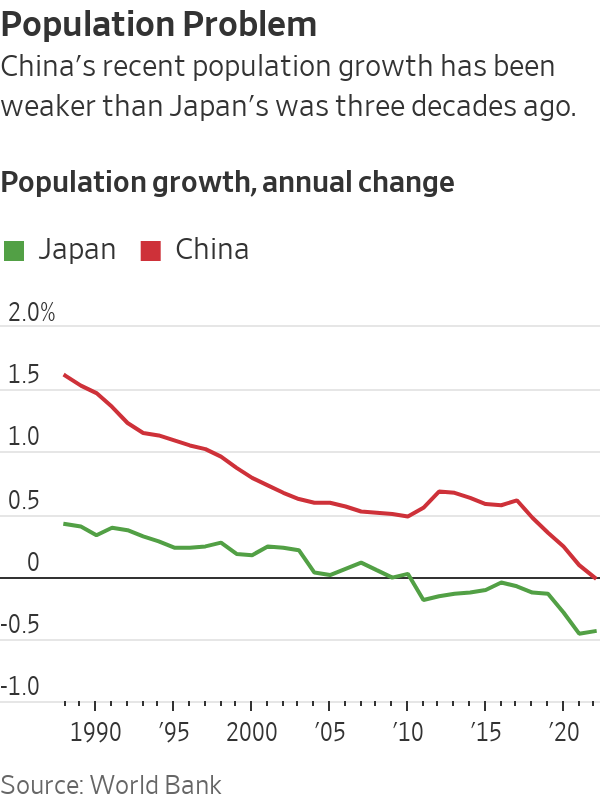
But some economists see alarming parallels between China’s current predicament and the experience of Japan, which struggled for years with deflation and stagnant growth.

In the 1990s, a collapse in stock markets and real-estate values in Japan pushed companies and households to drastically cut back spending to service burdensome debts—a so-called balance-sheet recession that some see taking shape in China today.

Data released Thursday showed industrial profits are sinking and average new home sale prices fell in June.

If China were to tip into protracted deflation, it has another big problem: Traditional methods of fighting it are either unpopular in Beijing, or lack potency due to the country’s heavy debt load and other issues. Beijing is wary of large deficit-financed spending programs that could juice growth and push prices higher, while big debts mean consumers and businesses are reluctant to borrow and spend.

“The big concern is whether the policy tools that they have will have much traction in terms of trying to avert deflation, or deal with deflationary pressures once they arrive,” said Eswar Prasad, a professor of trade policy and economics at Cornell University and a former head of the International Monetary Fund’s China division.

For the global economy, extended deflation in China might help cool inflation elsewhere, including the U.S., since its factories make up such a large share of the world’s goods.

However, a flood of cut-price Chinese exports on global markets could squeeze out rival exporters in some countries, hurting jobs and investment in those economies. Chinese export prices for steel and chemicals fell by about a third over the 12 months through June.

A deflationary spell in China would also likely mean weaker Chinese demand for food, energy and raw materials, which big chunks of the world rely on for export earnings.

“The market is underestimating the deflationary impact on the global economy,” said Frederic Neumann, chief Asia economist at HSBC in Hong Kong.

Consumer prices in the U.S. rose 3% in June from a year earlier, a sharp slowdown from the 8% annual rate a year earlier but still above the 2% rate targeted by the Federal Reserve. Annual inflation in the European Union last month was 6.4% as the region continues to feel the squeeze from high energy and food prices.

In China, annual consumer-price inflation in June was zero. Producer prices fell in China last month by 5.4% from a year earlier.

Subdued consumer spending is one big reason. Some idiosyncratic factors are also at play, including a steep rise last year in the price of pork—a staple in the Chinese diet—that hasn’t been repeated.

But weak price pressures are also a payback of sorts for China’s experience during the Covid-19 pandemic, when exports rocketed thanks to Western demand for gym equipment, home improvement supplies and other goods.

The demand surge helped push Chinese producer prices up 12% between the start of 2020 and their peak in April last year, according to an index calculated by Moody’s Analytics.

When governments lifted lockdowns and Western demand eased, the trend reversed. Producer prices began falling on a year-over-year basis in October and have kept falling every month since.

Chinese factories, which expanded to meet Western demand during the pandemic, now face overcapacity. The hope was that Chinese consumers would step into the breach and soak up excess inventories as export markets dried up. But that hasn’t happened, and as more businesses pivot toward selling into the domestic market, the downward pressure on prices is building.

With global energy and food prices also weaker than before, economists expect overall consumer prices in China to stay nearly flat, or even fall, in the coming months. In addition to many foodstuffs and clothing items, prices have also been falling for electric vehicles, as Chinese automakers and Tesla have slashed prices amid slower sales growth and in an effort to win more share in a crowded market.

China could escape further deflation if growth regains momentum later this year, helped by government stimulus, as some economists anticipate. Nomura economists expect annual consumer-price inflation in China of negative 0.2% in the third quarter, with inflation eventually turning positive again toward the end of the year.

The risk for China is that deflation proves more persistent than expected. Falling prices tend to squeeze spending as consumers await a better deal tomorrow, reinforcing a downward spiral.

The longer it lasts, the more severe its effects become. Entrenched deflation means debts become harder to bear as profits and incomes fall. Companies shed workers to fatten shrinking margins.

In Shanghai, Liu Wang has held off on plans to upgrade his apartment because he is worried about sinking more money into a property whose value he believes could keep dropping.

“The economic condition is highly uncertain now,” said Liu, who works at a logistics firm that is shifting its focus toward domestic business after its export business weakened. In his hometown of Qufu in China’s northeastern Shandong province, demand for homes has been tepid despite a drop in prices, he said.

“The housing bubble is still quite large,” Liu added. “I don’t see any reason why prices will go up.”

In Japan, deflation first appeared in 1995. Excluding a few respites, it more or less stuck around until the 2008-09 financial crisis. Even today, Japan is battling to sustain higher rates of price growth with ultraloose central bank policies.

One textbook response is a massive monetary expansion, lowering interest rates and printing money to spur borrowing and spending, which in theory should trigger more inflation.

But data show Chinese companies are reluctant to take on new debt to expand production, while droves of homeowners are choosing to repay mortgages early. Both are signs of weak demand for loans, muffling the effectiveness of interest-rate cuts.

A major reason is that many companies and households already have such large debts that they don’t want to add more. Household debt has surged to 1.5 times that of income, far above the level of most developed countries, including the U.S., according to calculations by Jens Presthus, associate director of Global Counsel, an advisory firm.

Deflation, or even just the fear of deflation, can make the problem worse. Borrowers worry the cost of servicing their debts is going to rise, so they respond by saving more and spending less.

“Deflation is particularly dangerous when there’s a lot of debt,” said Arthur Budaghyan, chief emerging markets economist at BCA Research.

THE BEYONCÉ EFFECT: SWEDEN’S INFLATION FEELS THE HIT

Call it Bey-flation.

Sweden’s higher-than-expected inflation in May was due in part to Beyoncé launching her Renaissance World Tour in Stockholm, according to an economist at Danske Bank.

Fans flocking to Sweden’s capital city sent hotel prices soaring, said economist Michael Grahn. Calling it a “Beyoncé blip,” he estimates that Beyoncé’s tour contributed about 0.2 percentage point to inflation.

“This is very rare,” Grahn said about the effect that Beyoncé’s Stockholm performances on May 10 and 11 had. “Basically, her fans vacuumed hotels around Stockholm with a radius of some 40 miles,” bidding up hotel rates.

Inflation in Sweden was at 9.7% in May, falling from 10.5% the month before, according to Sweden’s government. Economists surveyed by FactSet were expecting inflation to drop to 9.2% last month. Statistics Sweden, which puts out the country’s inflation and other economic reports, said hotel and restaurant prices rose 3.3% in May from the month before.

“Beyoncé probably had an effect on hotel prices in Stockholm the week she performed here,” said Carl Mårtensson, a price statistician at Statistics Sweden, “but it should not have had any significant impact” on Sweden’s inflation.

The Renaissance tour, named after Beyoncé’s most recent album, is making its way around Europe before coming to the U.S. next month. The superstar’s first tour in seven years is playing in soccer and football stadiums, where fans watch her dance with robots and sing while riding a mirrored horse that floats in the air.

Beyoncé, whose hits include “Crazy in Love” and “Formation,” broke the record for most Grammy wins in February after “Renaissance” won best dance/electronic music album. She’s had 32 Grammy wins over her career, the most of any person.

When Renaissance tour tickets went on sale earlier this year, Beyoncé superfans, who call themselves the BeyHive, tried to buy tickets in several cities, fearing they would go quickly. A day after tour dates were announced, Ticketmaster said fan demand for the first round of tickets exceeded the number of tickets available by more than 800%.

Grahn said Sweden’s currency, the krona, is weak, which means tickets and other costs are likely cheaper for fans outside the country.

Other superstars touring this year after a long break have also made an economic impact on the cities they have visited.

Taylor Swift, who is in the midst of her Eras Tour, helped Las Vegas nearly match pre pandemic visitor levels when she performed there in March, the Las Vegas tourism authority said. Cities have been going all out to welcome Swifties in town for the Eras Tour, lighting up monuments in her signature colours and temporarily renaming streets after her.