A Record Year Of House Building

According to economists at the Housing Institute of Australia (HIA), a record number of detached housing starts will occur in the 12 months to September 2021.

More than 146,000 detached houses commencing construction. This is more than 20 per cent higher than the peak of the previous boom in 2018,” stated HIA Economist, Angela Lillicrap.

This forecast is contained in HIA’s economic and industry Outlook Report. The State and National Outlook Reports include updated forecasts for new home building and renovations activity for Australia and each of the eight states and territories.

“This large volume of work will ensure that the industry remains very active through until at least the second half of 2022,” added Ms Lillicrap.

Ms Lillicrap cites a number of factors driving the level of activity, namely, the HomeBuilder scheme and low-interest rates, as well as consumer preferences shifting away from high-density areas.

“The extension of HomeBuilder’s commencement deadline will help limit the impact of constraints imposed by land, labour and materials and ensure the elevated volume of detached homes will be sustained for longer.”

However, the increase in building is not something that is shared between the detached and multi-unit sector, the latter expecting a decline in 2020/21.

“The timing and speed of a recovery in overseas migration will have a significant impact on these forecasts.

The return to stable and certain population growth is central to stable economic growth,” concluded Ms Lillicrap.

Bitcoin’s Plunge Sparks Wider Selloff

Bitcoin Hits New Highs

Bitcoin plunged to its lowest level since February on Wednesday, hitting a low of $30,200, down by more than half from an all-time high of $64,829 it reached just last month.

Ether, the second most valuable cryptocurrency, was down 21% as well on Wednesday.

The fallout was hitting stocks that have ridden the crypto boom. Square (ticker: SQ) dropped 4% and PayPal Holdings (PYPL) was off 1.5%. Companies with even more of their business models tied to the price of cryptocurrencies dropped even more precipitously, with crypto exchange Coinbase Global (COIN) falling 8% and business software firm MicroStrategy (MSTR), which has bought billions worth of Bitcoin, down 11%.

MicroStrategy’s CEO MIchael Saylor, among the most important evangelists for crypto had a short message on Twitter: “I’m not selling.”

Some crypto users couldn’t sell even if they wanted to. Coinbase users complained about trouble accessing the app. The company said “some features may not be functioning completely normal” and it is investigating.

Bitcoin had recovered to about $36,000 by 10:45 a.m. Eastern time, still down 19% in the past 24 hours. But even getting a definitive price was tricky. CoinDesk, among the most popular sites for crypto information, was down for part of the morning, and was showing different prices than coinmarketcap.com, another hub for data, and Coinbase. At about the same time, Coinbase was showing $36,998, while coinmarketcap showed $36,429—the kind of spread that used to happen in crypto but that had diminished in the past couple of years as the market became more liquid.

All of the gains Bitcoin accrued since Tesla (TSLA) got involved with the cryptocurrency have now been erased. And as with many things in crypto, it’s difficult to pinpoint the catalyst for the selloff.

Matt Hougan, chief investment officer of crypto fund provider Bitwise Asset Management, told Barron’s that the drop was caused by “short-term forced and panicked selling by retail investors who entered the market in the past year, spooked by a mix of bad news and misinformation, and turbocharged by the procyclical leverage that’s an inherent feature of the crypto market.”

Looking at patterns on the Bitcoin blockchain itself, he said he sees funds moving from overseas retail investors to institutions in the United States, “which is a good thing for the long-term. But in the short-term, volatility is a part of the market.”

The market has been dropping since Elon Musk began questioning Bitcoin’s negative environmental impacts about a week ago. One more recent catalyst may have been China’s decision to reiterate its ban on financial institutions facilitating crypto transactions.

In the crypto market, momentum can turn quickly and selloffs can accelerate as people try to lock in gains made in the latest bull market. Anyone who bought cryptocurrencies in 2020 is still showing a large paper profit, but maybe getting anxious that those gains won’t hold for long.

This “no doubt this will scare investors just as all pullbacks in all markets scare investors” Jim Paulsen, chief investment strategist at The Leuthold Group, wrote in an email to Barron’s. Paulsen is a more traditional investor who has warmed to Bitcoin in the past year. The selloff isn’t shaking his interest in crypto — he still thinks it’s worth allocating 1% or 2% of a portfolio into it. And he likes that the volatility makes it possible to rebalance frequently when prices go up and down.

One thing Paulsen is watching for is whether the selloff bleeds into the larger market. The S&P 500 was down 1.3% on Wednesday morning. “Note that the other 3 times crypto did this, the stock market suffered a correction or a bear market,” he wrote. “So part of the crypto story may depend on what the stock market does from here? Does it recover soon or is this a full-blown, longer-lasting correction for stocks?”

Saylor and other Bitcoin bulls have said that Bitcoin is an effective hedge against inflation, because the number of Bitcoins is capped at 21 million, theoretically making it impervious to the “money-printing” common with fiat currencies. Prominent hedge-fund managers like Stanley Druckenmiller have bought Bitcoin under that premise, and some analysts have found that Bitcoin has been stealing gold’s thunder.

But as inflation fears grow in the United States, there is evidence that institutional investors are returning to their familiar inflation hedge.

Investors have been pulling money out of Bitcoin futures and funds and putting more of it into gold, according to a new analysis by J.P. Morgan strategist Nikolaos Panigirtzoglou. That’s a shift from the prior two quarters, he wrote. On Wednesday, the spot price of gold was up 0.8% to $1,883.20 per ounce.

Reprinted by permission of Barron’s. Copyright 2021 Dow Jones & Company. Inc. All Rights Reserved Worldwide. Original date of publication: May 19, 2021.

Warren Buffett to Offer a New Spin on Modular Construction

A startup owned by Warren Buffett’s Berkshire Hathaway Inc. aims to shake up the construction industry by making it more like car manufacturing.

MiTek Inc., a Missouri-based construction-technology company, is launching a new modular building venture with New York City-based architect Danny Forster & Architecture. The company plans to build entire rooms for hotels and apartment buildings in factories, and then send them to a construction site to be stacked on top of each other.

MiTek has more than 6,000 employees and sells building components, construction software and services like engineering. The company said it is investing tens of millions of dollars in the modular venture, and plans to start working on its first projects early next year.

Modular construction isn’t new, but companies have struggled to be profitable. Transporting entire rooms to construction sites can be expensive, and some finished buildings have suffered from leaky facades.

Other efforts to streamline the construction process have also had issues. Katerra Inc., a Silicon Valley-based startup, has been looking to move a bigger part of construction work to factories and become a one-stop shop that cuts out middlemen like plumbers and architects. But it has struggled under this model, and its main backer, SoftBank Group Corp., had to bail it out.

MiTek looks to modernize modular construction by requiring assembly by general contractors. Instead of building entire rooms in a factory and driving them to a construction site on a flatbed truck, MiTek wants to ship kits of manufactured building parts along with instructions.

General contractors would then construct rooms from these parts, which would include a steel cage forming the structural support for the room, in a warehouse or other type of industrial building near the construction site.

Shipping the parts, rather than entire rooms, keeps transportation costs low and allows MiTek to supply the country from its factory in Lebanon, Pa., said Todd Ullom, the company’s vice president of modular building solutions.

That companies continue to invest in modular construction despite the challenges speaks to the business model’s promise, proponents say. Construction is a massive industry, plagued by rising costs and inefficiencies. Anyone who manages to automate it the way Henry Ford once changed car manufacturing stands to make a fortune, some industry observers say.

“How come an entire industry is operating on mid-to-late-20th-century mode when we’re a quarter of the way, almost, into the 21st century?” said Barry LePatner, a New York-based construction attorney. “It drives me crazy.”

MiTek’s approach brings its own challenges. Relying on customers to assemble rooms based on written instructions can be tricky. Many general contractors are resistant to change, which could lead to friction and mistakes.

Mr. Ullom, who worked as a general contractor for more than 30 years, said relying on a single supplier instead of numerous subcontractors reduces risk, and the instructions are simple to follow. He said MiTek would offer on-site training.

MiTek also plans to automate much of its 225,000-square-foot factory, for example by using robotic welders, not unlike how auto makers assemble cars. Architect Danny Forster’s firm has designed what could become the world’s tallest modular hotel, a planned 26-story building for Manhattan. He said other modular-construction companies moved work from building sites into factories but failed to make it faster or more efficient.

“A lot of times it has been bringing the chaos of the construction site and just putting a roof over it,” he said.

Reprinted by permission of The Wall Street Journal, Copyright 2021 Dow Jones & Company. Inc. All Rights Reserved Worldwide. Original date of publication: May 18, 2021.

Property Of The Week: 99 Fernberg Road, Paddington, QLD

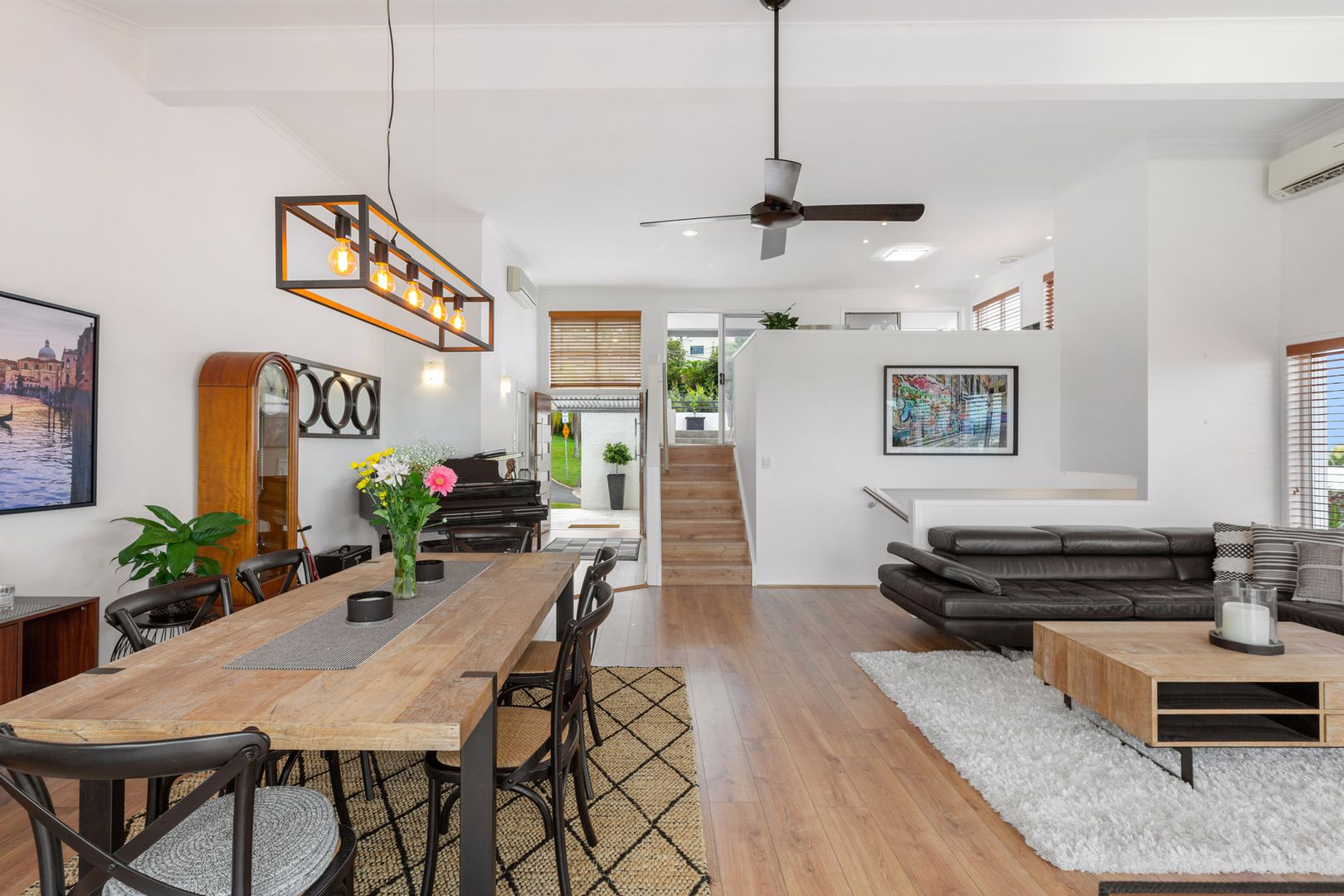
Located in the desirable suburb of Paddington comes this modern family home combining traditional cottage features with contemporary, free-flowing design.

The two-storey 4-bedroom, 2-bathroom, 1-car parking home sees an open plan living design on the first level. It’s here that the living, dining and kitchen area opens out – through bi-fold doors – to a large deck that is ideal for entertaining.

The opening of the bi-fold doors allows for streams of light, giving the home an airy presentation. Once outside, one finds the pool and beautifully landscaped gardens.

Timber, in the form of panelled walls and warm-toned flooring, dominates the aesthetic of the home, and helps keep some of its cottage charm. The use of timber is showcased heavily throughout the major living zones.

Other traditional features, such as the French doors and Venetian shutters all help the home retain some of its period look.

Upstairs sees a large master suite with lush outlook, views over Paddington and a large en-suite. An additional bedroom on the upper level is perfect for a nursery or study.

A further two bedrooms are found on the lower-level.

Paddington is a highly desirable Brisbane locale, with the home nearby to Rosalie Village, Paddington Woolworth’s, University of Queensland, Suncorp Stadium and the CBD via public transport.

The listing is headed to auction on June 5 and is managed by Glynis Austin (+61 403 333 013) of Glynis Austin Properties. Glynisaustin.com

China’s Economic Recovery Slowed In April

BEIJING—China’s economic activity grew at a slower pace in April as retail sales missed expectations, complicating the picture of a steady and balanced recovery in the world’s second-largest economy.

Official data released Monday showed industrial output and fixed-asset investment beating market expectations and continuing to lead the recovery, but domestic consumer spending, which has lagged behind for months, remaining soft.

China’s industrial production in April was up 9.8% from a year earlier, slower than March’s 14.1% pace, the National Bureau of Statistics said Monday. Fixed-asset investment decelerated as well, to 19.9% in the January-April period from 25.6% in the first quarter.

Retail sales, a key gauge of China’s domestic consumption, underwhelmed: April’s figure was up 17.7% from the pandemic-hit level a year earlier, well short of March’s 34.2% pace.

Economists had largely expected the double-digit year-over-year percentage growth that major indicators delivered, given the low-base of comparison from a year earlier, when China’s economy had just begun to bounce back from the coronavirus shock. In the coming months, however, that “low-base effect” will fade, given the economy’s recovery during the spring and summer last year.

Monday’s figures on industrial output and fixed-asset investment actually exceeded the forecasts of economists polled by The Wall Street Journal, who had pegged 9.1% and 19.2%, respectively. Retail sales, however, missed their predicted 24.9%.

To strip out last year’s pandemic distortions, government statisticians and economists have benchmarked this year’s numbers against 2019’s. By that measure, official data showed industrial production up 14.1% in April, largely in line with March’s growth rate, while the pace of retail-sales slowed to 8.8% from March’s 12.9%.

The retail-sales miss was a particular disappointment for economists and policy makers, who have been watching for several months for signs of a tilt toward consumption-driven growth in the Chinese economy, after more than a year of expansion led by manufacturing and exports.

For the Chinese economy as a whole, says Ding Shuang, an economist at Standard Chartered, “The problem is not the growth rate, but its unbalanced recovery. Some sectors, such as industrial activity, appeared to be too hot, while others, like service and consumption, haven’t yet recovered to pre-virus levels.”

China’s strong rebound from the Covid-19 pandemic last year was largely driven by its swift factory resumption and government-led investment, while household spending has repeatedly fallen short of expectations.

Pointing to the softness in domestic spending, the Chinese Communist Party’s Politburo—its top decision-making body—said last month that the economic recovery remains uneven and its foundation less than solid.

China’s gross domestic product reported a record year-over-year gain of 18.3% in the first quarter. That makes meeting Beijing’s official target of “above 6%” growth for 2021 a relatively light lift.

Economists argue that the modest growth target leaves Beijing’s policy makers with more wiggle room to address longer-term structural problems in the economy—such as high leverage, potential asset-price bubbles and, in particular, the weakness of domestic consumption.

Chinese policy makers face a dilemma, Louis Kuijs, an economist with Oxford Economics, told clients in a note Monday: While Beijing wants to dial down leverage generally, the persistently weak consumption numbers may increase “pressure to pursue a more pro-growth macro policy that could increase financial risks and leverage.”

April’s lacklustre consumption data came even as China’s labour market showed signs of improvement. The urban surveyed unemployment rate, China’s headline jobless figure, dropped to 5.1% in April, the lowest level in more than a year.

In a briefing Monday, Fu Linghui, a spokesman for China’s statistics bureau, acknowledged the imbalance in the economic recovery, but said the improving labour market and increasing household income would lift consumption.

Iris Pang, an economist with ING Group, said April’s consumption weakness might prove short-lived, with figures for the five-day Labor Day holiday at the start of May indicating robust spending.

Over the holiday, Chinese people made a total of 230 million trips, marking the first time that traveller numbers topped pre-virus levels. The nation’s box office also broke records for revenue and number of moviegoers.

Meanwhile, though fewer cities in China reported rising home prices in April, average new home prices nationwide in April were up 4.45% from a year earlier, official statisticians said Monday, following a 4.36% year-over-year rise in March—underscoring the challenge that policy makers face in reining in home prices.

Reprinted by permission of The Wall Street Journal, Copyright 2021 Dow Jones & Company. Inc. All Rights Reserved Worldwide. Original date of publication: May 18, 2021.

Future Returns: Investing In the Soaring Energy Sector

Energy has transitioned from the worst- to best-performing sector in a matter of months. How long is it likely to outperform? And which companies are most promising for investors?

Serious difficulties for the energy sector began in April 2020. Demand screeched to a halt under pandemic lockdowns, and the futures prices on the global benchmark West Texas Intermediate (WTI) cratered to negative territory for the first time. The per-barrel price plummeted from US$18 to negative US$37 due to oversupply as Covid-19 crippled industry and mobility around the globe.

But the sector came roaring back to life late last year on positive vaccine news and surged through this year’s first quarter, as successful vaccine rollouts enabled relaxation of Covid-19 restrictions and economic activity rekindled.

In the first quarter, many big oil companies banked a profit for the first time since the pandemic began. Meanwhile, investors have been soundly rewarded. Through last week, the energy sector was up 35% this year compared to 9.5% for the S&P 500.

Bull or Bear?

Sam Halpert, Philadelphia-based chief investment officer at Macquarie Investment Management who oversees the firm’s natural resources equity strategy, views the recent outperformance as a cyclical bull market in the context of a secular bear market for the sector.

“The bull market could last two or three years, but there are still long-term issues around hydrocarbon and the energy transition that will impact the sector,” Halpert says.

The energy sector was under pressure even prior to the pandemic as investors were increasingly hesitant to commit capital as an inevitable transition from fossil fuels to greener choices loomed.

Lack of capital flowing into energy companies focused on shale technology is a hindrance to oil production. “Investors have not been willing to finance shale, there’s been a decrease in investment and production,” Halpert says. “Production was 11 million barrels a day last week, and we peaked at 13.1 million barrels a day in March 2020.”

Pressure on the sector isn’t likely to let up. In fact, the transition from the U.S.’s reliance on fossil fuels to low-carbon energy alternatives has renewed political momentum under President Joseph Biden, who supports policies that elevate greener alternatives and aims for the U.S. to have a 100% clean energy economy and net-zero carbon emissions by 2050.

Investors’ decline in interest in energy has been steady and notable. In 1980, the sector accounted for almost 30% of the index. By 2019 the percentage was 5.3% and this it slipped to 2.33%.

While energy will clearly be impacted over the long term by fundamental changes, “there are a lot of companies that can benefit during the transition and are changing the way they do things,” Halpert says. “They’re becoming more environmentally friendly or changing business slightly to areas that have more growth, and the market is rewarding that.”

Consolidation Boom

Some of the best opportunities are among companies that are not only accommodating environmental factors in the way they do business, but that are sound enough to be gobbling up smaller players in what has been a highly fragmented industry.

The consolidation has been rapid: For example, in late 2019, Parsley Energy of Midland, Texas, acquired Denver-based Jagged Peak. Since then, Parsley was acquired by Pioneer Natural Resources of Irving, Texas, which in May completed the acquisition of Midland, Texas-based DoublePoint Energy.

A central region for the consolidation boom is the Permian Basin, a 75,000-square-mile region from West Texas to Southeastern New Mexico. With rich oil reserves discovered some dozen years ago, it now accounts for more than one-third of oil production in the U.S. Just two years ago the Permian Basin unseated Saudi Arabia’s Ghawar oilfield as the biggest producer in the world.

“There have been too many players, many with marginal acreage or fields they’re developing,” says Geoffrey King, senior vice president and portfolio manager at Macquarie. As investor capital has declined, many of the smaller players have struggled.

King looks for opportunities among companies with sustainable practices that are in position to buy the smaller players. They’re benefiting from strengthened commodity prices and a perked-up demand.

“They have the ability to not only develop and maintain a growth rate comparable to the overall average S&P 500 growth rate, but to deliver excess cash to shareholders,” King says. “The model is being proven out and we’re in inning two or three.”

Veteran Industry Players

Among biggest holdings in Halpert’s and King’s institutional strategy is Plano, Texas-based Denbury (DEN), one of their few small-cap names that focuses on producing carbon negative barrels oil through carbon sequestration, which is the process of capturing and storing carbon dioxide.

“As people talk more about carbon sequestration, this is the game in town,” King says. “A lot of industrial companies don’t want to deal with the complexity of storing carbon. We think this is a very unique small-cap story that’s underappreciated.”

Another is Valero, the San Antonio-based largest independent refiner in the U.S.

“It has best-in-class assets and best-in-class management team,” Halpert says. “They’ve done a really good job returning capital to shareholders over the last several years.”

The company recently entered into an agreement with Darling, which processes waste such as from meat processing plants and the leftover oil from restaurants and food businesses. Valero transforms the waste into the fuel equivalent of ethanol.

“It has the identical chemical properties as ethanol, but ethanol has constraints around usage. It’s tough in the cold weather because it can cause engines to clog,” Halpern says. “Valero’s product is a low carbon fuel and low cost to produce.”

Another noteworthy holding is the big oil service company Schlumberger (SLB), based in Houston but with a global reach. “It’s involved in lithium, carbon sequestration, and a number of technologies that will be important in the energy transition,” Halpert says.

While there are numerous new entrants to the energy transition play, “we prefer to play it with a company with a balance sheet like Schlumberger and the technology of Schlumberger.”

Reprinted by permission of Penta. Copyright 2021 Dow Jones & Company. Inc. All Rights Reserved Worldwide. Original date of publication: May 18, 2021

Three Of Sydney CBD’s Most Luxurious Penthouses

The last few years has seen a considerable uptake in apartment living across Sydney, notably in the prime market as driven by a slew of new luxury developments.

It’s meant recent Australian sales records – cue Crown’s One Barangaroo and its waterside neighbour, One Sydney Harbour – as purchasers look to secure a standout property and also embrace the benefits of expansive inner-city living.

While the penthouses of the aforementioned towers are now gone, there remains some unique, cloud-catching CBD abodes available.

Here, three of the best to purchase now.


3303/203 Castlereagh Street, Sydney, NSW 2000

The Castle Penthouse, located in Castle Residences and designed by Candelepas & Associates architects, sees a 4-bedroom, 4- bathroom, 2-car parking residence delivered in the heart of Sydney’s CBD.

Here a rooftop terrace boasts breathtaking views over Hyde Park and the city skyline, with an extensive and undoubtedly luxurious finish by Studio Aria ensuring it is one of the finest properties in Australia.

The penthouse is reached via a private lift, through a double door entrance and sees opulent finishes including the use of stone benchtops, large porcelain tiles and bespoke joinery.

Expect an open-plan design, leading outwards to the buildings highly desirable winter gardens. It’s here you’ll find an opulent kitchen, complete with Gaggenau appliances.

The penthouse is also offers a  master bedroom that spans the top floor, and opens out to a sky garden with decked spa.

Those fortunate to call Castle Residences home will also enjoy various hotel amenities – such as pool and gym access as well as desirable in-house dining sourced via restaurants such as Henry’s Bread and Wine, Dixon & Sons and Spice Trader. Meanwhile, housekeeping, concierge, valet parking and 24-hour security are all accessible via in-house app.

The property is expected to welcome residents from end of August 2021.

The listing is with McGrath Pyrmont’s Robert Alfeldi (+61 418 982 688); mcgrath.com.au


 Level 43/163 Castlereagh Street Sydney NSW 2000


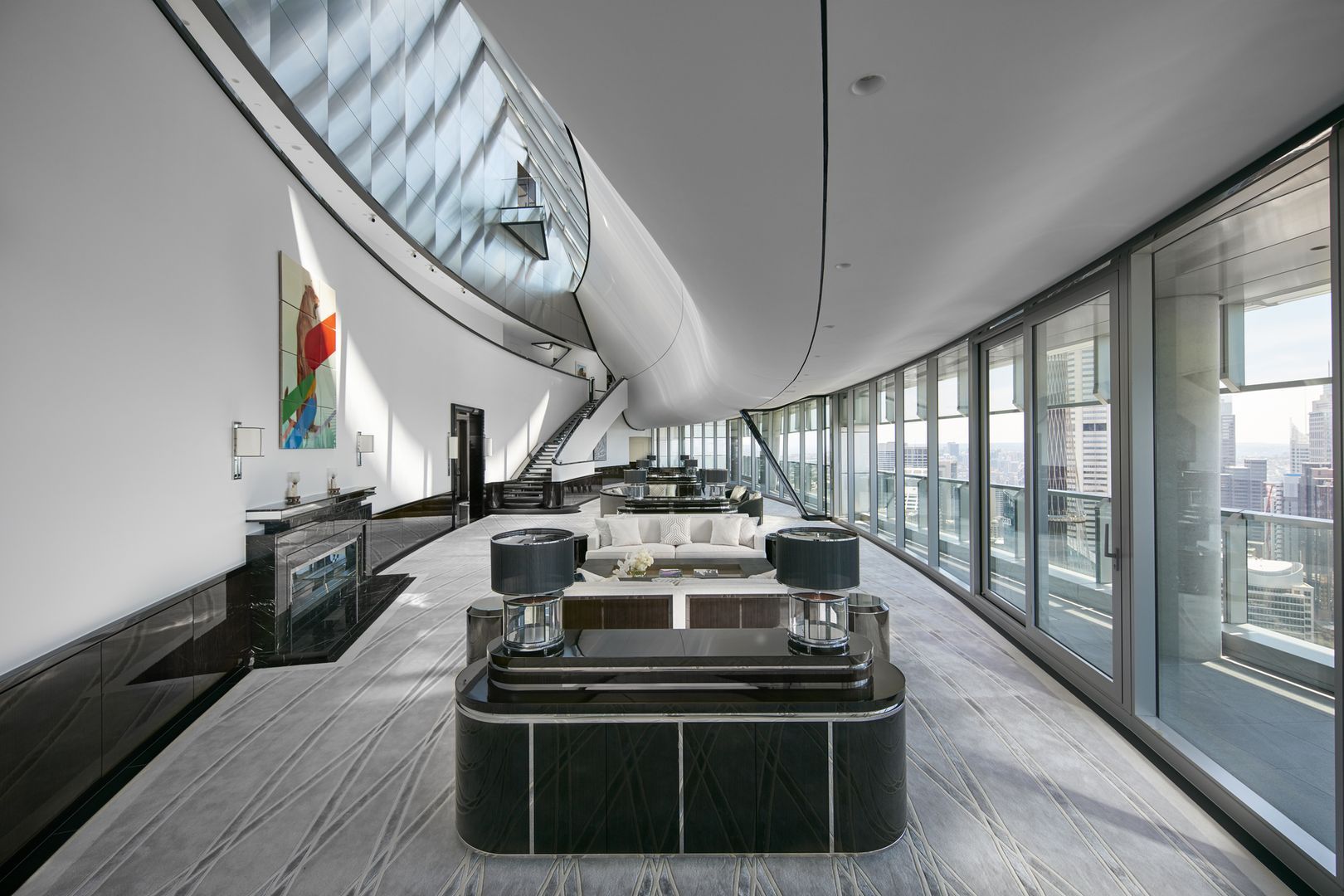
Much has already been written about the Boyd Residence. The grand, lavish, award-winning penthouse sits some 180-metres above street level offering. 2395sqm in the heart of the CBD.

Spread across three levels comes 4-bedroom, 5-bathrooms and 2 car parking. Inside sees unprecedented levels of privacy and opulence, with 24-hour security.

Accessed via private lift, it opens to a glass wall with built-in champagne storage. Elsewhere a sleek fireplace, multiple seating groupings and walls of glass take in the panorama of the city.

Each bedroom suite arrives with a marble bathroom, while the rest of the residence is framed by double-height ceiling and dramatic walls of glass.

Also, a resort-style private rooftop pool tops the living space, adding further luxury to the pad.

The listing is with Christie’s International’s Ken Jacobs (+61 407 190 152) and LJ Hooker Double Bay’s Bill Malouf (0411 428 354); theboydresidence.com.au


83.01/115 Bathurst Street, Sydney, NSW 2000

Known as the ‘King’ Penthouse, comes this luxurious pad inspired by the global cities of New York and London.

Here, at the very pinnacle of the Greenland Centre tower comes panoramic views of the CBD, Blue Mountains, Hyde Park and Sydney Harbour.

The 4-bedroom, 4-bathroom, 4-car parking penthouses offers sophisticated details, with glamorous stone island benchtops in the kitchen and concealed scullery, to towering balconies overlooking Sydney.

The master bedroom features an opulent dressing room that opens to reveal handsome timber-panelled interiors with wide drawers and open display shelving for all your finery, handbags, watches, belts and scarves

The master bathroom is cloaked in emerald green marble and features high-quality fixtures, a free-standing bath and heated towel rack bringing minimalist glamour while a soaring skylight adds luminous radiance.

Further amenities include a 30-metre outdoor pool, gym, spa, sun deck, and multi-function residents’ room.

Contact Ben Stewart (+61 412753740) of CBRE for more information; thegreenlandcentre.com.au


A Former WWII M16 Spy Post Re-Emerges As A Ultra-Modern Mansion

A pocket of leafy suburban London that once held a secret, wartime intelligence base with bullet-proof doors and windows, and wireless transmitters on the roof, is now a newly built luxury home.

Set in the village of Arkley in North London, Rowley Ridge, as it’s known, spans 1020 square metres and hit the market in April for £8.5 million (A$15.4 million) with estate agency Beauchamp Estates.

During World War II, the site of Rowley Ridge—then an Edwardian villa—was selected by British Prime Minister Winston Churchill as one of a handful of detached country houses to be a clandestine listening post base used by M16 to spy on German signals, intercept illicit wireless messages and support the code-breaking taking place at the famed Bletchley Park, according to a news release from the brokerage.

Casa E Progetti

Set 134-metres above sea level, Arkley was chosen by Churchill for its advantageous altitude—conductive for capturing radio transmissions.

“As a local resident I am naturally biased, but I truly believe that Arkley is a true leafy oasis,” Jeremy Gee, managing director of Beauchamp Estates said in the release.

It’s “one of London’s most exclusive enclaves, bordered by both greenbelt countryside and the private golf course, yet only nine miles from London’s West End,” he said. Arkley’s hidden role as a World War II M16 base adds the excitement and glamour of the secret services, spies and gadgets.”

Casa E Progetti

Now the six-bedroom family-home, developed by Domvs London—is loaded with very different amenities than it would have housed some 80 years ago.

There’s a three-story atrium, a main reception room with a lounge area, drawing room area and dining area, a custom-designed kitchen, a main bedroom suite with a private balcony and views across the nearby private golf course, according to the release.

On the basement level is a soundproof cinema room with a cocktail bar, a game room, a swimming pool, a steam room and a gym. There’s also a panic room and a biometric entry system.

10 Defining Themes For The Future Of Wealth Management

J. Pierpont Morgan would be proud that many of the historical tenets of the asset- and wealth-management industry still form the bedrock of how money is managed in modern times. The fund’s 150-year track record is a testament to our industry’s founding principle: While the world may change, clients’ desire for investment expertise and personalised service won’t.

With that in mind, here are 10 key themes that we look forward to helping our clients navigate in the future.

1) Price. Ever since I entered the asset-management industry, sceptics have warned that fee pressure will destroy profitability and detract top talent from the profession. Fees in every industry compress at some point. Successful firms of the future will thrive by either providing commodity-like products at scale for near-zero cost, or delivering hard-to-access insights and exposures that command a premium. Our industry must strive for continuous improvement on both ends of the spectrum.

2) Scale is a matter of survival. With compressed pricing, heavy regulatory controls, and immense spend on data, analytics, and risk-management tools, firms need a relentless focus on operational efficiency, a rigorous control framework, and a disciplined prioritization process around investments for the future. In this context, scale is key. Mergers and acquisitions and outsourcing of sub-scale and noncore capabilities to service providers will enable smaller firms to refocus their efforts back into their most important asset: talent.

3) Actively advising clients. If we learned anything from the Covid-19 crisis, it is the need for sound advice in volatile times. During that time, thousands of actively managed funds outperformed their passive alternatives across asset classes and portfolios. While markets may be efficient, manager selection is key and clients need guidance. The average industry return of a balanced portfolio over the past two decades was 6.4% annually, while the actual experience of the average retail investor was only 2.9%, a stark reminder of how critical hands-on advice is.

4) Impact and purpose. Portfolio managers and research analysts have become essential for investors seeking to make an impact in the world through their assets. Over 80% of surveyed CIOs expressed intent to invest in environmentally and socially conscious companies. Analyzing CEOs and their management teams is no longer just about inquiring about their financial and operational expertise and vision, but also about the impact they make on their communities and the planet. Rising demand for companies that drive positive change will create a virtuous cycle of asset allocation for good.

5) Personalization. Today’s investors want to be intentional, not passive, in investing. They care about taxes and want to overweight companies that can make a difference. They want to avoid whole sectors, or actively own and vote on a company’s strategic plans. Giving clients the freedom to pursue their very specific objectives in a highly customized manner will continue to drive innovation in our industry.

6) Stable and predictable incomes. Millions of investors around the world have come to rely on their investment portfolios as a stable source of income. With individuals enjoying longer life spans and more active lifestyles, especially during retirement years, asset managers need to adapt their strategies to provide for a stable and predictable flow of income every month. Along the same lines, saving needs to start at a young age. Today, less than 40% of Americans have enough savings to pay for an unexpected $1,000 expense in cash. It is our collective responsibility to educate and advise on what is required to cover all of life’s events and milestones.

7) Understanding China. The pandemic has highlighted the interconnectivity of the world and how important China is to supply chains and new innovations. Against this backdrop, it is irresponsible to be a fiduciary of client capital and not have a deep understanding of places like China. It is hard to imagine having a true grasp of competitive global forces without on-the-ground insights of the economies, cultures, and politics of re-emerging global marketplaces. After 100 years of being on the ground in China, J.P. Morgan is poised to become the first foreign asset manager to acquire full ownership of a Chinese fund manager, pending regulatory approval. That kind of commitment will contribute massively to our global research network.

8) Technology drives everything. To adapt to the velocity of progress and change, technology is providing our industry access, speed, and agility like never before. With more technologists than Google and Facebook combined, J.P. Morgan invests over $12 billion annually in technology to help empower our clients and employees to work faster and more seamlessly in ever-changing markets. We need to be forward thinking and have the ability to be a disruptor. Agile, collaborative partnerships between technologists and their businesses will drive innovation and speed to market at an exponential pace.

9) Access. With a global footprint and a full suite of investment vehicles, asset managers must continue to focus on enabling first-time investors to invest in previously inaccessible areas. We are finding ways to provide more opportunities, more choice, and more power to people. Investments once only available to the largest investors in the world are now being accessed by the everyday investor. Democratization of markets should create better outcomes for investors of all sizes.

10) A new flexibility. Our industry adapted quite seamlessly to a previously unimaginable work-from-home scenario. As such, increased flexibility will broaden talent pools and should promote greater diversity. While never losing the apprenticeship nature of our business, we should continue to find new ways of working with one another to generate even greater success.

In coming years, the industry’s winners will remain obsessed about their fiduciary responsibilities. As stewards of capital, the ability to leverage technology and scale to deliver the same extraordinary experience for every investor, with $100 or $100 million, is now within reach.

Reprinted by permission of Barron’s. Copyright 2021 Dow Jones & Company. Inc. All Rights Reserved Worldwide. Original date of publication: May 14, 2021.

You’ve Lost the Bidding War On Your Dream Home

If you are trying to buy a house right now, you’re in the middle of a real-life Hunger Games. You finally find that perfect little house that you can’t live without, and there will be 13 other people who feel the same way.

That means you’ll be sucked into the worst possible outcome in any house-hunting scenario—a bidding war. Those other house hunters, like you, will do whatever is required and use all the weapons at their disposal to land the place. And when you lose, which you most likely will, you will watch your dreams—of backyard cookouts, of being able to get out of bed on both sides, of room to turn around in the bathroom without bumping your butt on the sink, of a kitchen in which your pots and pans don’t all have to live in the oven—evaporate. You will be gutted. You will grieve mightily, just like when [your childhood pet’s name here] got hit by a car.

The good news is that you will get over it, eventually. But first, you’ll have to go through the five stages of grief that accompany the loss of any bidding war. The stages start right after you stop swearing. Here’s what each stage looks like, plus some suggested coping mechanisms to get through them:

Stage One: Denial

You didn’t really want that stupid house. It’s a stupid house. Forget that house.

You should: Keep saying this to yourself until this stage wears off. It’s the best you’re going to feel for awhile.

Stage Two: Anger

That house wasn’t stupid! It was awesome and you lost it. Why do you keep on LOSING?? Why can’t you ever WIN anything? It’s just like the high school state basketball championship that you LOST. And all those times you lost the lottery. Oh great! Now there’s a hole in the wall above the TV from you throwing your laptop in loser rage. Loo. Zer.

You should: Stop with the throwing. You’re going to be in your house awhile. But don’t repair the hole. That’s just conceding that you are never moving out. Go buy a painting to cover it up. It will take your mind off all the losing.

Stage Three: Bargaining

You are brilliant! Why didn’t you think of this before? You tell your broker to offer 5% above the winning offer, no matter what it was. Your broker tells you it was all cash, 30% over asking, included a new Range Rover, the buyers are closing on the property in eight hours, and their moving truck is already idling outside the house. “Face it,” your broker says. “You lost.” “NO!” you think really loudly to yourself. “You lost, broker person. YOU lost.”

You should: Drink and cry. But whatever you do, don’t watch HGTV. All those clueless, insanely picky, delusional, yet somehow winning house hunters will make you throw things at the TV, which you can’t replace because you need your savings for a downpayment. Theoretically.

Stage Four: Depression

You will never find a house. Just quit looking. It’s pointless. Why even bother? You’re going to be stuck in this dumb, ugly house for the rest of your life, looking at that terrible painting you just bought to put over the hole. You hate that painting. What is that even a painting of? An angry bee stinging a… a walrus of some sort? Is it even hung the right way up? It looks like a five-year-old drew it. It’s a stupid painting.

You should: Stop drinking and go to bed. Leave the picture alone. It’s hung properly. You maybe should have paid for a nicer one, or bought some fine art photography of the Eiffel Tower or a foggy Brooklyn Bridge. Deal with that tomorrow. If you have dreams about blowing up that house that someone else won, that’s a normal part of the grieving process.

Stage Five: Acceptance

Wait. That’s not a bee and walrus. It’s a flower in a garden. Now that the morning sunlight is hitting it, it’s not that bad of a painting. The colours go with the comfy chair. Like you planned it that way. You sort of like it now. You’re gonna sit in that comfy chair and admire your new painting, have a cup of coffee and take a quick scroll through the listings sites to see if anything came on the market overnight. You’ll use your phone, since your laptop is in pieces.

You should: Love the one you’re with. Maybe go ahead and fill in that hole. Keep the faith. Your house is out there. It might take you a year to find it. You might need to look at 100 houses or more. Maybe you’ll have to wait until this insane market crush has calmed down a bit. But you’ll find it. In the meantime, remember to be thankful that you’ve got a roof over your head, be that as it may.

Reprinted by permission of The Wall Street Journal, Copyright 2021 Dow Jones & Company. Inc. All Rights Reserved Worldwide. Original date of publication: May 13, 2021