When David Witting prepared digital-marketing agency Dept@’s Boston-area offices for employees’ return in 2022, he ordered trendy couches, chairs and high tables, envisioning lively collaboration and banter.
Yet when his co-workers arrived, many skipped the furniture and gravitated toward the private booths scattered in the office. Since then he’s jettisoned some of the furniture, and added more booths.
“People are coming in to do occasional big meetings, but really the rest of the time, they want a quiet private spot to get on a Zoom call,” said Witting, a partner at the company. “It’s weird.”
As Covid-19’s remote-work surge fades, some workplaces are quieter and odder than ever. Employees have returned only to park themselves in deserted conference rooms or sound-muffling chambers. Colleagues grumble about booth-hogging co-workers, and some companies have started enforcing time limits on them.
The pods, some resembling old-school telephone booths, have emerged as one of the hottest segments in the $24 billion North American office-furniture industry. Manufacturers such as Room, Nook and Framery say business has been brisk. But some workers and managers say more booths means less eavesdropping, less gossiping, less camaraderie and less fun.
“It’s strange,” said William Blaze, a technology recruiter and consultant, referring to colleagues who end up occupying booths for much of their workdays. Blaze, who lives in Atlantic Highlands, N.J., observed the phenomenon while working at tech companies from 2021 to 2023, as well as at a client’s Manhattan co-working office where he now works two days a week.
“It seems that the goal of returning to office has been to create a rowdy buzz,” said Blaze. “We’re not seeing that.”
Janet Pogue McLaurin, global director of workplace research at architecture and design firm Gensler, said workplace privacy has never been more important. Many of the firm’s clients, which include big companies such as Amazon, have more than doubled their booths and other private or semi-private areas since the pandemic.
“This is a huge trend,” she said.
Demand for privacy has office architects and landlords scrambling to rearrange layouts. Open-plan offices, often dreaded by employees, are now being peppered with pods and booths that scream “do not disturb.”
Jamie Hodari, chief executive of global co-working company Industrious, said some workers are monopolising private areas in office spaces that were designed for professionals to connect with other professionals. “We see a lot more people linger for two hours post-phone call or a Zoom call because they like having a little space to themselves.”
Booth-inclined office workers say their needs have changed post-Covid, and they have a harder time concentrating among noise and distractions.
At CrowdComms, a U.K.-based maker of event technology, managing director Matthew Allen got used to working in near-silence at the office during the pandemic. When colleagues returned, their phone calls—even at normal volume—annoyed him so much he bought a sound-dampening booth.
Though it was ostensibly for the entire office, he soon moved in.
“It’s quite selfish,” said Allen, who has added a trio of plants. “I think it has very much become my home.”
On social-media sites such as X, Reddit and TikTok, employees generally celebrate the booths. Even Chatty Cathys are seeking them out. One X user tweeted that she locks herself in an office phone booth most days because she talks too much.
Others vent about booths’ poor ventilation and small size, or their aesthetics. Kirsten Auclair, a biomedical researcher in San Francisco, shudders at the harsh lighting in the booths she uses to take Zoom calls at work.
“It casts like the worst shadows, you look just kind of, like, on the brink of death,” she said. Still, Auclair considers the oasis from colleagues’ noise an office lifesaver.
Booth manufacturers insist their products can coexist with collegiality. SnapCab founder and CEO Glenn Bostock said the glass walls of his company’s pods allow for a sense of connection with co-workers.
“They can see you,” he said. “You can wave at them. You can still interact with people visually but you get that audio privacy.”
Other products seek a different balance between isolation and community. Furniture maker Steelcase offers a desk-encircling tent meant to ensure “territorial privacy” instead of silence. Nook, headquartered in the U.K., makes hut-shaped hideaways intended to provide a sense of psychological safety without being completely enclosed.
Nook founder David O’Coimin said an office filled with phone booths “is like you have a jail instead of having a workplace.”
Furniture distributor Thinkspace sells booths that Sid Meadows, principal and vice president, said are designed to allow a low level of outside sound. Humans are wired to crave some background noise, he said, pointing to popular YouTube videos of ambient office chatter.
That matches the findings of a study co-authored by Dr. Esther Sternberg, director of the University of Arizona Institute on Place, Wellbeing and Performance. She and colleagues discovered people became stressed when their surroundings were too quiet as well as too loud. The typical volume of birdsong, at 45 decibels, appears to be just right.
Nick Fine, a user-experience researcher in London, describes himself as an “old school, pre pandemic office worker” who enjoys the hubbub of a busy workplace. But the now-hybrid worker still spends considerable time in an enclosed pod to work without overhearing his colleagues’ chatter on days he’s in the office.
“I have ADHD and working in a pod engages my hyper focus,” he said, adding he likes having the booth option when the din is too much.
Farmer’s Fridge, which sells fresh salads out of vending machines, has eight pods made by Zenbooth and a plethora of conference rooms in its Chicago office. It offers about 40 hideaways for the 85 people who work there, yet that bounty of isolation isn’t always enough, even for the CEO.
“I actually live three minutes from here,” said Luke Saunders, also the company’s founder. “If I really have to get work done, I do it at home.”



 4 min
4 min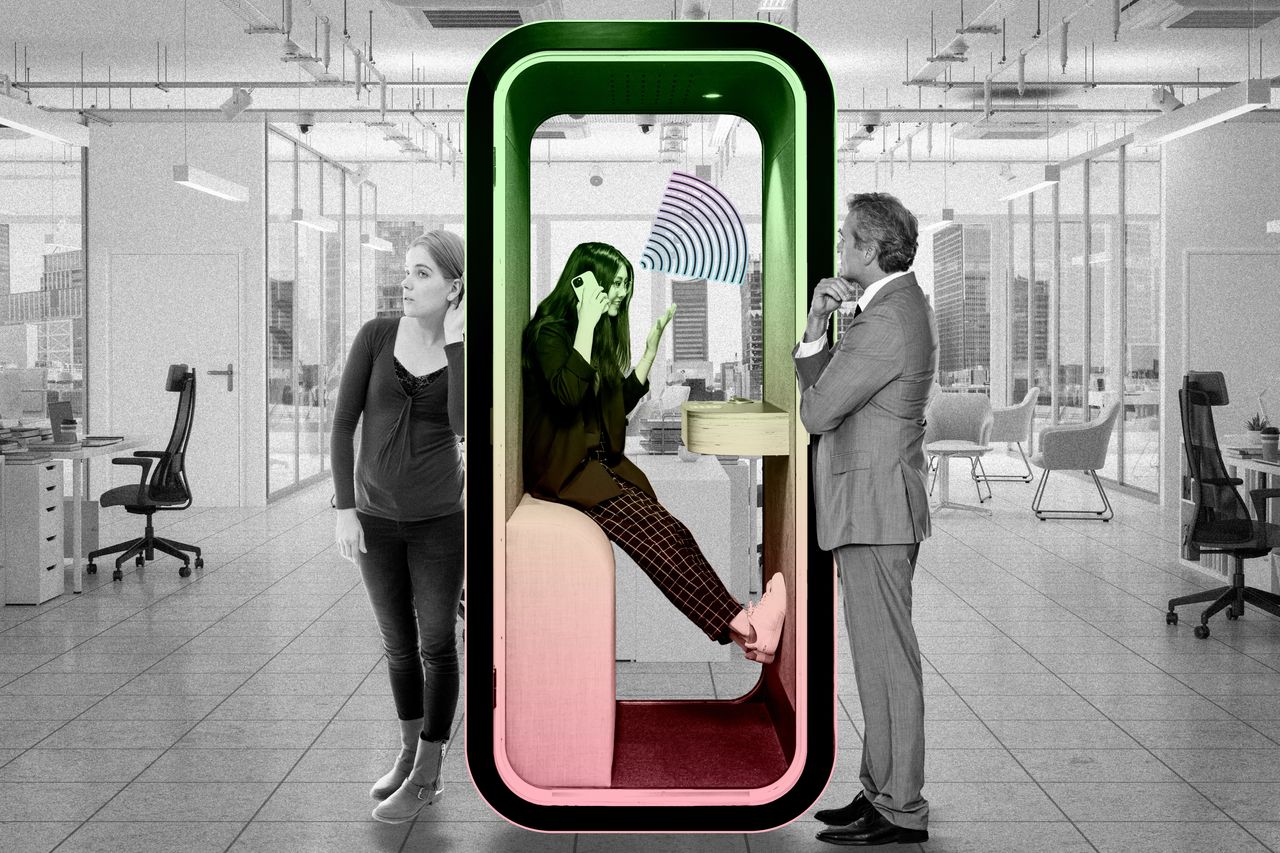
 Copyright 2020, Dow Jones & Company, Inc. All Rights Reserved Worldwide.