How do you tell the time? Neal W. McDonough, the COO of a finance and policy startup in Ho-Ho-Kus, N.J., looks to Charlie Brown, the loveable, miserable “Peanuts” protagonist. An illustration of the character occupies the exec’s watch dial, Brown’s stout arms acting as the minute and hour hands.
McDonough, 55, bought the kooky Timex for a Valentine’s Day trip about five years ago, along with a matching model depicting Lucy van Pelt (Brown’s frenemy) for his then-girlfriend. To his surprise, he kept wearing the $150-ish ticker after the trip. “It’s now my business watch,” he said, adding that such a non luxury model can telegraph that he’s under no obligation to be flashy. “I have nothing to prove to anyone,” he said. “And the fun thing is, a lot of people notice [my watch].”
Though finance guys famously flaunt Rolexes or Patek Philippes on their wrists, an established subspecies of money men goes the other way entirely. In place of a sleek steel case and elegant ceramic dial? Mickey Mouse. SpongeBob SquarePants. Fanta-orange rubber straps.
Over the years, highfliers have made headlines for sporting Swatches. (See: Blackstone Group CEO Stephen A. Schwarzman or former Goldman Sachs CEO Lloyd Blankfein .) That “wealthy guy, cheap watch” ethos continues to resonate in boardrooms and on trading floors, with men of all seniority levels embracing plasticky, offbeat designs, from superhero models to calculator Casios. Many resemble something you might win in a claw machine. Priced from $30 to a few hundred bucks, they’re a bit of fun and a different sort of flex, conveying an “I don’t need a Rolex” bravado that comes from having made it. Call them anti-status watches.
Patrick Lyons, the managing partner of a family office in New York, rotates two contrasting watches: a 1988 Santos de Cartier and a Nickelodeon “SpongeBob SquarePants” model with a tangerine strap.
The Cartier, a family heirloom, is a slice of French sophistication; the Nickelodeon dial features a giant image of a pink starfish named Patrick Star who lives under a rock. Lyons, 35, likes that the second watch is idiosyncratic—and that its starfish shares his name. “I wear that more often than my Cartier,” he said, adding that he hopes to pass down both models to future offspring.
Leroy Dikito, 42, an executive director at JPMorgan Chase in New York, chose his $450 “Avengers” watch from Citizen because it reminds him of his father, who loved comic books. Though its stainless-steel strap reads urbane enough, its cheerfully garish dial slices together images of the Hulk, Iron Man, Captain America and other superheroes. Working in finance, you need to be “serious all the time,” so a fun watch brings welcome levity, said Dikito. “People need to know there is more than the big job and the title.”
Since a suit can only inject so much colour, a watch offers that rare opportunity to “show off your personality,” said Eli Tenenbaum, 36, the director of corporate development for a New York private-equity firm. Plus, he noted, “If you wear a fancy watch, chances are someone else may be wearing the same one.” Tenenbaum runs little risk of twinning with a colleague when he straps on his Mickey Mouse or Snoopy Swatches, worn with premium Brioni or Zegna suits.
Evan Vladem, 37, considers his Casio calculator watch a neat “ice breaker” when schmoozing, a professional obligation for the partner at a financial advisory in Fort Lauderdale, Fla. “It came in handy to break up awkward moments,” he said of the black, $30-ish design, a Casio classic. At a dinner with an insurance partner a few years ago, he recalls, the conversation petered out after an exchange about a client’s situation, which involved some financial arithmetic. “I pulled out my wrist and said, with a smile, ‘Well, I’m happy I have my trusty calculator watch to help me here,’” said Vladem. “We both laughed. [It] kicked off another conversation.”
Even men who have invested heavily in high-end horology seem to be falling for cheap, kitschy designs. Scott Jay Kaplan, 44, a film producer and financier for Brooklyn company CoverStory, owns pricey models from Rolex and Audemars Piguet. But for daily wear he’s currently favouring a super-chunky $25 watch he bought in Argentina this past winter, a model similar to a G-Shock but by an unfamiliar brand. He says he has received a lot of compliments on it, and it has held up surprisingly well. “I bought it because it looked silly,” he said. “Not for clout.”
McDonough, the Charlie Brown fan, urges anyone considering a novelty ticker to follow just one rule: Don’t splurge. “I think the whole idea of luxury watch brands coming out with ‘kitsch’ watches is…a little bit absurd,” he said. “So anything over, say, $500 would be out.”
Prop styling by Marina Bevilacqua
The Wall Street Journal is not compensated by retailers listed in its articles as outlets for products. Listed retailers frequently are not the sole retail outlets.



 3 min
3 min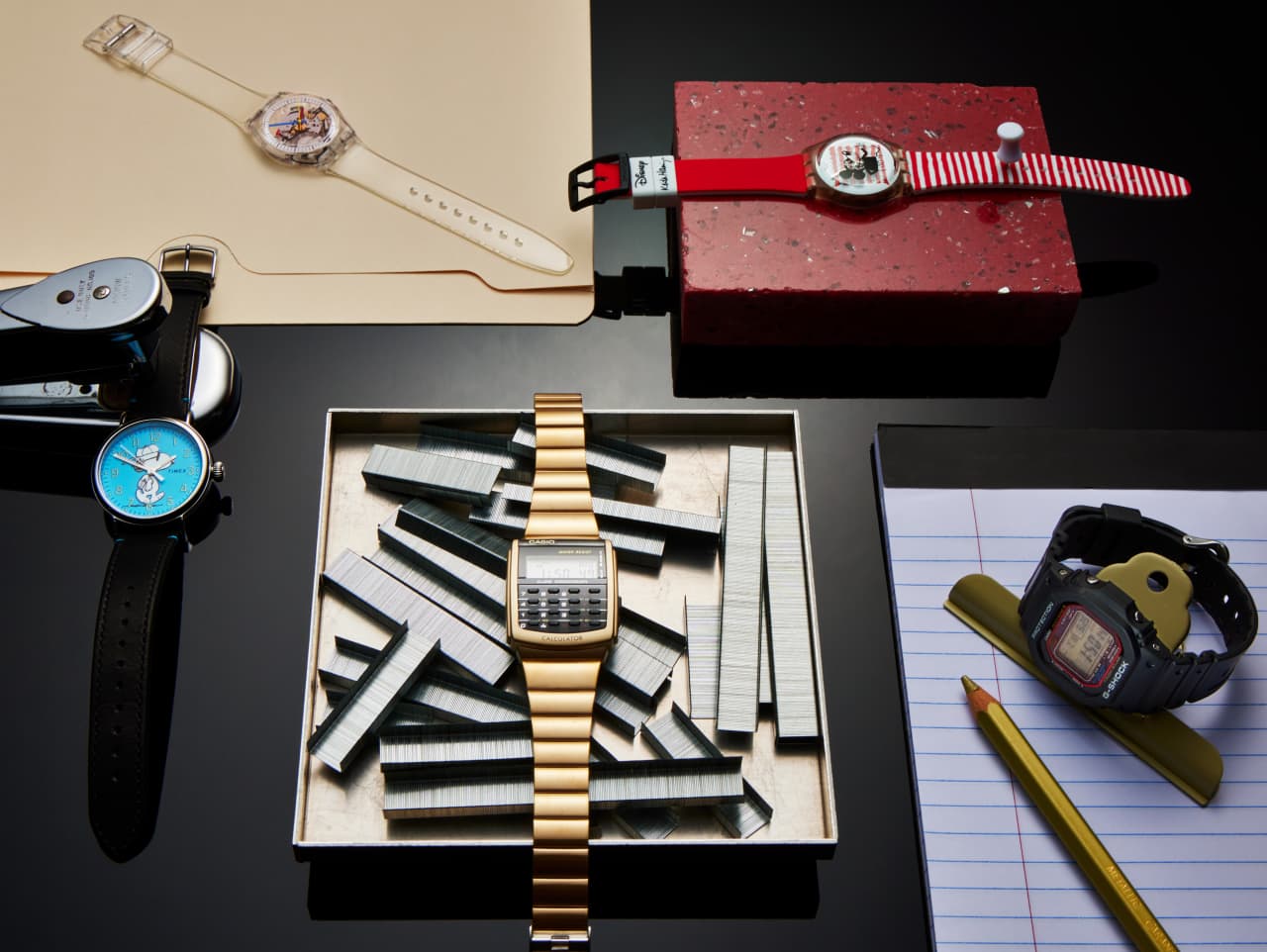
 Copyright 2020, Dow Jones & Company, Inc. All Rights Reserved Worldwide.