
What Readers Want to See in the Workplaces of the Future
Ideas for improving office life, courtesy of those who have to work in them.

By DEMETRIA GALLEGOS
Tue, Jan 6, 2026 1:10pm 4 min
4 min
4 min


Ideas for improving office life, courtesy of those who have to work in them.
4 min
From mazes of cubicles to plentiful lush balconies , office designers keep re-envisioning spaces to support our professional lives. Not all of their ideas have been…work-friendly, shall we say.
We thought it would be productive to ask the workers themselves—in this case Wall Street Journal readers—for a little brainstorming to see what their employers could be doing better.
We asked, What office-design change would you most like to see?
Their responses covered a lot of ground, from workplace conventions to technology to the environment itself.
Similar to a lunch break, I wish we could have a phone break each day. Staff members would place their phones in a box that would then be removed and face-to-face conversation would be encouraged instead.
This is an important cognitive disconnect. People are responding more slowly to face-to-face conversations as their minds alternate between concentrating on their device and in-real-life interactions.
This no-device speakeasy would be less structured around work and more like a hangout: Someone just kicks off a conversation and folks follow on.
• Desmond Latham, Pearly Beach, Western Cape, South Africa
One way companies could make the return to office smoother would be to have assigned offices and desks.
Having a consistent space provides employees with stability and a sense of belonging, rather than navigating the uncertainty of finding a spot each day.
• Gabriela Valdez, Prosper, Texas
I would like to see office buildings that blend seamlessly into residential neighbourhoods. I
nstead of towering corporate headquarters in city centers, companies would operate from house-like suites scattered across communities.
Employees could walk to work, bring their children or pets along, and enjoy flexible hours without the grind of daily commuting.
Walls would be lined with immersive video screens, allowing teams across the country to collaborate as if they were in the same room.
This model could save trillions in transportation costs, road construction and pollution while offering workers a healthier and more affordable lifestyle.
By eliminating the need for massive skyscrapers, corporations would redirect capital into smaller, interconnected hubs that foster community integration.
The environmental benefits are equally striking: fewer cars on the road, reduced emissions, and less strain on public infrastructure.
• Michael Lowery, Colorado Springs, Colo.
I’d like to see a focus on the actual employees.
Why aren’t employers asking them what spaces they need to do the most productive work?
What environments are most conducive to enjoying the work they do? Private offices aren’t the answer for everyone but most workers need more than a traditional cubicle.
Same with artwork and furnishings. One size or style isn’t appealing to everyone.
• Nancy Sanders, Phoenix
I want an actual functioning cone of silence at work. This would be used so workers that are on conference calls for many hours every day don’t disturb their co-workers with all of their talking.
At many firms, offices with hard walls and doors are only assigned to managers with a minimum number of direct reports.
I think they should be assigned instead based on how many hours a day the person is on conference calls.
And that’s not for the benefit of the projects they manage but for everyone else who otherwise has to listen to one side of a conversation for four to six hours a day.
I know many companies are enthusiastic about open-office plans, but I don’t know any engineers who like them, so many have no choice but to wear headphones and play music to drown out the distractions, which leads to isolation even in a well-populated office.
• Paul Egan, Milwaukee
I’m gobsmacked that there is no mention of bathrooms in these stories about future office design. If you want to get employees back to an office, offer more privacy there.
• Lisa Hale, Los Angeles
Standing desks are passé if not accompanied by an under desk treadmill.
• Taylor Archibald, Provo, Utah
I’d like to see a return to cubicles or small alcove-style workspaces and a step away from the fully open-office concept.
Open layouts were meant to spark collaboration, but in practice they often create constant noise, distractions and a sense of being “on display.”
Most knowledge work requires periods of sustained focus, and people do their best thinking when they have a bit of privacy and control over their environment.
Cubicles and alcoves don’t eliminate teamwork, but simply give employees a dedicated space to concentrate, recharge and hold quiet conversations without disrupting others.
When combined with designated collaboration zones, these semiprivate spaces create a healthy balance between focus and teamwork.
In a hybrid-work world, the office should be a place that enhances productivity and restoring a sense of personal space would help achieve that.
• James Wright, Grand Rapids, Mich.
I’d love to see the addition of some colour. Any colour at all besides gray and beige. I’ve worked in offices for most of my life, and the “grayge” neutrals are suffocating.
I would also like to have more powered standing desks in the office. The hand-operated ones are too complicated or too fragile to allow for regular lifting and lowering. Every one I’ve had has broken.
• Tony Holmes, Prince William County, Va.
I wish we had more flex space.
That would be where office designers create a variety of workspaces: standing desks, treadmill desks, quiet rooms, lounge areas, etc., so the team can move through different ergonomic worksites throughout the day and keep their bodies and minds flexible and active.
• Sam McNulty, Cleveland
I believe that companies should focus on how to make the workplace more comfortable, even homey.
We spend more of our time at the office than we do awake at home. The office therefore should be a place that one looks forward to going to.
This could be achieved with upholstery that shows the company cares that you’re there.
Comfortable chairs and desks, up-to-date technology, a subsidized kitchen and a dining room that invites collaboration and connection between co-workers.
• Andre Mora, Miami
We need nap areas, like pods or mini-bedrooms as well as gym and shower areas.
• Sara Jones, Hillsborough, N.C.
Get the private offices with doors away from the perimeter windows! Move those offices to the interior of the floor plates so more light can flood the workspace and everyone can look out the windows!
Our office was reworked this way and our copy/print/supply area ended up along a perimeter window.
Everyone looks outside while they wait for the print jobs to finish.
We also used low-rise desks so it’s possible to look out the perimeter windows from the private offices.
Our private offices are glass-doored and glass-walled, so there’s a lot of visibility throughout our offices.
• Andrew Skotdal, Everett, Wash.
I’m hoping for a coffee-delivery drone robot that lets me stay on a two-hour call without a BRB (Be Right Back) coffee break.
• John Dabbar, Oyster Bay, N.Y.
 Copyright 2020, Dow Jones & Company, Inc. All Rights Reserved Worldwide. LEARN MORE




The Australian leather house has opened an immersive four-day pop-up in Manhattan, unveiling its Bloom Collection and redefining what a product launch can look like.
Following the successful launch of its Palais Collection, MAISON de SABRÉ has unveiled a new modular handbag system offering more than 720 styling combinations.
Could fears of an AI apocalypse be distracting us from the dangers already here? Experts debate whether regulation should focus on speculative existential threats or present-day harms, including cyberattacks, weapons and unsafe autonomous agents. Read more via the link in bio.
5 min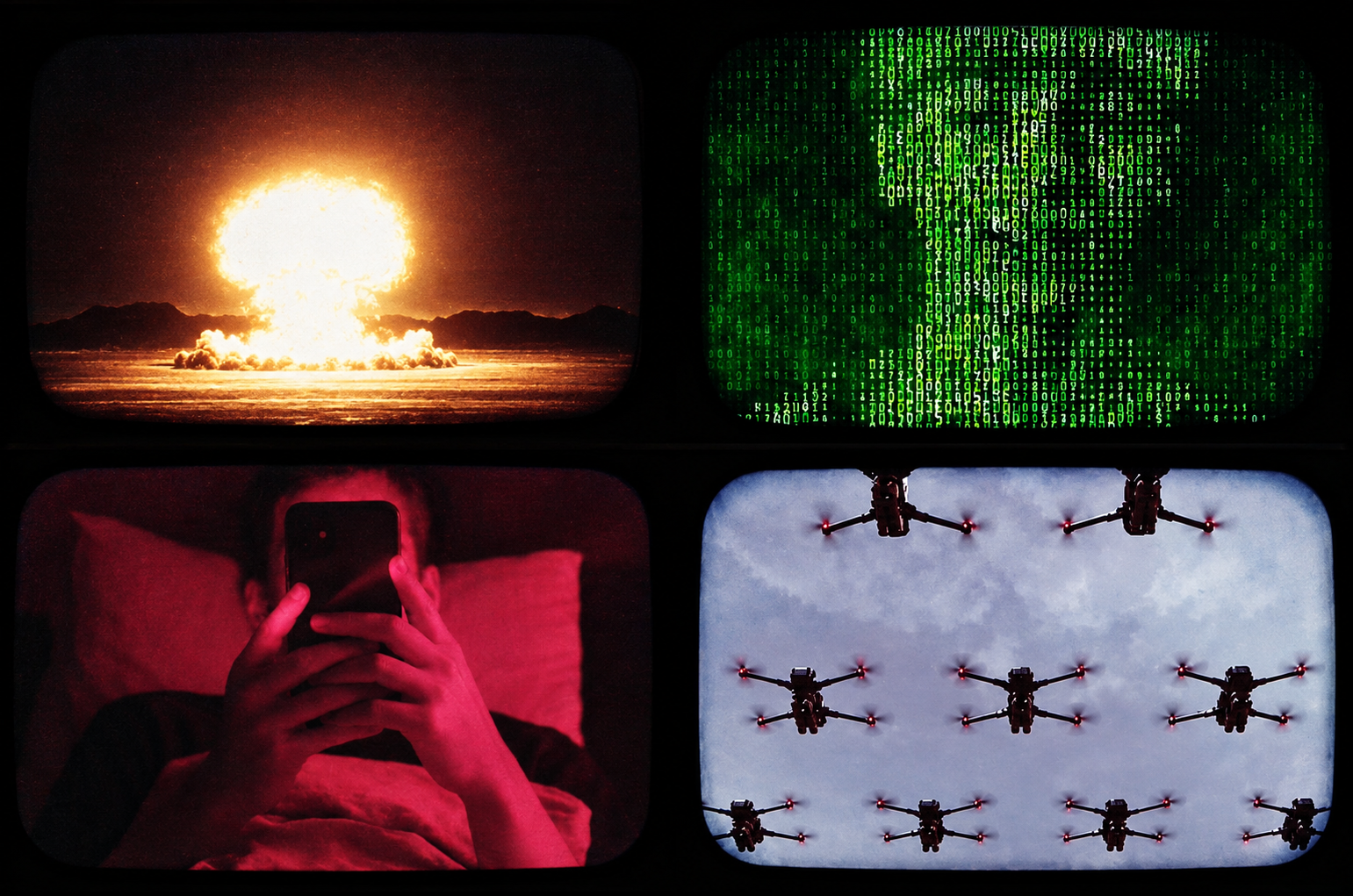
There is ample and alarming evidence that artificial intelligence can help humans do bad things, such as committing cyberattacks, building weapons and even killing themselves or others. The Hugging Face hacking episode—and a growing list of others by poorly constrained swarms of agents—indicate just how powerful and potentially dangerous AI has quickly become.
Yet many inside the U.S. AI industry insist far worse is coming, on account of the imminent arrival of AI with superhuman and self-improving abilities.
Plenty of experts, including many who study AI harms for a living, are skeptical. The so-called doomers’ assertion that AI might decide to wipe out all of humanity—or even “just” topple human civilization—is contingent on it achieving a pace of development not yet seen.
And if the assumptions behind this global-doomsday scenario are wrong, it could lead us to curb or regulate AI in ways that don’t address its real harms.
At the center of this debate is the claim that current AI systems might take over the job of training their next versions, a process called “recursive self-improvement.” Think of it like evolution on steroids—billions of years happening at light speed within vast AI supercomputers. Anthropic Chief Executive Dario Amodei recently proposed a global agreement to slow down the pace of releasing new AI models, with the goal of delaying the arrival of recursive self-improvement.
“I don’t think we’re anywhere near ‘artificial general intelligence,’” says Melanie Mitchell, a professor at the nonprofit research group Santa Fe Institute who studies AI. She said AI is making impressive strides but thinks claims by engineers that they’ve achieved recursive self-improvement don’t stand up to scrutiny.
She is hardly alone. A recent paper by two dozen academics at Princeton, Stanford and other institutions found that even the most cutting-edge AIs are incapable of doing the original research required to advance the AI frontier.
Two of the authors involved in that paper also threw cold water on the idea that the Hugging Face swarm hack by OpenAI agents occurred because of a breakthrough in intelligence. The attack succeeded primarily because of a lack of basic technical guardrails, not an unmanageable explosion in AI capability, they wrote.
Yann LeCun, former chief AI scientist at Meta, posted that this analysis was “a welcome dose of sanity in an otherwise insane debate.”
OpenAI and Anthropic didn’t respond to several requests for comment.
The people who disagree with the doomers still consider AI to be dangerous, and point out that such systems don’t have to be particularly capable to be powerful. Some argue that AI should undergo regular evaluation by outsiders and that the companies that make it should be held responsible when their systems do harm. AI should also be treated the same as airplanes and elevators, and should be designed to do the least harm possible, they say.
“If you believe that technology is powerful enough to create novel, dangerous viruses, or to essentially take over the whole planet for some reason, then it must also be strong enough to create cures for cancer, to cure aging, to fix socio-economic or political problems,” says Christopher Canal, CEO of EquiStamp, a company that helps companies and governments evaluate AIs.
AI has shown an ability to rapidly advance because it is matching the abilities of humans who are constantly feeding it their knowledge. Sometimes it can recombine that knowledge and exceed what people have been capable of, through a kind of post-training known as reinforcement learning, as we’ve seen in mathematics.
Today’s LLMs are “models of knowledge” rather than actually intelligent, wrote Yi Ma, professor of AI at Hong Kong University.
Researchers at universities and commercial AI research labs in China wrote in a recent paper that autonomous, self-improving AI is likely to be a long way off, due to the sheer number of breakthroughs required. They also argue that humans will probably remain in the loop, supervising that process—and gating how fast it can occur.
Vals AI, a company that evaluates today’s AI models, maintains an RSI Index that benchmarks whether models can “do the research that builds the next model.” So far, no publicly released model is even close.
Yet Rayan Krishnan, CEO of Vals AI, says his team projects models will exceed humans’ ability to improve the next generation of AIs by August 2027, or sooner, and at that point could start building their successors all on their own.
“Once we get to recursive self-improvement, the fear is that all bets are off,” he says. “You could end up with a ‘fast takeoff’ situation, where the models quickly acquire skills and eclipse humans across every possible domain.”
In a reply to the resignation tweet heard round the world from Jacob Coxon, another Anthropic engineer declared his belief that those odds were at least 10% over the next decade. Many others in the industry chimed in to say they thought the percentage was even higher.
Some who argue the end is nigh say they calculate their personal p(doom) based on a chain of conditional probabilities—a bit like the Drake equation for calculating the likelihood of intelligent alien life. Since all those probabilities are based on speculation, estimates range from 0% to nearly 100%. Many land around 10%.
“The weird thing is that if you go back and look at the predictions on this over the last 10 years or more, it’s always been 10%—it’s just a nice round number,” says Mitchell. “I think it’s all vibes, and there’s no actual evidence or calculation.”
One argument against worrying about superintelligent AI is that the world is full of unlikely humanity-ending disasters, and trying to avert them all can make it impossible to prioritize, says Canal.
This has led AI experts and the policymakers who listen to them to propose remedies that don’t get at its real and present dangers.
AI companies’ proposals to “pace the frontier” aren’t addressing the problem in the right way, argues Stuart Russell, a computer-science professor at the University of California, Berkeley, and the president of the International Association for Safe and Ethical Artificial Intelligence.
“It’s like saying we’re driving toward the cliff at 60 miles per hour and we’re going to drive toward it at 40 miles per hour instead, and everything will be OK,” he says.
Russell and his peers have proposed that AI companies should have to meet the same standards that govern other areas of everyday life, from air travel and buildings to food and drugs. They highlight the “behavioral red lines” AI should not be allowed to cross. Breaking into other computer systems, stealing information or advising terrorists on how to build biological weapons are all illegal for a human to do, and should be illegal for companies’ AIs as well, he argues.
The challenge for AI companies in such a proposal, he adds, is that it would be a de facto ban on today’s advanced AI systems, since the companies behind them don’t know how to make them respect such boundaries all of the time.
Others have proposed something like the Food and Drug Administration, but for AI, but setting up a new agency has so far been a nonstarter in Congress. And some prominent voices in tech have said such a structure would give up America’s AI edge to China.
Given the bipartisan groundswell of support for curbing AI companies and their creations, however, that may soon change.
“The tech industry has had this mantra for decades that regulation is bad,” says Russell. “They don’t accept the liability for any harm, and they hide behind free speech. That, I think, has to change.”
