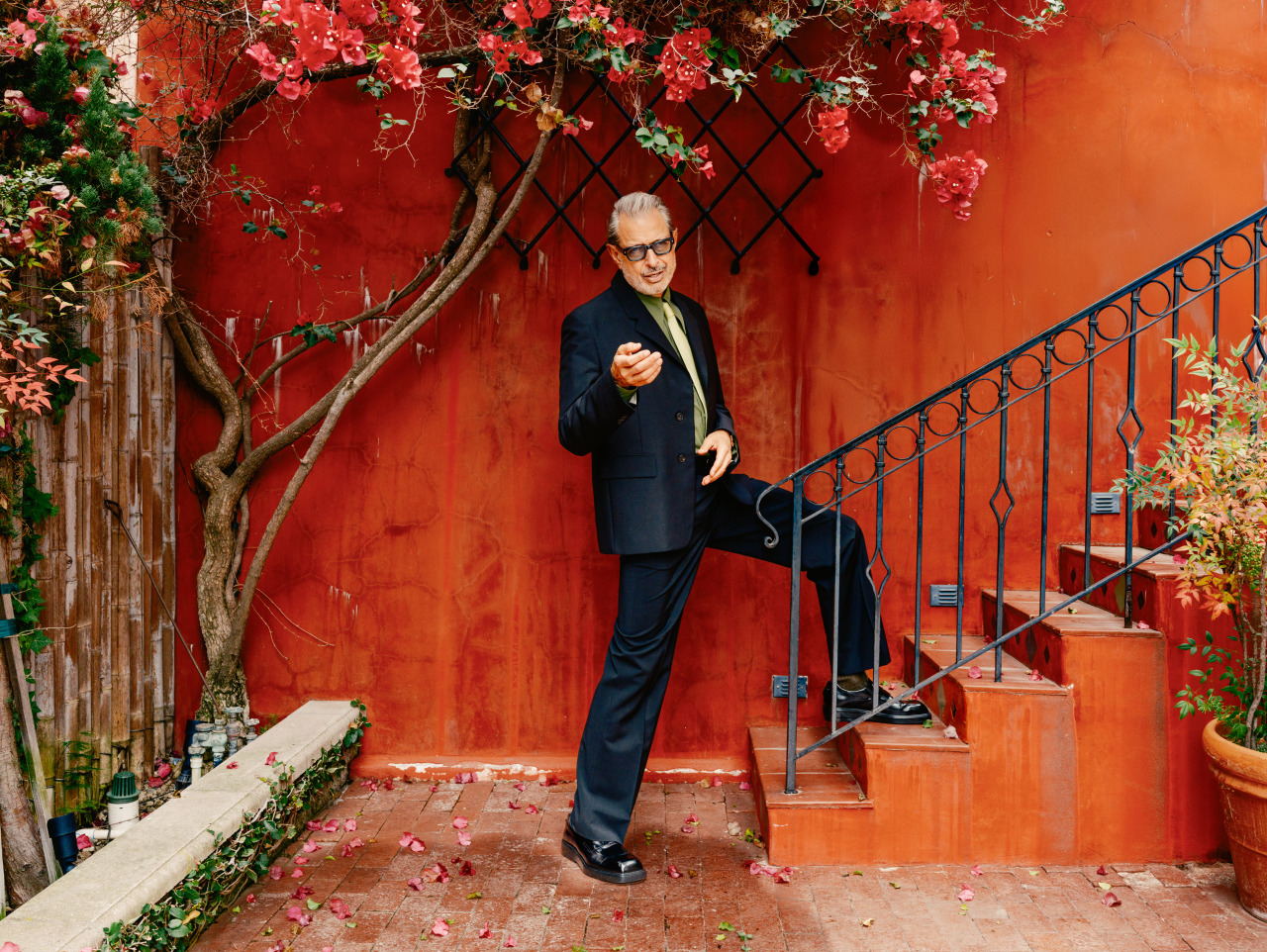
Jeff Goldblum on Leather Jackets, Fist Bumps and His ‘Darn’ Oura Ring - Kanebridge News
Share Button

Jeff Goldblum on Leather Jackets, Fist Bumps and His ‘Darn’ Oura Ring

The 73-year-old star of ‘Wicked: For Good’ gets cameras flashing with his kooky off-screen style. Here, he discusses his morning stretch routine, a work-in-progress sock drawer and his antagonism toward fitness rings.

By Marshall Heyman
Tue, Nov 18, 2025 9:59amGrey Clock 5 min

From a young age, Jeff Goldblum had an eye for clothes. Growing up in Pittsburgh, he wanted glasses like John Lennon’s and turtlenecks like the Rat Pack’s.

As a member of New York’s Neighborhood Playhouse studying under the legendary Sanford Meisner, he scoured vintage shops for Russian-style overcoats and aviator hats.

After his success in blockbusters like “Jurassic Park” and “Independence Day,” he went through a Japanese-denim phase and loved what he calls “I’ve-been-working-on-the-railroad-type vests.”

“I’ve swung wildly, and I’ve had a lot of bad ideas,” Goldblum said of his style on a recent Zoom. 

The 73-year-old wore a bespoke green shirt from Anto, a shirtmaker based near his Los Angeles home.

On his feet were light-green socks, and handmade shoes from Florence, where he lives part-time with his wife, Emilie Livingston, and their two sons. 

This month, he reprises his role as the Wizard of Oz in “Wicked: For Good,” the second installment of the film adaptation of the musical juggernaut. He insisted he’s not contracted by Universal Studios to only wear green on the press tour.

In the last decade the world has paid more attention to the actor’s off-screen style, which has evolved since he began working with stylist Andrew Vottero around 2014.

A silver-haired fixture on best-dressed lists, Goldblum often finishes his zany outfits with chunky black specs. He has collaborated with glasses label Jacques Marie Mage and formed a close relationship with Prada , walking its runway and appearing in a 2022 brand campaign.

Here, Goldblum, who regularly performs with his jazz band the Mildred Snitzer Orchestra, talks cashmere, vegan Bolognese and handshakes.

Studying with Sandy Meisner was: a portal into my more-intense interest in clothing. Everything could be a key to finding a character, behavior and discovering who you are in the story – (for example) how the shoe felt and how it made you walk.

You don’t really see: a 1970s-style long shirt collar in stores. I had this green shirt I’m wearing made at Anto in Los Angeles. I have them in a bunch of flavors, including some with Western buttons. I’m thinking about getting one in orange.

I just read: James Kaplan’s two-part biography of Frank Sinatra, whose favorite colour was orange. I’ve always liked orange.

I like: that Marie Kondo book “Tidying Up.” In my youth, my family left me alone one day in the garage. It seemed messy to me. I started to throw everything away. I was sweating under my arms with excitement. I got a big kick out of it.

My kids: like to wear my band merchandise. They sometimes help me dress. I say, “Hey, pick out what I’m going to wear.”

I’ve had to get cozy with one or two: leather jackets for parts like Ian Malcolm in “Jurassic Park.” I have a Saint Laurent motorcycle jacket that I wore the other day that’s kind of tight. I like it a lot.

I probably wouldn’t want to wear: real fur. I’ve stopped eating animals except fish. It’s part health-wise from my nutritionist and part my own feeling about it.

My favourite meal is at: Craig’s in West Hollywood. My wife and I share a chopped salad, minus the cheese, to start. They have a spaghetti squash primavera with broccoli and a spicy tomato sauce. I get it with shrimp or vegan Bolognese.

I’ve always been hypersensitive to: certain fabrics, such as wool. I’ve recently accepted—what’s that wool called?—cashmere. I don’t like things that itch. And I don’t like tags in the back of my shirt. I use a professional seam ripper to cut out tags.

What drives me crazy are: printing machines and my phone, especially how it breaks down so often. I had to deal with that this morning.

My feet must be: comfy cozy. My wife, a ballet dancer, says we’re not really working unless our feet are bleeding. I can’t accept that. I really like these handmade shoes I had made in Florence. They’re the most comfortable ever.

Florence is: a jewel box of a city. I’ve found the people delightful and the quality of life great. There are so many artisans. My favourite hat is one I purchased at the Borsalino store. I don’t know any Italian. Just a word here or there.

I don’t want to get sick so I prefer: fist bumping to a handshake. My knuckles have hurt from a too-hard fist bump. So let’s fist bump gently. Let’s just fist touch.

I have to organise my: sock drawer. It’s in the research and development stage. I’m very into socks of one kind or another. I like to experiment with a colour, which is why I have a light green pair on now. For tight shoes, I like (thin) Pantherella socks . I like a shorter sock, too. Sometimes I make it look like it’s falling down.

For a while I had an aesthetic allergy to: cobalt blue. You’d see it on a lady’s blouse sometimes, and I would go, “That hurts! It’s too bright.” But yesterday, after going to the Dodgers game with my kids, I put on a Dodgers blue cobalt sock, and I was very happy. So I’m nothing if not changeable.

I love: pockets. I recently got a minty green chore coat by the Row that I really like. Its flap pockets are deep enough that things aren’t going to fall out. I’d never even heard the term “chore coat.” It carries my wallet, keys, maybe a Kleenex, a lozenge, a little pillbox with an aspirin and some hand sanitizer.

I never used: sunscreen. But my wife has got me using Sarah Chapman sunscreen , sometimes even tinted. I’ll use a Joanna Vargas serum of some kind. I’m not sure what it’s doing, but I put it on at night. I imitate Boris Karloff (in the “Frankenstein” films) and I make a joke with Emilie that I’m going to my laboratory to work on my new longevity theorem.

My acid-reflux man said: “Take care of your vocal cords.” So I’m off caffeine. I’ll have a Ryze mushroom coffee in the morning—a scoop with hot water and oat milk. Sometimes the kids will make me a decaf cappuccino with oat milk and a sprinkling of chocolate powder, and that is too delightful.

For many decades: I’ve been totally on the natch. I’ll have a sip of red wine if Emilie says it’s really fantastic, but I don’t want to get loopy.

I get the usual: seven or eight hours of sleep. I stopped wearing my Oura ring. I’d be in bed for 8 hours and it would go, “No, Jeff, let’s call it 5½ hours that you got.” It used to say, “You’re somewhat ready for the day,” and I’d say, “Go to H-E-Double Hockey Sticks.” I threw the darn thing away. I go with how I feel.

When I wake up: I go through the little vestige of transcendental meditation I learned decades ago. I crack my bones and do this stretching routine that ends with my taking a tennis racket and going through the motion of a backhand, forehand and serve. Then I take a Centrum for Men multivitamin, play my piano and work out in our gym.

Early on I was: a lanky guy. Then I started lifting weights. I wanted to steer some of those roles that were a little nerdy—even those scientist parts—in a cooler direction.

Am I: nerdy or cool? Well, these days, according to some circles, the two have overlapped. At this point, who knows?


MOST POPULAR

The Australian leather house has opened an immersive four-day pop-up in Manhattan, unveiling its Bloom Collection and redefining what a product launch can look like.

Following the successful launch of its Palais Collection, MAISON de SABRÉ has unveiled a new modular handbag system offering more than 720 styling combinations.

Related Stories
Lifestyle
Academia Is in Trouble and This English Professor Understands Why
By 03/09/2026
Lifestyle
Shein Had 4.4 Billion Reasons to Speed Its IPO Along
By Esther Fung 01/09/2026
Lifestyle
How to Outsmart AI When It’s Tracking Your Workday
By Callum Borchers 20/08/2026

Randy Boyagoda’s new novel, “Lords of Serendipity,” delivers a biting satire of cheating, politics and dysfunction across modern universities.

By
Thu, Sep 3, 2026 5 min

Administrative cowardice. Rampant cheating. The soaking and scamming of undergrads and grad students. Performative wokeism. Intensifying competition for international tuition dollars from an expansive China.

These are either the latest dire headlines about American higher ed or the myriad subplots of “Lords of Serendipity,” an ambitious new novel by Randy Boyagoda. Unlike most campus fiction, its scope extends well beyond the cloister of the liberal arts classroom to whammy the entire university system, from its financial model to its function within a globalized economy. Along the way, it skewers its lightning-rod targets with a precision too sharp to be considered entirely fictional.

That its author is not only well-versed in satire, having written four other novels in the genre, but is also a professor of English at the University of Toronto and an experienced college administrator, further blurs the lines between comic fiction and brutal fact. It’s the kind of no-holds-barred book only a consummate insider would know to write—but only one who is also conveniently outside the American university system could get away with writing.

“This is someone who’s got the inside dope on what can go on at universities, especially with international students, and what kind of con games are going on,” said Margaret Atwood, a friend and fellow Torontonian.

The novel, like Boyagoda himself, is often very funny—even as the dilemmas its characters face read as tragedy. Its cast includes the bickering members of a Sri Lankan hotel cleaner’s family, insecure American freshmen, dead-end third-tier college professors and their highflying Ivy League counterparts and dispirited university functionaries. An old-fashioned Dickensian tale, it sweeps across continents and campuses, from a classic liberal-arts college to a stand-in for Harvard University to an urban technical school to the dilapidated buildings of a state-run university in Sri Lanka.

“I’m a joyful person,” Boyagoda said in an interview, though he prefers to see his outlook on academia as “hopeful” rather than optimistic. He smiles and laughs frequently. He bikes everywhere. He derives energy from his students and from his four daughters, ages 14 to 20. They help him and his American wife, Anna, also an educator, care for Boyagoda’s father, an immigrant from Sri Lanka who has dementia and lives with the family.

Randy Boyagoda speaks at a panel discussion.
Randy Boyagoda taking part in a panel discussion at the University of Toronto in 2024. Polina Teif/University of Toronto

The germ of the novel came to Boyagoda during the pandemic, when he was serving as a vice-dean. An urban legend was circulating about a statistics grad student selling passing grades to international students. The cheating scheme itself may well have been apocryphal, but it felt tantalizingly plausible.

“As a novelist, it stayed with me,” Boyagoda said. “Who would sell grades for a stats course? Why would someone buy grades? What’s motivating them? Why wouldn’t the university be doing something about it?” What he didn’t want to do, he explained, was write “another novel about a creative writing professor and his drama with students.”

In addition to writing novels—the first of which was a finalist for Canada’s prestigious Giller Prize; he’s written eight books in total—Boyagoda teaches literature full-time. For his students next semester, kids raised in a purportedly “post-literature era,” he’s assigning three 700-page novels, he noted mischievously, books by George Eliot, Ralph Ellison and Kiran Desai.

On RateMyProfessors, students remark on Boyagoda’s heavy assignments, tough grading and distaste for cellphones, but also hail his “comedy.” When alerted to these reviews, Boyagoda laughed. “Guilty as charged,” he said.

“Randy’s one of those people in academia who is very well educated but doesn’t have an ounce of superiority about him,” said John Irving, who frequently guest lectures in Boyagoda’s classroom. “It’s amazing to see how willing students are to talk in his classrooms, how little afraid they feel of being mocked or put down—he gets complete candor out of them.”

Negotiating competing interests seems to come naturally to him. Like many college campuses, after the Oct. 7 Hamas attack on Israel, the University of Toronto was embroiled in protests, encampments and discord; part of the school’s response was to convene a working group on civil discourse. Boyagoda was put in charge, serving for two years. It’s the kind of thankless task many professors would flee from, but Boyagoda relished the prospect and thinks the group, which is ongoing, made progress.

He has since pivoted to another formidable academic concern: the waning prestige of the humanities. In July, Boyagoda became the director of the Jackman Humanities Institute and special advisor on the humanities to the dean of arts and science. This fall, he is starting a series of gatherings he calls the Dead Book Club. (Dead writers feature heavily among his favorites: St. Augustine, Dante, William Faulkner, Evelyn Waugh, Saul Bellow.)

“The goal is to encourage students to read for its own sake and have conversation for its own sake,” Boyagoda said. “The importance of the humanities will be revealed to those who participate.”

Illustration of the book cover for "Lords of Serendipity" by Randy Boyagoda, depicting a woman wearing a hat with various buildings on top, against a blue background with a white airplane.

“Lords of Serendipity,” which publishes next week, reflects Boyagoda’s commitment to the pursuit of knowledge: “I’m supposed to say I learn more from my students than they do from me, but no,” Boyagoda said. “I enjoy sharing my excitement and joy about literature and ideas. There are these moments when you are teaching and you can see someone’s face change because they didn’t know something and then they did. That moment when you’re actually watch someone enlarge themselves is deeply satisfying.”

In literary circles, Boyagoda is often referred to as a Catholic novelist, a description he embraces. “A novelist willing to give shape and voice to contemporary religious experience is needed,” Boyagoda said. “I understand myself as a Catholic novelist, provided that I’m not only a Catholic novelist, I’m also a South Asian novelist and I’m a Canadian novelist. I don’t want to be captive to one label.”

His characters, he said, are subjected to what he calls “Graham Greene character situations.”

“They are trying to do good in a fallen world and realize the most they can do is less harm than someone else would do in that same role,” he explained. “They have to accept they are complicit in something that provides some good thing to others. It’s a very Graham Greene way of thinking about sacrifice.”

The campus green they inhabit is a febrile zone in which lofty ideals and cynicism regularly collide. It’s a place where a traditional holiday college celebration is now an occasion for political protest. Kids freely police one another inside and out of the classroom with social media their constant, ready weapon of choice. International students, knowing their family’s financial futures hinge on their degrees, operate in terror of failure and deportation.

Early readers of the book include Gary Shteyngart and Junot Diaz, both of whom have taught at universities and written comic novels. They each contacted Boyagoda midway through to say, in essence, “You nailed it.”

As biting as “Lords of Serendipity” can be, Boyagoda’s faith in higher education remains undaunted.

“It’s absurd that we live in societies that make the decision to take people between the ages of 18 and 22, when they are most physically capable of contributing to our nations and communities, and tell them, ‘Go away for four years, and read and learn and have conversations,’” he said. “I want students to be aware of what an incredible privilege that is.”

Corrections & Amplifications
Randy Boyagoda is a special advisor on the humanities to the dean of arts and science at the University of Toronto. An earlier version of this article incorrectly said he is a special adviser to the dean of humanities. (Corrected on Sept. 2)