Page 20 – Kanebridge News

Mariah Carey’s Lavish Beverly Hills Rental up for Sale Asking $32 Million

A Beverly Hills mega mansion that singer Mariah Carey once rented hit the market Monday asking $31.99 million.

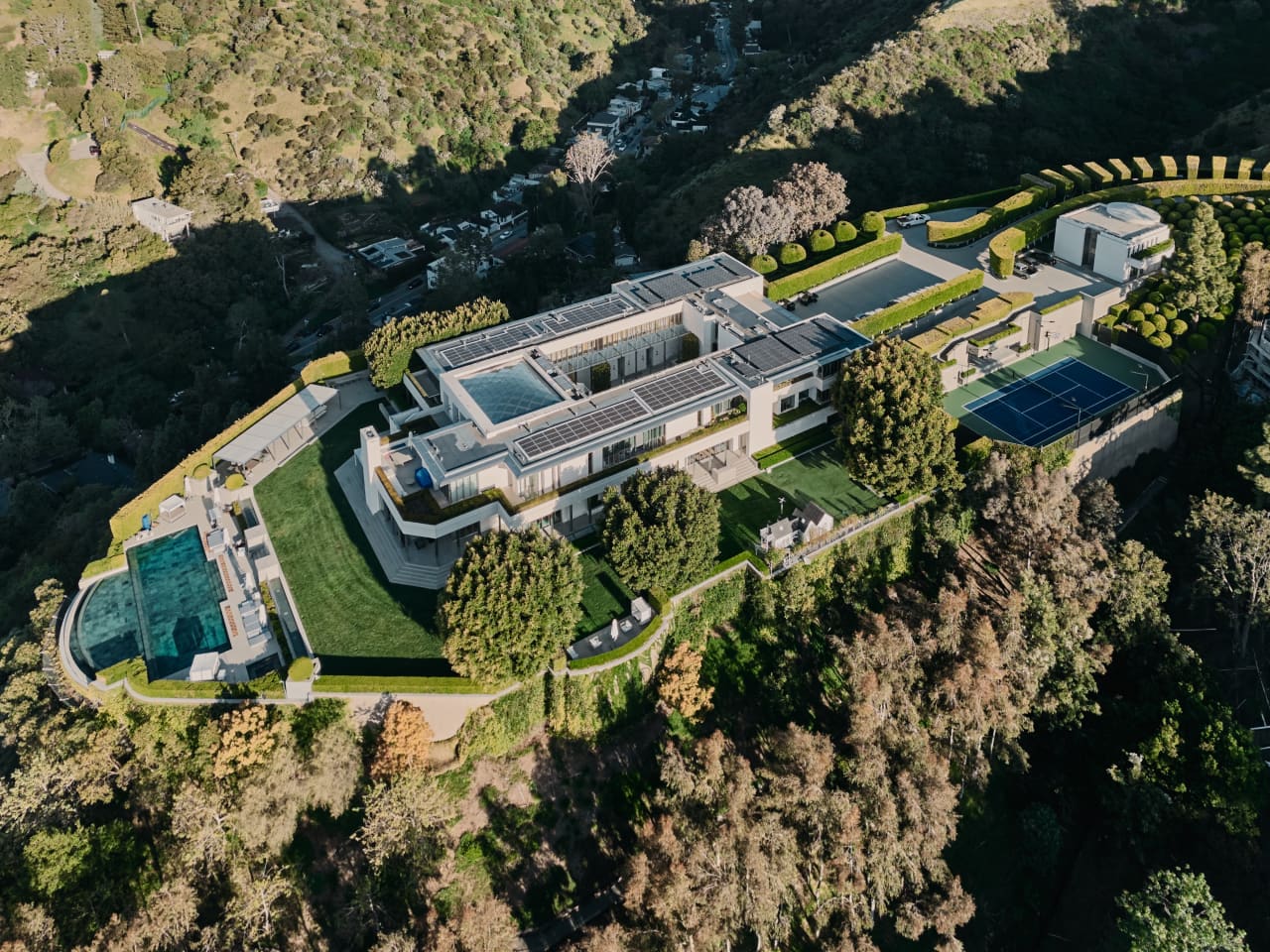
The 15,000-square-foot residence, inspired by a mashup of European architectural styles from Baroque to Louis XV, is located on a 0.6-acre lot on Laurel Way. The three-story home includes eight bedrooms, and an entryway that features a 30-foot rotunda and not one, but two imposing double stairways, one outdoors and one indoors.

It was built by a Russian couple who immigrated in the 1970s, and set about building their dream home, much to their neighbours’ consternation . “I used all of what Europe has to offer,” Natalie Glosman, whose husband Leonid is a dentist, told Today.com in 2014.

The Glosmans purchased the land for $2.2 million in 1988 and sold the home in 2019 for $30 million. The buyer was a California entity, BHLW LLC, according to property records. The manager for the entity could not immediately be reached for comment.

Last year, Mariah Carey rented the house for three months in the spring, which was asking for $125,000 in monthly rent at the time. The Queen of Christmas then partnered with Booking.com, which offered visitors a special two-night “ritzy summer reprieve” at the house, with a Carey-curated itinerary, including reservations to her favourite restaurants, according to marketing material from the booking platform.

Mariah Carey rented the Beverly Hills home in a promotion for Booking.com.
Photo by RB/Bauer-Griffin/GC Images

“One of my Lambs has the opportunity to experience L.A. in true Mimi fashion by staying in the same home and visiting all my favourite places in the area!” Carey said in the Booking.com news release at the time

The house has some additional Hollywood elan, as it served as filming location on several occasions. Danny DeVito and one of the cast members of the “Real Housewives of Atlanta” have been filmed there, according to Today, and in the second season of “True Detective,” it stood in for the “incredibly gaudy” home of the corrupt and alcoholic mayor Austin Chessani, according to Curbed.

In addition to its grand entryway, the home features arched doorways, French windows, coffered ceilings, wainscotting and Rococo wall mouldings, in a blend of Art Deco and Art Nouveau styles. Outside, there is a broad green lawn with a shaded sitting area, and a back patio with a glamorous pool to match the home’s style.

Alla Furman and David Kramer of Hilton & Hyland/Forbes Global Properties are marketing the property. They were not immediately available for comment.

Is This 1987 All Over Again? What’s Driving the Market Meltdown?

Financial markets are supposed to capture the wisdom of the crowd, but on Monday the crowd ran in all directions waving its hands in the air screaming. Japan’s stock market fell the most in 37 years with a 12% plunge that wiped out all its gains for the year, while in the U.S. the VIX index of implied stock volatility briefly had its biggest rise ever. Panic hit.

The selloff was triggered by Friday’s jobs data prompting a sudden switch in the economic narrative from soft landing to hard landing. Add to the mix a period of deflating hype about artificial intelligence and a Bank of Japan rate rise designed to strengthen the yen. News that Warren Buffett’s Berkshire Hathaway had sold half its Apple shares and boosted its cash pile added to the pain.

But the triggers couldn’t possibly justify the scale of the moves. When a new trigger arrived, in the form of better-than-expected data on the service sector, markets partially rebounded and the Vix fell sharply — again, far more than the data could justify.

The selloff—which at one point had chip maker Nvidia down 15%—was so big because investors had been all-in betting that things would work out well. Now things have calmed a bit, the question is whether the unwind of these bets, and the leverage behind them, is done. If it resumes, will the selloff feed back into higher savings and a weaker economy or, worse, hit the financial system?

The extreme examples of past effects from big market falls are 1987’s crash, 1998’s Long-Term Capital Management blowup and 2008’s global financial crisis. History is never perfect, but so far this looks more like a (much milder) version of 1987 than it does the other two.

In 1987, the stock market had its biggest one-day fall ever, with the S&P 500 down more than 20% on Black Monday in October. Investors had built up excessive leverage after a stunning 39% gain in the year to August’s high, and the crash led both to big margin calls and to badly designed automated trading that exacerbated the selling. But the Federal Reserve poured liquidity into the banks, brokers didn’t default and the market made back all its losses within two years. The economy was fine.

The good news was that 1987 was all about markets: They went up, they went back down, no one else was hurt. The S&P made 36% in the eight months to its August 1987 peak, similar to the 33% it rose in the eight months to the end of June this year. As in 1987, this year’s gains came in spite of tight monetary policy and higher bond yields. Just like today, in 1987 investors were on edge and ready to sell to lock in the unexpected profit. The losses are smaller so far, but lucrative trades have reversed , just as they did for the market as a whole in 1987.

In 1998, the situation was much worse, although stocks recovered more quickly. Highly levered hedge fund LTCM was crushed when Russia’s domestic debt default created a flight to safety. LTCM was big enough that it threatened to bring down Wall Street institutions. The Fed cut rates three times and pulled together a group of banks to rescue the firm and wind down its trades slowly. Stocks took just four months to recover, but the easy money helped stoke the dotcom bubble, which popped two years later and led to a mild recession—and gigantic losses for investors in tech stocks.

We don’t know yet if any hedge funds have been taken out by the big moves in markets, which have brought heavy losses for those engaged in the “ carry trade ” of borrowing cheaply in yen and buying higher-yielding currencies such as the Mexican peso or dollar. Large swings in Treasurys on Monday might also have hurt, given the large positions hedge funds hold. Traders are betting that the Fed will slash rates, with a super-sized cut of 0.5 percentage points priced into futures for the September meeting (and far more earlier in the day).

The really bad outcome would be a repeat of 2008, but it seems highly unlikely. True, some large U.S. banks failed last year, due to bad bets on government bonds. But banks are much less leveraged than they were, and the system is less exposed to a liquidity crisis, as private lenders have taken on much of the risk that used to sit in banks. Big losses are entirely possible, and private funds could hit trouble, but that would take time and wouldn’t create the same system-wide crisis.

The ideal would be that excess in the stock market unwinds as in 1987 without creating wider trouble, hopefully more gradually than in 1987. AI enthusiasm could deflate stock prices much more—even after falling 30% from its June high, Nvidia has still doubled in price this year. But the market is already much closer to normal, with Monday’s falls leaving the Nasdaq 100 index up only 6% this year, and the S&P 7%.

If panic continues to abate, the Fed cuts and nothing breaks in the financial system, we should count ourselves lucky. But it would be good if investors could remember the sinking feeling they had on Monday morning, and try to be a bit wiser and less speculative.

Beyond the Suite Life. Total Hotel Buyouts Are Growing in Popularity.

Group travel has taken on new meaning for some wealthy consumers, who increasingly are taking over entire hotels.

In an experience-obsessed era, those who can are going beyond just a stay at a five-star hotel to having it all to themselves alongside family and friends. Luxury travel advisors report an uptick among their deep-pocketed clients who book accommodations in their entirety for both large and small groups.

Andrew Steinberg, an advisor with the Ovation Network in New York City, says that his buyout business is up 50% this year compared with 2023.

“From a dozen, I have more than double now. The prices for these weekend stays can start at US$500,000 and easily top US$1 million,” he says. “People love them because they can manage every aspect of the experience and extend their event.”

As an example, Steinberg planned a lavish 50th birthday last year in Versailles, France, for a client who took over Airelles Château de Versailles, Le Grande Controle, located on the grounds of Versailles, for a weekend. The extravaganza cost well into the seven figures, he says, and included elements such as a scavenger hunt on the palace grounds and a five-course dinner party prepared by the renowned chef Alain Ducasse, where guests donned 17th-century costumes provided by the host.

Entertainment included fire breathers and Cirque du Soleil-style dancers. Steinberg notes that guests also received a different gift each day such as silk scarves and pricey wines. “By having the property to ourselves, we were able to manage every touchpoint,” Steinberg says. “We had napkins for every meal with the host’s initial and amenities such as a personalised cookie station.”

Andrew Steinberg, an advisor with the Ovation Network in New York City, says that his buyout business is up 50% this year compared with 2023.
Andrew Steinberg

Stacy Fischer-Rosenthal, the president of the New York-based Fischer Travel, which charges a US$150,000 membership fee, is also planning more buyouts than ever before for occasions such as weddings, birthdays, and “just because” get-togethers.

“Takeovers offer complete privacy, safety, and flexibility. The client does not have to adhere to a set schedule and can make theirs up as they go along,” Fischer-Rosenthal says. “There is a dedicated team catering to all of their wants and needs.”

The membership-based travel company Andrew Harper is another brand that has seen a jump in buyouts. Colin Housley, vice president of member experience, says the increase in demand led the company to launch an initiative called Exclusive Experiences, which focus on immersive and private trips such as luxury hotel buyouts and private island stays.

“Our members who plan these trips receive access to unique activities and excursions that we have negotiated with our partners,” Housley says. “We also leverage our relationships to make buyouts happen for properties that normally wouldn’t offer it.”

Andrew Harper has seen a “flood of requests” for private stays since Exclusive Experiences launched, he says.

Steinberg planned a lavish 50th birthday last year in Versailles, France, for a client. The extravaganza cost well into the seven figures, he says,
Andrew Steinberg

Meanwhile, another New York-based travel company Black Tomato had a client who bought out Aman Venice to throw a US$1 million party for his wife’s 50th birthday.

“We arranged performances by opera singers, an orchestra, and a rock band, and the celebration ended with a treasure hunt on the rooftop of the Gritti Palace in the penthouse suite,” says Black Tomato travel expert Sunil Metcalfe , who also notes the uptick in such buyouts.

In addition to travel companies, representatives from several upscale hotels, including the Ranch at Rock Creek in Philipsburg, Mont., and Cal-a-Vie Health Spa in Vista, Calif., say that takeovers of their properties are on the rise. Many, particularly smaller hotels, offer buyout-specific packages.

Cali Mykonos, located on the namesake island’s Kalafati Beach, has created a package for a cost of between US$57,000 and US$75,000 that allows guests to book its 40 villas, each with a pool and large terrace, and enjoy amenities such as the large main pool, yoga classes, boat fleet, beach and restaurants exclusively with others in their group.

Sir Richard Branson ’s Necker Island in the British Virgin Islands has a buyout package starting at US$118,500 a night for 24 rooms that’s consistently booked throughout the year, according to a property representative. The rate includes meals and most activities, such as water skiing, snorkelling, and pickleball.

Weekapaug Inn, located in Westerly, R.I., introduced a buyout experience to commemorate its 125th anniversary this year. Called the Milestone Getaway, it encompasses the use of the hotel’s 33 rooms for two nights, meals and activities; the price is US$125,000.

Tom Parisi, an investment banker, and Adriana Destefanis, an asset manager, who live in Darien, Conn., bought out Weekapaug Inn for their wedding last October.

In addition to the wedding events, the couple’s more than 150 guests stayed busy by participating in diversions such as bike riding, birdwatching, stargazing, and s’mores by the fire pit.

“Having a private element is very unique in our view,” Parisi says. “We felt like we were in our own massive house and able to spend quality time with our family and friends. And we could be loud without worrying about other guests. We didn’t want to just have a wedding. We wanted an experience, and the buyout gave us that.”

Christie’s to Host Auction in Support of Ocean Health With Works Donated by More Than 20 Leading Artists

Christie’s is partnering with U.K.-based ocean protection charity Blue Marine Foundation to raise funds through a sale of works by  leading contemporary artists during an October week of major London sales.

“Blue: Art for the Ocean” will include works from more than 20 artists, including Serbian performance artist Marina Abramović, Japanese painter Yoshitomo Nara, English artist Lydia Blakeley, English potter and author Edmund de Waal, and German painter Jonas Burgert.

Christie’s announced the first three pieces to be auctioned, including a photograph of Abramović from a May 2024 filming of a separate project that shows the artist on the shores of Fire Island, N.Y.

“My Performance for the Oceans artwork for the auction blends my artistic vision with environmental consciousness,” Abramović said in a news release. The image is one of three from the film that Christie’s will sell for between £50,000 and £70,000 (US$64,012 and US$89,617), according to Blue Marine, citing the Sunday Times of London.

The other two pieces are an underwater painting by Blakeley titled The Hunters and an illustration by Nara titled Walk On .

The foundation works toward ocean health by putting a spotlight on overfishing and efforts to protect critical marine ecosystems around the world.

Christie’s expects to announce a full lineup of lots and price estimates in the coming weeks, according to a company spokesperson. The auction will be held during Christie’s annual Frieze Week sales of 20th- and 21st-century art.

Stocks Are Crashing—That’s a Great Reason to Sit Tight

The red numbers in your 401(k) today might appear to vindicate warnings about an artificial-intelligence bubble and infirm economy. But don’t tilt your portfolio toward full pessimism just yet.

The S&P 500 was down 3% Monday, with the Nasdaq falling even further. Investors have been selling the year’s best performers, concerned that disappointing second-quarter results from big technology companies such as Alphabet , Tesla and Intel are a sign that the AI frenzy is a fad. Also, consumer discretionary stocks have become the worst-performing sector in the S&P 500, as lacklustre labour-market reports have raised worries that the Federal Reserve made a mistake by waiting until September to cut interest rates.

Overseas, the Stoxx Europe 600 closed almost 5% below where it was a week ago, whereas the Swiss franc, a common haven asset, is up roughly 4%. The most eye-popping moves happened in Asia, though, where the Nikkei 225 plunged 12.4% Monday in the worst trading session since Oct. 20, 1987—the day that followed Wall Street’s infamous Black Monday.

Yet it is precisely the breakneck speed with which Japanese equities tumbled that should give most investors a reason to remain calm.

As a guideline, sudden market selloffs are less dangerous than those that unfold progressively over time. This is because investors who rationally price in bad economic data often do so slowly, as it trickles in. Flash crashes, conversely, are often a sign that some tidbit of bad news made speculative bets go awry, triggering a cascade of trades, many of them automated.

Japan is particularly prone to such reversals because interest rates there are so low that many investors use them to fund higher-yielding investments in other currencies. Whenever markets get jittery, these “carry trades” tend to unravel, pushing up the yen and hitting Japanese stocks, many of which are diversified exporters that do better when global growth accelerates. Amplifying this tendency, Japanese stocks had this year become extremely popular among global investors.

The timing of the rout also points a finger at the Bank of Japan , which last week decided to tighten monetary policy for the first time in 17 years with the explicit goal of boosting the yen. Investors who rushed to cover their bets then triggered the reversal of stretched trades elsewhere, including in the U.S.

One of the most striking features of the S&P 500 for most of this year has been its extremely low volatility. Until July, the Cboe Volatility Index, or VIX, was at 2019 levels, and kept sliding lower even as investors made big changes to their monetary-policy forecasts.

While the VIX is often dubbed Wall Street’s “fear gauge,” the options contracts it is based on often themselves influence volatility. Whenever investors make bets against market swings, as they have recently in the U.S. by buying lots of structured products , the banks that sell those options are forced to take the other side. These hedges then suppress volatility in the stock market.

The flip side is that whenever a panic breaks through this feedback loop, volatility skyrockets. As the stock market opened Monday, the VIX hovered above 50, making it the highest weekly jump since the onset of the pandemic, though it later fell below 40.

This suggests the selloff is disproportionate, especially looking at the historical record: 87% of the time, investors who bought the S&P 500 on days when the VIX closed at 30 or higher ended up making money a year later.

The second-quarter reporting season has brought mostly good news, with 78% of the S&P 500 firms that have reported so far beating analysts’ earnings estimates—compared with a 74% 10-year average. Both AI-related companies and the rest are reporting net income above what was forecast a month ago. Overall, the U.S. economy still looks robust: The unemployment rate has gone up because the labor force has expanded.

Also, looking at S&P 500 returns since 1994 shows that selling based on the previous day’s falls is a bad strategy. Electing to move into cash after large monthly declines fared better, but still less well than sitting tight.

This isn’t to say that concerns about an economic slowdown or high tech valuations aren’t warranted. Investors have reasons to diversify away from the AI trend or swap more cyclically exposed stocks for more “defensive” names. Indeed, selling out of stocks after particularly exuberant days and months has historically tended to be a winning move. But hindsight is a terrible guide to investing your savings.

A Classic Mercedes Roadster Is Going Electric in a New Partnership

Hemmels, a Cardiff, Wales-based company that rebuilds Mercedes-Benz SLs, will soon offer an electric drivetrain for the W113 “Pagoda” models to the tune of half a million dollars through a new partnership.

The W113 SL is a glamorous two-seat roadster, which replaced the 190SL. It was introduced as the 230 SL at the 1963 Geneva Motor Show, then was gradually replaced by larger-engine models until the end of the line in 1971. The model was quite popular in the U.S., where nearly 20,000 were sold.

“We were on a route to develop a battery powertrain in-house at Hemmels, and we began to realise what a complex undertaking it is, given international regulations. That’s when we discovered that Everrati had already engineered a solution,” says CEO Tom Butterfield.

The result is a collaboration between Hemmels and Everatti—which restores and electrifies classic “icons” from Porsche, Mercedes, and Land Rover from its base in Bicester, Oxfordshire. Hemmels will restore the cars and Everrati will install electric powertrains. The partnership will be officially announced on Friday, and SLs from both companies will be shown at the upcoming Pebble Beach Concours d’Elegance during Monterey Car Week (Aug. 9-18). The first jointly produced car should be available to customers in November or December. Ordering a car and taking delivery will take eight to 10 months.

The price for a full Hemmels build, with the Everrati electric drivetrain, is £400,000 (US$513,000), excluding the donor vehicle that the company can locate for customers. The cars will be offered internationally.

The SLs will have 68-kilowatt-hour batteries, distributed to help maintain the car’s ideal front-rear balance.

“The bulk of the weight will be where the original engine and gearbox were located, and there will also be batteries in place of the fuel tank and a small pack in the boot [trunk] occupying about the space of the spare tire,” says Justin Lunny, Everrati’s founder and CEO. As battery technology evolves, Lunny says, it should be able to get a more powerful pack into the same locations, and upgrades can occur.

Another British company Helix, a Lotus supplier, will provide a power-dense but compact 300-horsepower motor that together with the battery pack should yield a range of 200 miles and a zero-to-60 miles per hour time of under seven seconds. The cars will use a limited slip differential for good grip, and will be equipped for regenerative braking—recapturing energy and allowing “one pedal” driving. “The end result is a very usable driving experience,” Lunny says.

“Our process in rebuilding the cars is very in-depth, and it’s what makes us stand out,” says Butterfield, whose family bought Hemmels in 2018. “We use brand-new and upgraded parts—we don’t restore what’s there unless we absolutely have to go that route.” The restoration process can take 4,000 worker hours, and bespoke buyers have wide latitude in colours, interior materials, and a choice of options. High-end audio and Bluetooth are available.

The cars will have already been rebuilt by Hemmels by the time they take their 130-mile journey to Everrati, where the drivetrains are—very carefully—installed.

Lunny says that the SLs will not be cut up or altered during the drivetrain installation. “We don’t damage the structure of the vehicle,” he says, “and everything is technically reversible. We retain the value of the original vehicle. The owners can keep the original internal-combustion engine, ensuring that it’s still with the car.” Butterfield adds that one of his clients is turning his engine into the base “for a glass table that will be installed in his man cave.”

Lunny describes the SLs as “art pieces that happen to have wheels. We love them like our babies, and everything we do is to a replicable standard, on par with what an [original equipment] manufacturer would do.”

The W113 SLs may be more than 50 years old, but their styling—and appeal across generations—remains timeless.

“It’s not just a certain age or demographic,” Lunny says. “The new audience is the ultra-high-net-worth individuals who adore beautiful iconic cars, especially the Pagoda, but want a clean-air powertrain, with modern air conditioning, that is enjoyable to drive.”

Butterfield intends to keep production relatively low, producing perhaps 10 to 12 electric Pagodas annually. “To stretch to 25 cars per year would risk the quality of our builds,” he says. Some 60% to 70% of Hemmels’ output has gone to U.S. buyers, and that’s one reason the Monterey appearance—the company’s first—is important to the brand.

Hemmels also works its magic on the earlier 190SL, and electric conversions of those models, through the partnership, are possible in the future, Butterfield says.

Mallorcan Megamansion That’s Set to Break Ground This Fall Lists for €42.5 Million

What will be a sprawling villa in Mallorca has hit the market for €42.5 million (US$45.8 million) making it one of the most expensive offerings currently available on the bucolic Spanish island.

Work on the almost 19,000-square-foot residence is set to begin in September, and construction is expected to take somewhere around two-and-a-half to three years, according to Alby Euesden, managing partner of the Agency’s Mallorca office, which brought the home to the market at the end of June.

Surrounded by Port d’Andratx and the scenic mountain ranges of the Tramuntana, “Villa Pura has been designed to frame its surrounding environment at every opportunity, using space, light and form,” Euesden said.

Renderings show the home’s planned gym.
Nacho Riutort at PH Mallorca

“In many ways the central feature of the space is its unique pool, which acts as its main focus point, providing a rich source of visual interest,” he said.

The sizeable infinity pool, which will run the length of the home, will be joined outside by multiple terraces, a lounge area, an outdoor bar and dining space.

Inside, the open-plan home is set to boast a sleek and organic palette, with walls of windows, exposed stone and wood details.

There will also be multiple living areas, a kitchen with two islands, a double-sided fireplace, a formal dining room, a gym and nine bedrooms, including a primary suite with a private terrace and hot tub. And of course, far-reaching Mediterranean views.

The property will have far-reaching views.
Nacho Riutort at PH Mallorca

The seller is one of the leading developers on the island, according to Euesden. “They acquired the land site over five years ago and have been meticulously planning the project, which initially consisted of various lots,” he said.

Euesden declined to comment on how much was paid for the underlying property.

Mallorca’s luxury market is “very buoyant right now,” he explained. “Spain has much lower mortgage rates than the rest of Europe and the U.S., with fixed rates [currently] from 2.15%.”

With Mallorca “being a destination market which attracts buyers from all over Europe, and with an ever-growing interest from U.S. investors, the market has remained stable and even seen an increase in pricing within new developments,” he added.

Eurozone Inflation Picks Up Pace in Blow to Rate-Cut Hopes

Inflation unexpectedly heated up in the eurozone this month, presenting a fresh challenge to policymakers looking for signs that eurozone price rises are easing sustainably.

Consumer prices were 2.6% higher on year in July, picking up pace from in June, according to EU figures released Wednesday. That defied economists’ expectations for a slight decrease in inflation over the month, and leaves the rate further from the European Central Bank’s elusive 2% target. Inflation heated up over the month in Germany, France and Italy, the eurozone’s three largest economies.

Core inflation, which strips out the often volatile effects of food and energy prices, meanwhile stayed stable, against expectations for a slight decrease. But services, a key focus for policymakers at the European Central Bank, did fall slightly.

That decline makes a cut to interest rates the most likely outcome in September, said Franziska Palmas, an economist at Capital Economics.

Still, the higher headline rate may give pause to the central bank as it mulls its next steps on the direction of interest rates in the 20-member eurozone.

The ECB cut interest rates in the currency union for the first time in five years last month, but has refused to be drawn on when and how quickly it will continue to lower rates from their current heights. Markets still expect a second cut to rates at the bank’s next policy meeting in September, but with less certainty than earlier in the summer.

“Until services inflation falls more significantly, the ECB is likely to continue to ease policy only slowly,” Palmas said.

Inside ‘Billionaires’ Bluff’: Why Paradise Cove Keeps Drawing the Superrich

Driving north in Malibu, Calif., on the famed Pacific Coast Highway, there is a spot where the road veers away from the ocean, and the views are replaced by a hillside, thick foliage and, in some places, a man-made barrier. Many drivers have no idea they are driving past some of the world’s most expensive homes, including a recently-expanded compound owned by the widow of Apple visionary Steve Jobs.

Beyond that hillside sits a roughly 1-mile stretch of beach known as Paradise Cove, known to local realtors as “Billionaires’ Bluff.” It is so exclusive that, since 2020, three of the approximately 25 homes there have sold for $100 million or more, making up a third of the deals that closed at that price point in the Los Angeles area during the same period. Two have broken the record for the most expensive home ever sold in California at the time of each sale.

They include transactions by household names such as Beyoncé and Jay-Z, as well as technology heavyweights such as venture capitalist Marc Andreessen , WhatsApp co-founder Jan Koum and Laurene Powell Jobs . Some buyers have gone to great lengths to piece together their blufftop Paradise Cove compounds over time.

“Rich people like to congregate and they’ve congregated here,” said local agent Leonard Rabinowitz. “It makes them feel safe and more comfortable.”

In some ways, the location, roughly 35 miles from Downtown Los Angeles, seems like an unlikely destination for the country’s wealthiest people. To the north is Paradise Cove Mobile Home Park, widely regarded as the most expensive trailer park in America. Dating to the 1950s, when the then-owners allowed commercial fishermen to park campers there, the park is a throwback to the days before Malibu was brimming with the super rich. Its roughly 250 trailers and manufactured homes have since drawn celebrities such as Stevie Nicks and Matthew McConaughey, who have helped drive prices of the trailers into the millions of dollars. A casual beachfront cafe sits at the base of the bluff.

On the other side of the trailer park, on the cusp of Paradise Cove, sits an estate long owned by Barbra Streisand. To the south is the iconic Geoffrey’s restaurant, which has been serving surf and turf from its oceanfront patio since 1983.

Local realtors say the appeal of the Cove is obvious. Rather than a beach house on the sand or a blufftop mansion with more far-reaching views, homes in Paradise Cove offer the best of both worlds. Sitting behind gates off the highway, the houses are largely shielded from public view and occupy multi-acre parcels much larger that those typically available in nearby Point Dume or in the neighbouring celebrity-filled Malibu Colony. Most of the homes are also shielded from the view of their neighbours. “If you do see them, you’re seeing the corner of a roof in the distance,” said local agent Kurt Rappaport , who has sold many of the homes on the cove.

A lot of the homes also offer direct beach access via private pathways and some include beachfront cabanas or smaller homes on the sand. One formerly owned by singer Kenny Rogers has a private funicular, a type of cable railroad, that leads from the blufftop house to the ocean.

While publicly accessible, the beach at Paradise Cove is rarely busy, since there is limited parking, though it is a draw for local surfers, local agents said. Some might recognise it from the 1970s television hit “The Rockford Files,” starring James Garner, which was filmed at the cove.

A steady drumbeat of big-ticket deals in recent years has helped cement the stretch’s reputation as the most sought-after beachfront enclave in California.

Most famously, entertainment power couple Beyoncé and Jay-Z paid $190 million for a mansion designed by Japanese architect Tadao Ando. The blufftop house, measuring about 42,000 square feet, was designed by Ando for prominent art collectors Bill and Maria Bell, who spent a dozen years constructing what Maria Bell has said is a “sculpture as much as it is a building.” The deal, which closed in May 2023, was briefly the most expensive ever in the state.

Before that, a deal by venture capitalist Marc Andreessen and his wife, Laura Arrillaga-Andreessen, on the same blufftop held the record. In 2021, they paid $177 million for a 7-acre compound formerly owned by fashion mogul Serge Azria and his wife, Florence Azria. That property includes a roughly 10,000-square-foot main residence, two guesthouses, a cinema and a spa.

More recently, Powell Jobs, founder of philanthropic and investment company Emerson Collective, added a $94 million property to her private Paradise Cove compound, bringing her total aggregate spending in the cove to more than $170 million. The assemblage has involved separate transactions with four sellers spanning from 2015 to 2024.

Other major transactions include WhatsApp co-founder Jan Koum’s purchase of two neighboring compounds for a combined $187 million in 2020 and 2021, as well as movie producer Edward H. Hamm Jr’s $91 million deal to buy a home from British videogame designer Jonathan Burton and his ex-wife, Helen Musk, in 2023. In 2022, billionaire media mogul Byron Allen also paid $100 million for a Malibu estate formerly owned by self-storage billionaire Tammy Hughes Gustavson.

These wealthy newbies join a string of well-known names on the bluff. They include tennis legend John McEnroe, “The Apprentice” creator Mark Burnett, and Kari Clark, the wife of the late television host Dick Clark.

Leonardo DiCaprio is also doing construction on a home on Paradise Cove; he bought the site, which is next to the home owned by Burnett, for $23 million in 2016, according to property records and a person familiar with the deal. His property was formerly owned by director Ridley Scott.

Values in Paradise Cove have shot up so significantly thanks in large part to the lack of available inventory, Rappaport said. Since prices there are so high, the cove doesn’t typically draw speculators. Owners there are so rich they usually don’t need the money and don’t typically sell, unless they have had a significant change in circumstances, he said. One of the few available homes on the cove is an $85 million Greek-inspired estate owned by Peter O’Malley, the former owner of the Los Angeles Dodgers. O’Malley has owned the 2.5-acre property since around 2000 and is selling following the death of his wife, Annette O’Malley, last year.

When properties do come up, “there’s usually a neighbour to buy it,” Rappaport said.

Homeowners such as those on the cove don’t always start out with a plan to assemble a larger compound. Those plans shape up over time as opportunities arise, Rappaport said. The larger footprints mean increased privacy and protected views and limit the chance that homeowners will have to deal with construction on the neighbouring lot. “They think, ‘Oh, it would be nice to have the house next door,’ ” he said.

Even as the broader Los Angeles luxury market has been hobbled by interest rate increases, a drop in demand from foreign purchasers and an exodus of high-net worth individuals to lower-tax states, the Paradise Cove market has continued to post record deals.

“It reminds us that these home sales have nothing to do with the broader market they sit within,” said appraiser Jonathan Miller of Miller Samuel. “It’s a very specifically designed submarket and its success doesn’t wash over onto the whole housing market.”

Miller said it isn’t uncommon in ultrahigh-end communities for transactions to happen in clusters as they have in Paradise Cove.

“There is one big transaction and then a lot of copycats around it. I think it’s FOMO,” he said, using the popular acronym for “fear of missing out.”

In the overall L.A. market, the slowdown in deals has been compounded by a new mansion transfer tax, which applies only to the city of Los Angeles. It has “killed off excess demand,” particularly from developers and property speculators who plan to flip the properties, Miller said. Previously, that represented a significant portion of the buyer pool and the market fed on itself, he said. The new tax, enacted last year, requires sellers to pay 4% on sales of homes priced between $5 million and $10 million, and 5.5% on sales of properties at $10 million or above.

While sales are up 15% year-over-year in the overall luxury Los Angeles market, eight-figure sales are rare. None have closed in the city of Los Angeles since the introduction of the tax, according to data from Stephen Shapiro, co-founder of Westside Estate Agency.

The tax has only made sellers more resolute about their pricing, local agents said.

“Our problem [in Los Angeles] has been that the buyers think that it’s a buyer’s market and the sellers have been feeling like they’ll get their price if they hold out,” said agent Jade Mills of Coldwell Banker Realty.

In Paradise Cove, buyers are under no such illusion that the market favours them.

“They are willing to step up,” Mills said.

Affluent Home Buyers Are Driving up Prices in Southern European Cities

Lisbon was home to the fastest growing luxury-home prices in the first half of this year, according to a report Monday from Savills.

With gains of 4.2% in the six months through June, the Portuguese capital bested the performance of any of the other 29 prime property markets globally analysed by the property firm.

Cities in southern Europe and the Middle East saw their high-end home sectors perform best, with Lisbon followed by Amsterdam, Madrid and Athens, which all logged capital value increases above 3% over the same time. Dubai rounded out the top five with growth of 2.9%.

In southern Europe in particular, prime prices are being driven by a lack of supply, and American buyers have become a “key prospective buyer base,” Savills said, “thanks to a comparatively strong dollar and a growing interest in the lifestyle on offer.”

In the U.S., meanwhile, persistently high interest rates have impacted demand across the. housing market, and as a result, prime residential prices have fallen in three of the four U.S. cities monitored in the report, with only San Francisco seeing positive growth of 0.7% for the first half of the year.

Los Angeles ranked at the bottom of the list, with luxury prices falling roughly 4%.

Across all 30 cities analysed by Savills, prime residential property prices “remained resilient over the first half of 2024,” recording an average growth of 0.8% and outperforming the 0.6% growth predicted for the year as a whole, the report said.

More than half (60%) of the cities recorded positive capital growth, “reflecting a level of relative confidence in the asset class,” according to Savills.

Looking ahead, “we predict an average capital value growth of 0.5% for the second half of the year, which would bring total 2024 growth to 1.3%,” said Kelcie Sellers, associate director at Savills World Research in the report.

“The ongoing supply-demand mismatch for high-end residential product is projected to fuel price growth in European cities such as Amsterdam, Lisbon and Barcelona, where 2% to 3.9% is forecast in the second half of 2024.”

This article first appeared on Mansion Global